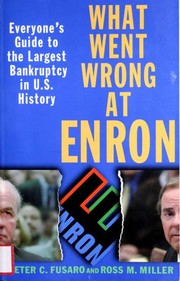
What Went Wrong at Enron
Early energy-market explainer.
Summary
Peter Fusaro and Ross Miller, both energy market specialists, wrote this short account of the Enron collapse within months of the bankruptcy.
The content covers Enron's transformation from a pipeline company into an energy trading operation, the gas bank concept that made the trading business work, the extension into electricity trading after deregulation and into other commodities and into broadband capacity; the special purpose entities including LJM and the Raptors through which losses and debt were kept off the balance sheet, and the role of Andrew Fastow in creating them; the mark-to-market accounting applied to long-dated contracts whose values were internally modelled; the role of Arthur Andersen as both auditor and consultant; and the California electricity crisis and Enron's trading practices during it.
The authors' background is in energy markets rather than in accounting, and the book is strongest on what Enron's trading business actually was and on the deregulation that made it possible. It was written very quickly and predates the criminal trials, the bankruptcy examiner's reports and the extensive later literature. Readers wanting the definitive account should go to Bethany McLean and Peter Elkind's The Smartest Guys in the Room; readers wanting the accounting should go to the examiner's reports.
Key takeaways 7
- Enron's gas bank made it the counterparty to both producers and consumers, which was a genuine innovation in energy markets.
- Mark-to-market accounting on long-dated contracts let Enron book profits from internally modelled values that no market confirmed.
- Special purpose entities kept debt and losses off the balance sheet while the company retained the underlying economic exposure.
- Arthur Andersen served as both auditor and consultant, which removed the independence the audit was supposed to supply.
- Electricity deregulation created the market opportunity that Enron's trading business was built to exploit.
- The book was written within months of the bankruptcy and predates the trials, the examiner's reports and the later literature.
- The authors are strongest on the energy trading business and weakest on the accounting.
Who should read it
Readers wanting an early account of Enron from energy market specialists, with the definitive treatments read afterward.
Where it sits in the reference 2
Similar books 6
Chosen by shared topics, the entries that hold them, and the people who recommended both.