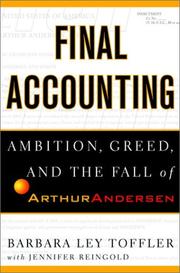
Final Accounting
An Andersen partner on how consulting revenue corroded audit.
Summary
Toffler ran Arthur Andersen's ethics and responsible business practices consulting group from 1995 to 1999, and wrote this after the firm collapsed. It is an insider account of how a firm that had built its reputation on refusing to sign accounts it disagreed with became one that could not say no to clients.
Her explanation is about the internal economics. Andersen's consulting arm grew faster than the audit business and paid better, which shifted status and power inside the partnership toward people who sold services rather than people who signed opinions. Partner compensation was driven by revenue generated, which made every partner a salesperson. The audit relationship became the entry point for consulting sales, which meant an audit partner who challenged a client threatened far more revenue than the audit fee. The firm's internal review function, which had once had authority to overrule an engagement partner, was weakened and eventually restructured so that the local partner could prevail.
Toffler also describes the culture in detail: the training centre in St. Charles, the uniformity of dress and manner, the internal language, and the way the firm's identity made challenging it feel like disloyalty. The book is a memoir and it is partisan, since Toffler left unhappily and is settling accounts. Her own group's role in selling ethics consulting to clients including Enron is described with some awareness but not much. The general mechanism she identifies, that cross-selling destroys the independence of an assurance function, is the durable contribution and it has been confirmed by later analysis of the period.
Key takeaways 7
- Andersen's independence collapsed because consulting revenue from audit clients dwarfed the audit fee, which made challenging a client extremely expensive for the partner who did it.
- Partner compensation driven by revenue generated turned every partner into a salesperson and removed the professional incentive to refuse work.
- Weakening the central review function, which had once been able to overrule an engagement partner, removed the last internal check on client accommodation.
- A strong uniform firm culture made internal challenge feel like disloyalty rather than professional duty.
- The audit relationship was treated internally as a channel for selling other services rather than as the firm's product.
- An assurance function cannot remain independent inside an organisation that sells other services to the same client, whatever the stated policies say.
- The firm's collapse followed from a business model change made a decade earlier, not from the actions of the individuals prosecuted.
Who should read it
Directors, auditors and operators who want an insider account of how cross-selling destroys an assurance function's independence.
Where it sits in the reference 5
Similar books 6
Chosen by shared topics, the entries that hold them, and the people who recommended both.