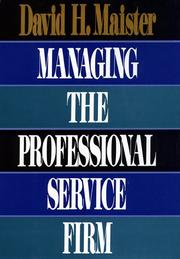
Managing the Professional Service Firm
Leverage, utilisation and the partnership arithmetic. Still the core text.
Summary
Maister wrote the standard text on running firms whose product is expertise, covering consultancies, law firms, accounting practices, agencies and similar businesses. It is organised as essays on the specific management problems these firms face.
His central analytical device is that professional firm economics are determined by leverage, meaning the ratio of junior to senior staff, and that the appropriate leverage is determined by the mix of work. He divides engagements into three types: brains work, which requires new solutions and can carry little leverage; grey hair work, which applies previous experience and carries moderate leverage; and procedure work, which is well understood and can carry high leverage. A firm must match its staffing pyramid to its work mix, and the most common failure is a pyramid built for one type of work while selling another.
The financial material shows that profit per partner decomposes into margin, productivity and leverage, and that improving leverage is usually the largest available lever and the one firms neglect.
The other themes are client relationships, where he argues that existing clients are the cheapest source of new work and are systematically under-served; practice development, where he argues marketing to strangers is the least efficient use of partner time; and people management, where he argues the firm's asset walks out every evening and the retention of good people is the binding constraint on growth.
The book is dated in its examples and predates the current structure of several of the industries it covers. Its economics remain correct and it is still the standard reference.
Key takeaways 7
- Professional firm profitability is determined by leverage, meaning the ratio of junior to senior staff, more than by billing rates.
- Work divides into brains, grey hair and procedure categories, each supporting a different leverage ratio, and a firm must match its pyramid to its work mix.
- The most common structural failure is a staffing pyramid built for one type of work while the firm sells another.
- Profit per partner decomposes into margin, productivity and leverage, and leverage is usually the largest available improvement and the least examined.
- Existing clients are the cheapest source of new work and are systematically under-served because partner time goes to pursuing strangers.
- The firm's assets leave the building every evening, which makes retention of capable people the binding constraint on growth.
- A professional firm cannot simultaneously be excellent at brains work and efficient at procedure work, because the two require incompatible economics and cultures.
Who should read it
Anyone running or building a firm that sells expertise, who needs the economics of leverage, work mix and client development.
Where it sits in the reference 4
Similar books 6
Chosen by shared topics, the entries that hold them, and the people who recommended both.