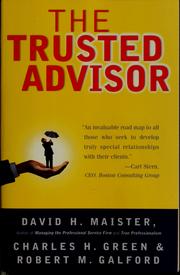
The Trusted Advisor
How relationship capital converts into billable work.
Summary
Maister, Green and Galford analyse what makes a professional trusted by a client, and set out how to build that position deliberately. Their central device is the trust equation: trust equals credibility plus reliability plus intimacy, all divided by self-orientation.
Each term is defined operationally. Credibility concerns words and expertise, and is the easiest to demonstrate and the least differentiating. Reliability concerns actions and predictability, built through repeated small commitments met. Intimacy concerns emotional safety, meaning whether the client can say something difficult to you, and the authors argue it is the term most professionals neglect and the one that moves trust fastest. Self-orientation, the denominator, concerns whether the professional's attention is on themselves, and it is the term that does the most damage, since any perceived focus on your own revenue, reputation or need to appear clever divides everything above it.
The practical material covers the stages of trust building, being engage, listen, frame, envision and commit, with the observation that professionals routinely skip listening and framing to arrive at a recommendation. They also cover the specific moves that build trust quickly, including naming the difficult issue, admitting uncertainty, and giving advice against your own commercial interest.
The book has no empirical base and rests on the authors' consulting experience. It is written for professional services and much of it presumes an advisory relationship. Its formulation of self-orientation as the denominator is the idea that transfers most widely, and it is genuinely useful to anyone selling judgement.
Key takeaways 7
- Trust equals credibility, reliability and intimacy divided by self-orientation, and the denominator does more damage than any of the numerator terms contribute.
- Any perceived focus on your own revenue, reputation or need to appear clever reduces trust regardless of how competent you are.
- Intimacy, meaning whether the client can raise something difficult with you, is the term professionals neglect and the one that moves trust fastest.
- Credibility is the easiest term to demonstrate and the least differentiating, since every competing adviser can demonstrate it.
- Professionals skip listening and framing to arrive at a recommendation, which is the most common failure in advisory relationships.
- Giving advice against your own commercial interest is the single most effective demonstration that your attention is on the client.
- Naming the difficult issue that everyone is avoiding builds more trust than any amount of well-executed analysis.
Who should read it
Anyone who sells judgement rather than product, including advisers, consultants, founders selling to enterprises and investors dealing with management teams.
Where it sits in the reference 3
Who recommended it 1 · 1 direct
Similar books 6
Chosen by shared topics, the entries that hold them, and the people who recommended both.