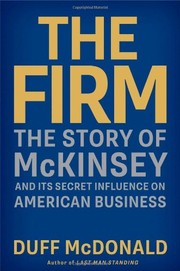
Perspective on McKinsey & Company
Summary
The reference has not verified this book in detail; the summary states only what the title, author and subject establish.
Marvin Bower led McKinsey from 1950 to 1967 and wrote this internal history of the firm for its own people. It was published privately by McKinsey rather than commercially and covers the firm's development, its governing principles and Bower's account of the decisions that shaped it.
What the book establishes is Bower's own statement of the model he built: that consulting should be a profession rather than a business, that the client's interest must come before the firm's revenue, that the firm should decline work it cannot do well, that partners should be paid from a single pool rather than by the business they bring, that the firm should never advertise, and that the up-or-out promotion structure maintains quality. He is explicit that these were imported from the norms of a law firm, where he had trained.
The reference has not verified the detail of this volume, which was privately printed, is not widely available, and is known mainly through citation in later histories of the firm including Duff McDonald's. Readers wanting an account of McKinsey's development with independent reporting and a critical perspective should read that instead. This book's interest is as a primary source in the founder's own words, and it should be read as an institutional self-account written for internal audiences rather than as history.
Key takeaways 7
- Bower deliberately constructed consulting as a profession on the model of a law firm rather than as a commercial service business.
- The client's interest must take precedence over the firm's revenue, including declining engagements the firm cannot perform well.
- Paying partners from a single firm-wide pool rather than by business generated prevents client hoarding and allows staffing from anywhere.
- The firm should not advertise, on the reasoning that a professional practice is engaged through reputation rather than solicitation.
- Up-or-out promotion maintains the quality standard and produces the alumni network the firm depends on for future work.
- Firm values must be stated explicitly and enforced by the leadership, since they will not survive commercial pressure otherwise.
- The reference has not verified this privately published volume's specific content, and independent histories of McKinsey should be consulted alongside it.
Who should read it
Readers interested in McKinsey's founding principles in its architect's own words, treated as an institutional self-account rather than as history.
Where it sits in the reference 3
Who recommended it 1
Similar books 6
Chosen by shared topics, the entries that hold them, and the people who recommended both.