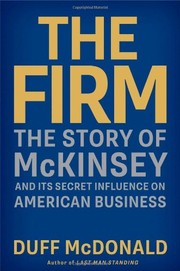
The Firm: The Story of McKinsey
How the modern consulting partnership was invented and priced.
Summary
McDonald traces McKinsey from James O. McKinsey's accounting practice through Marvin Bower's construction of the modern professional firm, the Ron Daniel and Fred Gluck years, the Rajat Gupta era, and the reputational damage from Enron, from Gupta's insider trading conviction, and from the firm's role in the 2008 period.
The institutional analysis is the useful part. McDonald explains how Bower built the model that every professional services firm copied: hire from top schools rather than from industry, promote or leave, sell to the chief executive, never advertise, maintain a single global profit pool, and insist that the client's interest overrides the engagement. He shows how the up-or-out system creates an alumni network that becomes the firm's most valuable sales asset, and how the one-firm profit pool prevents partners from hoarding clients. He also documents the shift from advising on organisation to advising on strategy, and the emergence of a competitive threat from Bain and BCG that pushed McKinsey toward measurable results.
The accountability question runs through the book. McDonald asks what McKinsey is actually responsible for, given that it advises without bearing consequences, and he covers the Enron relationship in detail, since Jeff Skilling was a McKinsey partner and the firm blessed the business model. His answer is somewhat inconclusive, and critics have said the book is too admiring given the material. Subsequent reporting, particularly on opioid work and on authoritarian government clients, is more damning than anything here and postdates the 2013 publication.
Key takeaways 7
- Marvin Bower built McKinsey by importing the norms of a law firm, insisting on a profession rather than a business, and those norms became the template for the entire consulting industry.
- The up-or-out promotion system exists to manufacture an alumni network of clients, which is the firm's primary source of new work.
- A single global profit pool prevents partners from treating clients as personal property and is what allows the firm to staff engagements from anywhere.
- McKinsey sells access and reassurance to chief executives as much as it sells analysis, which is why it is engaged for decisions already made.
- The firm bears no consequence for the advice it gives, and that structural absence of accountability is the central unresolved problem in its model.
- Hiring generalists from elite programmes rather than industry specialists is a deliberate choice that trades domain knowledge for analytical uniformity and client acceptability.
- McKinsey's endorsement of Enron's business model shows that its authority can validate a strategy without the firm having tested whether the strategy works.
Who should read it
Operators who buy consulting services and anyone building a professional services firm who wants the origin of its standard operating model.
Where it sits in the reference 4
Who recommended it 1
Similar books 6
Chosen by shared topics, the entries that hold them, and the people who recommended both.