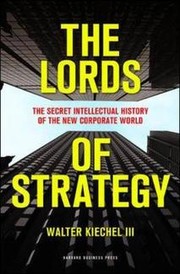
The Lords of Strategy
How BCG, Bain and McKinsey created the market for strategy itself.
Summary
Kiechel, a former Fortune editor, writes the intellectual history of corporate strategy as a discipline, arguing that it did not exist before about 1960 and was created by four people: Bruce Henderson at BCG, Bill Bain, Michael Porter at Harvard, and Fred Gluck at McKinsey.
The substance is the sequence of ideas and their commercial consequences. Henderson produced the experience curve, showing unit costs fall by a predictable percentage with cumulative volume, and the growth-share matrix, which turned a corporate portfolio into four boxes with cash flow implications. Bain left BCG to found a firm that would work with a single client per industry and be measured on the client's share price. Porter imported industrial organisation economics and produced the five forces, generic strategies and the value chain, which gave strategy an academic foundation and a teachable structure. Gluck rebuilt McKinsey's capability around this in order to compete.
Kiechel is clear about the consequences he attributes to this: the experience curve justified market share pursuit and price cutting, the portfolio matrix justified divesting businesses and became a tool for capital reallocation, and the whole apparatus supplied the analytical language for the restructuring, offshoring and shareholder value movements of the 1980s and 1990s. He treats greater competitive intensity and reduced employment security as products of this intellectual shift.
The book is well reported and readable and it is the best available account of where these frameworks came from. Kiechel is close to his subjects and treats consultants as the central actors in corporate history, which overstates their agency relative to capital markets and technology.
Key takeaways 7
- Corporate strategy as a discipline did not exist before about 1960 and was constructed by a small number of consultants and academics within twenty years.
- The experience curve, showing unit costs falling predictably with cumulative volume, justified pursuing market share through price cuts and reshaped competitive behaviour across industries.
- The growth-share matrix converted a diversified corporation into a capital allocation problem, which made divestiture a routine strategic move.
- Porter's five forces gave strategy an academic foundation by importing industrial organisation economics, which made industry structure rather than firm capability the unit of analysis.
- Consulting firms competed by developing proprietary analytical frameworks, which is why strategy ideas diffused as commercial products rather than as academic findings.
- The analytical language of strategy supplied the justification for the restructuring, offshoring and shareholder value movements of the following decades.
- Treating the firm as a portfolio of businesses to be bought and sold changed the relationship between companies and their employees permanently.
Who should read it
Executives and investors who want to know where the standard strategy frameworks came from, what each assumes, and what their adoption did.
Where it sits in the reference 5
Similar books 6
Chosen by shared topics, the entries that hold them, and the people who recommended both.