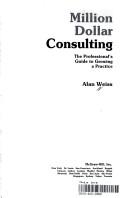
Million Dollar Consulting
Value pricing for solo and boutique consultancies.
Summary
Weiss argues that independent consultants should charge for the value they create rather than for their time, and that hourly and daily billing caps income while creating incentives that conflict with the client's interest.
His central prescription is value-based fees, meaning a fixed project fee derived from the value of the outcome to the client rather than from the effort required. His method for arriving at it involves establishing the business outcomes the client wants, quantifying their value with the client, and then proposing a fee that represents a fraction of that value. He argues that this aligns the consultant with completing the work quickly rather than extending it.
His practical material includes the requirement to reach what he calls the economic buyer, meaning the person who can authorise the expenditure, rather than working through procurement or through intermediaries; the proposal structure, which he says should follow a conceptual agreement already reached verbally rather than being used to persuade; offering options at different price points rather than a single quote, which changes the client's question from whether to which; and never reducing a fee without reducing scope.
He also covers marketing through what he calls market gravity, meaning building visibility through writing, speaking and referrals so that clients approach rather than being pursued. The book is written for solo and small-firm consultants and does not transfer to large firm economics. Weiss is relentlessly self-promoting and the tone is abrasive. The value-based fee argument and the requirement to reach the economic buyer are the elements practitioners adopt.
Key takeaways 8
- Consultants should charge for the value of the outcome rather than for time, since hourly billing caps income and rewards inefficiency.
- A fee derived from the value of the outcome aligns the consultant with completing the work quickly rather than extending it.
- The value of the outcome must be quantified with the client before any fee is proposed, or the fee has no basis to justify it.
- Work should be sold only to the economic buyer who can authorise the expenditure, and working through procurement or intermediaries fails.
- A proposal should follow a conceptual agreement already reached verbally rather than being used to persuade someone who has not agreed.
- Offering options at different price points changes the client's question from whether to buy to which option to take.
- A fee should never be reduced without a corresponding reduction in scope, since doing so establishes that the original number was arbitrary.
- Visibility built through writing, speaking and referrals brings clients to the consultant, which is a different activity from selling.
Who should read it
Independent consultants and small professional services firms who want the value-based fee method and the economic buyer discipline.
Where it sits in the reference 3
Who recommended it 2 · 1 direct
Similar books 6
Chosen by shared topics, the entries that hold them, and the people who recommended both.