The Big Four
The accounting oligopoly's economics and conflicts.
Summary
Gow and Kells trace the history of the accounting profession from its nineteenth-century origins through the consolidation that produced Deloitte, PwC, EY and KPMG, and examine what the firms have become.
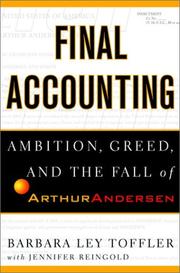
The historical material covers the founding partners, the development of the audit as a statutory requirement, the firms' expansion into consulting and tax, the merger wave that reduced the Big Eight to the Big Five, and the Andersen collapse that produced the current four. They also cover the peculiar legal structure: each Big Four firm is a network of national partnerships bound by contract rather than a single entity, which limits liability across borders and makes the firms difficult to hold accountable or to regulate as a whole.
The critical argument concerns what the firms actually do. Audit has become a low-margin compliance product that the firms cross-sell from, tax practice has moved toward structuring that governments then attempt to close, and consulting has grown to dominate revenue despite the conflicts that produced the Andersen collapse and the reforms that followed it. They document repeated audit failures and note that the firms' market position is protected by regulation requiring audits and by the fact that only four firms can serve large multinational clients.
The book is well researched and written for a general audience. It is stronger on history and structure than on proposals, and its suggestions for reform are sketched. The concentration problem it identifies has since become a live regulatory question in Britain and elsewhere.
Key takeaways 7
- Each Big Four firm is a network of national partnerships bound by contract rather than a single legal entity, which limits cross-border liability and complicates regulation.
- Audit has become a low-margin compliance product that the firms use as an entry point for higher-margin consulting and tax work.
- Only four firms can audit a large multinational, which means a regulator cannot credibly threaten any of them with the sanction that ended Andersen.
- The conflicts between audit and consulting that destroyed Andersen were addressed by reforms that the firms have since substantially worked around.
- Tax practice at these firms involves designing structures that governments then legislate against, which is an adversarial relationship with the state that sits oddly with their public role.
- Repeated audit failures have produced fines rather than structural change, because no regulator can afford to reduce the number of firms below four.
- The profession's market position is protected by regulation requiring audits, which means competition operates on price rather than on audit quality.
Who should read it
Directors, investors and anyone relying on audited financial statements who wants to understand the structure and incentives of the firms producing them.
Where it sits in the reference 4
Similar books 6
Chosen by shared topics, the entries that hold them, and the people who recommended both.