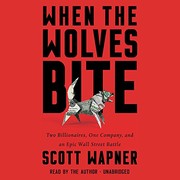
When the Wolves Bite
Ackman against Icahn over Herbalife; the MLM model argued in public.
Summary
Wapner, a CNBC anchor, reconstructs the public fight between Bill Ackman and Carl Icahn over Herbalife, the multi-level marketing company selling nutrition products. Ackman announced a large short position in December 2012, presenting a detailed case that Herbalife operated as a pyramid scheme whose distributors made money from recruiting rather than from selling product, and predicted the shares would go to zero. Icahn took the other side, built a large long position, and the two men attacked each other on television.
The reporting covers the mechanics of the campaign as much as the merits. Ackman's fund spent heavily on research, lobbied regulators and legislators, funded Latino community organisations to file complaints, and organised media coverage. Herbalife responded with its own lobbying and public relations. Other investors including Daniel Loeb and George Soros's fund took positions on both sides at various points. The Federal Trade Commission investigated and in 2016 settled with Herbalife for two hundred million dollars and required restructuring of its compensation, without calling it a pyramid scheme. The shares rose and Ackman eventually closed the position at a large loss.
Wapner's argument is that the fight demonstrated how activist short selling had become a public campaign rather than a research exercise, and that the outcome turned on positioning, financing and short squeeze dynamics rather than on whether Ackman's analysis was correct.
The book is business journalism built on interviews and public record, with limited independent analysis of the underlying company. Readers wanting an evaluation of multi-level marketing economics will need other sources. The account is also written from close to the television coverage, which gives it the emphasis of that medium.
Key takeaways 7
- A public short campaign is a lobbying and media operation as much as an investment thesis.
- Being right about a company's business model does not produce a profit if the position can be squeezed before the thesis is proven.
- Concentrated short positions in a company with a small float invite deliberate accumulation by opponents.
- Regulators settled with Herbalife on compensation practices without accepting the pyramid scheme characterisation, which left both sides claiming vindication.
- Ackman's decision to announce and defend the position publicly removed his ability to exit quietly when it moved against him.
- Hedge fund positions became public entertainment during this period, which changed the incentives of the managers involved.
- Multi-level marketing companies derive a large share of distributor income from recruitment rather than from retail sales, which is the contested factual question at the centre of the dispute.
Who should read it
Investors considering activist short positions who need a case study in how position size, float and publicity can defeat a correct analysis.
Where it sits in the reference 2
Who recommended it 1 · 1 direct
Similar books 6
Chosen by shared topics, the entries that hold them, and the people who recommended both.