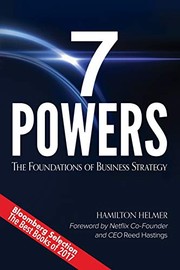
7 Powers: The Foundations of Business Strategy
Seven sources of lasting advantage, each a benefit plus a barrier to rivals.
Self-published via Deep Strategy
Summary
Helmer defines strategy narrowly as the study of what makes a business durably valuable, and reduces it to seven sources of power. Power in his definition requires two things simultaneously: a benefit, meaning a material improvement in cash flow, and a barrier, meaning something that prevents competitors from arbitraging that benefit away. Anything lacking both is not power.
The seven are scale economies, network economies, counter-positioning, switching costs, branding, cornered resource and process power. Counter-positioning is his original contribution: a newcomer adopts a business model that the incumbent will not copy because copying would damage its existing business more than not copying does. He uses Vanguard against active managers and Kodak's response to digital photography as examples, and argues that incumbents fail here through rational calculation rather than through inertia or stupidity.
Helmer adds a dynamic dimension, arguing that each power type can only be established during a particular stage of an industry's development, and that the origination of power almost always coincides with invention. He worked as a strategy consultant and taught at Stanford, and the book uses mathematical treatment where it clarifies, including a formal expression of the value of power.
The book is short and dense, which some readers find abrupt. Its examples are mostly familiar large-company cases and it does not test the framework systematically. It says almost nothing about execution, organisation or people, by deliberate exclusion. Investors use it more than operators do, because it gives a checklist for assessing whether a company's advantage will survive competition.
Key takeaways 8
- Power requires both a benefit that improves cash flow and a barrier that prevents competitors from removing it, and one without the other is not an advantage.
- There are exactly seven sources of durable business power, and any claimed advantage that fits none of them will be competed away.
- Counter-positioning describes a new entrant adopting a model that the incumbent rationally declines to copy because copying would damage its existing business.
- Incumbents fail against counter-positioning through correct short-term calculation, not through stupidity or complacency.
- Network economies produce winner-take-most outcomes because value to each user increases with the number of other users.
- Each type of power can only be established at a particular stage of an industry's development, so timing determines which powers are available.
- Operational excellence is not strategy, because competitors can copy it and it therefore fails the barrier test.
- Scale economies require that unit cost declines with volume in a way competitors cannot match at their own volume, which many claimed scale advantages fail.
Who should read it
Investors testing whether a company's advantage is durable, and founders deciding which kind of advantage their business can actually build.
About Hamilton Helmer
Co-founder and Chief Investment Officer, Strategy Capital; strategy consultant for four decades and long-time lecturer in economics at Stanford
7 Powers is the reference taxonomy investors and operators use for durable competitive advantage, but it is his only published work.
Who recommended it 9 · 1 direct
Similar books 6
Chosen by shared topics, the entries that hold them, and the people who recommended both.
Why barriers to entry are the one force that matters in business strategy.
“Bruce Greenwald and Judd Kahn, Competition Demystified: A Radically Simplified Approach to Business Strategy (New York: Portfolio, 2005), 52-76” — Michael Mauboussin
Source: New Business Boom and Bust: How Capitalism Experiments, page 9
Recommended by: Li Lu, Michael Mauboussin, Mohnish Pabrai
The value chain: how to find where a firm's cost or differentiation advantage lies.
“For example, I read Competitive Strategy and Competitive Advantage by Michael Porter.” — Michael Mauboussin
Source: Thirty Years: Reflections on the Ten Attributes of Great Investors, page 3
Recommended by: Michael Mauboussin, Li Lu
The five forces model for analysing an industry and a firm's place in it.
“For example, I read Competitive Strategy and Competitive Advantage by Michael Porter.” — Michael Mauboussin
Source: Thirty Years: Reflections on the Ten Attributes of Great Investors, page 3
Recommended by: Jim Collins, Michael Mauboussin and 3 others

How to spot a durable economic moat from public information, and what isn't one.
Recommended by: Mohnish Pabrai

Price is the strongest profit lever and the least managed; how to set it well.
Recommended by: Michael Mauboussin
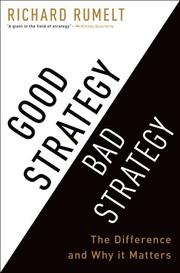
Why most so-called strategies are not, and the three-part kernel real ones need.
“Rumelt, Richard P., Good Strategy Bad Strategy: The Difference and Why It Matters (New York: Crown Business, 2011)” — Michael Mauboussin
Source: Measuring the Moat: Assessing the Magnitude and Sustainability of Value Creation, page 65
Recommended by: Michael Mauboussin, Ann Handley and 3 others
Where it sits in the reference 9
Topics 1
As an Amazon Associate I earn from qualifying purchases.