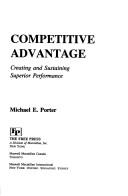
Competitive Advantage
The value chain: how to find where a firm's cost or differentiation advantage lies.
Creating and Sustaining Superior Performance
Summary
Porter's sequel to Competitive Strategy moves from industry analysis to the firm, and introduces the value chain as the tool for locating where advantage comes from within a company.
The value chain divides a firm's activities into primary activities, meaning inbound logistics, operations, outbound logistics, marketing and sales, and service, and support activities, meaning procurement, technology development, human resource management and firm infrastructure. His argument is that competitive advantage cannot be understood by looking at a firm as a whole, and that it arises from specific activities performed differently or more cheaply than competitors perform them.
He develops cost advantage through the analysis of cost drivers for each activity, including scale, learning, capacity utilisation, linkages between activities, interrelationships between business units, integration, timing, policy choices, location and institutional factors. His argument is that a firm must understand which driver governs each activity before it can act on cost. He develops differentiation through buyer value, arguing that differentiation must reduce a buyer's cost or improve their performance in a way the buyer can perceive, and that signalling criteria matter as much as use criteria because buyers frequently cannot evaluate the substance.
He also covers linkages within the value chain and with suppliers and channels, technology strategy, competitor selection, industry segmentation, substitution and complementary products. The book is a textbook, long and systematic. The framework predates the resource-based view and gives limited attention to capabilities that are not activities. The value chain remains the standard tool for locating advantage inside a firm.
Key takeaways 8
- Competitive advantage arises from specific activities performed differently or more cheaply than competitors perform them, not from the firm as a whole.
- The value chain divides a firm into primary and support activities, which is the unit at which advantage must be located and analysed.
- Each activity has a governing cost driver, and a firm must identify which driver applies before it can act on cost.
- Linkages between activities, and between the firm and its suppliers and channels, produce advantages that competitors examining individual activities cannot see.
- Differentiation must reduce a buyer's cost or improve their performance in a way the buyer can actually perceive.
- Signalling criteria matter as much as use criteria, because buyers frequently cannot evaluate the substance of what they are buying.
- Segmentation within an industry reveals where a firm's activities produce advantage and where they do not.
- The framework treats advantage as residing in activities and gives limited attention to capabilities that are not activities.
Who should read it
Executives and analysts locating where a firm's advantage actually sits, wanting the original value chain framework rather than a summary.
About Michael E. Porter
Bishop William Lawrence University Professor Emeritus, Harvard Business School; founder, Institute for Strategy and Competitiveness
Competitive Strategy and the five-forces framework are the primary source for industry analysis, and Competitive Advantage supplied the value-chain vocabulary the field still uses.
Who recommended it 2 · 1 direct
“For example, I read Competitive Strategy and Competitive Advantage by Michael Porter.”
Similar books 6
Chosen by shared topics, the entries that hold them, and the people who recommended both.
Why barriers to entry are the one force that matters in business strategy.
“Bruce Greenwald and Judd Kahn, Competition Demystified: A Radically Simplified Approach to Business Strategy (New York: Portfolio, 2005), 52-76” — Michael Mauboussin
Source: New Business Boom and Bust: How Capitalism Experiments, page 9
Recommended by: Li Lu, Michael Mauboussin, Mohnish Pabrai
The five forces model for analysing an industry and a firm's place in it.
“For example, I read Competitive Strategy and Competitive Advantage by Michael Porter.” — Michael Mauboussin
Source: Thirty Years: Reflections on the Ten Attributes of Great Investors, page 3
Recommended by: Jim Collins, Michael Mauboussin and 3 others
Seven sources of lasting advantage, each a benefit plus a barrier to rivals.
Recommended by: Keith Rabois, Alex Lieberman, Brett Adcock and 6 others
How to spot a durable economic moat from public information, and what isn't one.
Recommended by: Mohnish Pabrai
Why most so-called strategies are not, and the three-part kernel real ones need.
“Rumelt, Richard P., Good Strategy Bad Strategy: The Difference and Why It Matters (New York: Crown Business, 2011)” — Michael Mauboussin
Source: Measuring the Moat: Assessing the Magnitude and Sustainability of Value Creation, page 65
Recommended by: Michael Mauboussin, Ann Handley and 3 others
Harvard Business Review readings on strategy and competitive advantage.
“Michael E. Porter, “The Internet and Strategy”, Harvard Business Review, February 2001. Jeff Bezos at the 1999 Internet Summit, quoted in Julie Rawe, “Doom Stalks the Dotcoms,” Time, April 17, 2000. 3 See Extinction: Bad Genes or Bad Luck by David M. Raup, W.W. Norton, 1991, pp” — Michael Mauboussin
Source: Fill and Kill: Succeeding with Survivors is Nothing New, page 11
Recommended by: Jim Collins, Michael Mauboussin
Where it sits in the reference 6
Topics 1
As an Amazon Associate I earn from qualifying purchases.