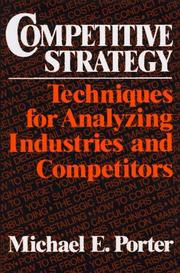
Competitive Strategy
The five forces model for analysing an industry and a firm's place in it.
Techniques for Analyzing Industries and Competitors
Summary
Porter, then at Harvard Business School, took industrial organisation economics and turned it into a framework managers could use. The book established the five forces model: rivalry among existing competitors, threat of new entrants, threat of substitutes, bargaining power of suppliers and bargaining power of buyers. His argument is that industry structure, defined by these forces, determines the average profitability available in an industry, and that strategy consists of positioning within that structure or changing it.
He identifies three generic strategies: cost leadership, differentiation and focus, and argues that a firm attempting more than one becomes stuck in the middle and earns below-average returns. The barriers to entry he catalogues include economies of scale, product differentiation, capital requirements, switching costs, access to distribution, cost advantages independent of scale, and government policy.
The second half covers analytical techniques including competitor analysis, market signals, strategic groups, and industry evolution, and the third covers strategic decisions in specific industry environments including fragmented industries, emerging industries, declining industries and global industries.
The framework has been criticised on several grounds. It treats industry structure as relatively stable, which fits poorly with technology industries. It gives limited attention to complementors, which Grove added as a sixth force. It says almost nothing about internal capability, which the resource-based view developed in response. Rumelt and others argue that the generic strategies are too coarse and that the stuck in the middle claim is contradicted by firms that achieve both cost and differentiation advantages. The five forces remain the standard starting point for industry analysis, which is the book's real position: a diagnostic rather than a generator of strategy.
Key takeaways 8
- Industry structure, defined by five competitive forces, determines the average profitability available to firms within it.
- The forces are rivalry, new entrants, substitutes, supplier power and buyer power, and any of them can capture the value an industry creates.
- A firm's position within its industry determines its returns relative to the average, and strategy consists of positioning within the structure or altering it.
- Barriers to entry are the mechanism that allows above-average returns to persist, and they should be identified explicitly rather than assumed.
- Buyer power rises when buyers are concentrated, purchase in large volumes, face low switching costs or can integrate backwards.
- Cost leadership, differentiation and focus are the three coherent positions, and Porter argues that a firm attempting more than one earns below-average returns.
- Competitor analysis requires assessing the competitor's goals, assumptions, current strategy and capabilities, since responses depend on all four.
- The framework treats industry structure as relatively stable and gives little attention to internal capability or to complementary products.
Who should read it
Executives and investors performing industry analysis who want the original statement of the five forces rather than a secondhand summary.
About Michael E. Porter
Bishop William Lawrence University Professor Emeritus, Harvard Business School; founder, Institute for Strategy and Competitiveness
Competitive Strategy and the five-forces framework are the primary source for industry analysis, and Competitive Advantage supplied the value-chain vocabulary the field still uses.
Who recommended it 5 · 3 direct
“For example, I read Competitive Strategy and Competitive Advantage by Michael Porter.”
Similar books 6
Chosen by shared topics, the entries that hold them, and the people who recommended both.
The value chain: how to find where a firm's cost or differentiation advantage lies.
“For example, I read Competitive Strategy and Competitive Advantage by Michael Porter.” — Michael Mauboussin
Source: Thirty Years: Reflections on the Ten Attributes of Great Investors, page 3
Recommended by: Michael Mauboussin, Li Lu
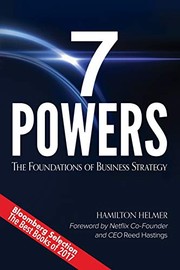
Seven sources of lasting advantage, each a benefit plus a barrier to rivals.
Recommended by: Keith Rabois, Alex Lieberman, Brett Adcock and 6 others
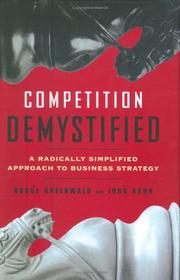
Why barriers to entry are the one force that matters in business strategy.
“Bruce Greenwald and Judd Kahn, Competition Demystified: A Radically Simplified Approach to Business Strategy (New York: Portfolio, 2005), 52-76” — Michael Mauboussin
Source: New Business Boom and Bust: How Capitalism Experiments, page 9
Recommended by: Li Lu, Michael Mauboussin, Mohnish Pabrai
Harvard Business Review readings on strategy and competitive advantage.
“Michael E. Porter, “The Internet and Strategy”, Harvard Business Review, February 2001. Jeff Bezos at the 1999 Internet Summit, quoted in Julie Rawe, “Doom Stalks the Dotcoms,” Time, April 17, 2000. 3 See Extinction: Bad Genes or Bad Luck by David M. Raup, W.W. Norton, 1991, pp” — Michael Mauboussin
Source: Fill and Kill: Succeeding with Survivors is Nothing New, page 11
Recommended by: Jim Collins, Michael Mauboussin
Why most so-called strategies are not, and the three-part kernel real ones need.
“Rumelt, Richard P., Good Strategy Bad Strategy: The Difference and Why It Matters (New York: Crown Business, 2011)” — Michael Mauboussin
Source: Measuring the Moat: Assessing the Magnitude and Sustainability of Value Creation, page 65
Recommended by: Michael Mauboussin, Ann Handley and 3 others
Why certain countries become home to world-leading firms in certain industries.
“Porter, Michael E., The Competitive Advantage of Nations (New York: Free Press, 1990)” — Michael Mauboussin
Source: Public to Private Equity in the United States: A Long-Term Look, page 67
Recommended by: Michael Mauboussin
Where it sits in the reference 5
Topics 1
As an Amazon Associate I earn from qualifying purchases.