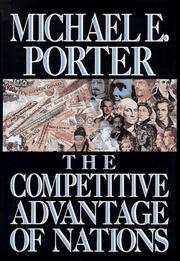
The Competitive Advantage of Nations
Why certain countries become home to world-leading firms in certain industries.
Summary
Porter extended his firm-level competitive strategy work to explain why particular countries become the home base for internationally successful firms in particular industries. The research covered ten nations and many industries over four years.
His central framework is the diamond, comprising four interacting determinants. Factor conditions, meaning not inherited resources but created and specialised factors such as skilled labour and research infrastructure. Demand conditions, where he argues that sophisticated and demanding home customers push firms to improve faster than complacent home markets do. Related and supporting industries, meaning the presence of internationally competitive suppliers and adjacent industries in the same location. And firm strategy, structure and rivalry, where he makes the counterintuitive claim that intense domestic rivalry, rather than national champions protected from competition, is what produces internationally competitive firms.
From this he derives an argument about clusters: competitive industries concentrate geographically because the four determinants reinforce each other locally, and the cluster rather than the firm or the nation is the correct unit of analysis. He also argues that government's role is to improve the determinants rather than to protect firms or pick winners.
The book is very long and the case material is exhaustive. Its influence on economic development policy has been enormous, and cluster policy is now standard practice worldwide. Economists have criticised the framework as unfalsifiable, as inconsistent with trade theory, and as derived from cases selected to fit. The empirical evidence that cluster policies work as intended is weak.
Key takeaways 7
- National competitive advantage in an industry arises from four interacting local conditions rather than from inherited resources or macroeconomic policy.
- Intense domestic rivalry produces internationally competitive firms, while protected national champions produce firms that cannot compete abroad.
- Demanding and sophisticated home customers push firms to improve faster than large but undemanding home markets do.
- Created and specialised factors, such as skilled labour and research institutions, matter far more than inherited endowments of land or basic labour.
- Competitive industries concentrate geographically because the determinants reinforce each other within a location, which makes the cluster the correct unit of analysis.
- Government should improve the determinants through education, infrastructure and standards rather than protect firms or select winners.
- Disadvantages in basic factors can produce advantage by forcing innovation, which is why resource-poor countries sometimes lead resource-intensive industries.
Who should read it
Executives choosing where to locate operations and policy readers assessing cluster and industrial strategy, treated as an influential framework rather than settled economics.
About Michael E. Porter
Bishop William Lawrence University Professor Emeritus, Harvard Business School; founder, Institute for Strategy and Competitiveness
Competitive Strategy and the five-forces framework are the primary source for industry analysis, and Competitive Advantage supplied the value-chain vocabulary the field still uses.
Who recommended it 1 · 1 direct
“Porter, Michael E., The Competitive Advantage of Nations (New York: Free Press, 1990)”
Similar books 6
Chosen by shared topics, the entries that hold them, and the people who recommended both.
The value chain: how to find where a firm's cost or differentiation advantage lies.
“For example, I read Competitive Strategy and Competitive Advantage by Michael Porter.” — Michael Mauboussin
Source: Thirty Years: Reflections on the Ten Attributes of Great Investors, page 3
Recommended by: Michael Mauboussin, Li Lu
The five forces model for analysing an industry and a firm's place in it.
“For example, I read Competitive Strategy and Competitive Advantage by Michael Porter.” — Michael Mauboussin
Source: Thirty Years: Reflections on the Ten Attributes of Great Investors, page 3
Recommended by: Jim Collins, Michael Mauboussin and 3 others
Harvard Business Review readings on strategy and competitive advantage.
“Michael E. Porter, “The Internet and Strategy”, Harvard Business Review, February 2001. Jeff Bezos at the 1999 Internet Summit, quoted in Julie Rawe, “Doom Stalks the Dotcoms,” Time, April 17, 2000. 3 See Extinction: Bad Genes or Bad Luck by David M. Raup, W.W. Norton, 1991, pp” — Michael Mauboussin
Source: Fill and Kill: Succeeding with Survivors is Nothing New, page 11
Recommended by: Jim Collins, Michael Mauboussin
Teaching cases for applying the framework of Competitive Strategy.
Research on how firms compete internationally, from a Harvard colloquium.

Harvard Business Review articles on competitive strategy across two decades.