Updates

  1. Person pages list letters, writing, profiles and links as sortable tables with filters, and show each person's companies as links; Fund letters show each letter's description in its own column.
  2. Experts show a checked job title and a short description of each person; 30 more people have photographs.
  3. Every company, fund, university and publication the experts work for has a page listing the people there.
  4. Fund letters show each letter's thesis and filter by it; 225 person pages list the essays, columns and newsletter issues the person wrote.
  5. Person pages list every essay and newsletter issue a person wrote, and their own books as a table in List view.
  6. Recommends shows the five largest kinds of book and the rest under More; browse pictures load sooner.
  7. Podcasts and talks link the original episode, filter by Audio and video or Press, and list each publisher once.
  8. Pages are wider, Recommends has List and Grid, and a filter clicked again turns off.
  9. Book cards sit in a ruled grid with Open Library and Goodreads links and each book's one-line note.
  10. Funds is now Investors; each investor's styles are buttons that filter the table.
  11. Podcasts and talks on a person's page filter by year and publisher and show as a list or a grid of pictures.
  12. Quotes show only people's own words: 472 summaries written by list sites are gone.
  13. Country pages open from Browse again, and every link on the shelf lands on a page.
  14. Subject and person pages show their sections as tabs, and each book appears once on a person's page.
  15. Book cards show the quote, who said it and the source; grids show five cards to a row.
  16. On a phone, a menu holds the sections, search, Updates, Feedback and dark mode.
  17. Feedback takes a screenshot of the page with no browser prompt, opens a screenshot full size when you click it, and clears itself once sent.
  18. Book cards are centred, search names the topic each book sits in, and any text cut short shows whole on hover.
  19. Search groups its results by kind: people, companies, geographies, subjects, topics, books, funds, fund letters and papers.
  20. The Books table lists who recommended each book by name, and the browser tab names the section you are in.
  21. Feedback can take a screenshot of the page, or one you paste or choose, and opens in the corner beside Updates.
  22. Each rail button reopens its section where you left it, and Browse, Table and People show on every book and subject page.
  23. Filters grey out choices that hold nothing instead of hiding them, and Books › People filters by authors or recommenders.
  24. Feedback takes a subject line and up to three screenshots.
  25. Biographies are grouped by the person they are about: 41 new pages, from Abraham Lincoln to Lee Kuan Yew.
  26. Sport splits into 23 sports, and Religion into one topic per faith.
  27. Book lists show as cards: the cover, one recommendation quote and every recommender by name.
  28. Seventeen subjects that had two or three pages under different names now have one page each.
  29. Every page lists its Experts as authors and recommenders, with a link to them on the Experts tab.
  30. Economics, Financial history, Financial panics and Accounting are subjects of their own, with one page per financial crisis.
  31. Book, person and subject pages open inside the app, so the tabs stay in view.
  32. 996 more book covers, and photographs or logos for 227 more people and companies.
  33. Books › Browse shows every subject as cards, and the rail holds Fund letters, Papers, Experts, Books and Funds.
  34. Every topic over 150 books splits into narrower topics, each with a page of its own.

Send feedback

What is it?
Screenshots, up to 3 (optional)
or paste one with Ctrl+V

We use your email only to reply to you.

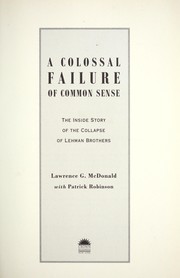
A Colossal Failure of Common Sense

A Colossal Failure of Common Sense

Lawrence G. McDonald, Patrick Robinson
2009
T2 351 pages · about 5h 51m to read Open Librarygoodreads

Insider account by a former Lehman convertible bond trader.

Summary

McDonald traded distressed debt and convertible bonds at Lehman Brothers and wrote this account with Patrick Robinson after the firm's bankruptcy.

The substantive argument concerns internal risk warnings. McDonald reports that traders in his part of the firm identified the deterioration in mortgage credit during 2005 and 2006, positioned against subprime exposure where they could, and attempted to communicate the analysis upward. He argues that the firm's leadership, particularly Richard Fuld and Joseph Gregory, was insulated by layers of management, dismissed the warnings, removed risk officers who raised them, and continued increasing the firm's commercial real estate and mortgage exposure through 2007 while competitors were reducing theirs. The Archstone acquisition in 2007 is his central example of a decision taken after the evidence was available.

The structural material covers Lehman's leverage, its dependence on short-term repurchase agreement funding, and the concentration of illiquid assets against that funding, which is what made the firm unable to survive a loss of confidence.

The book combines this with memoir: McDonald's route into the industry, the trading floor culture, and the personalities.

It is one participant's account written shortly after the events and it is self-serving in the ordinary way, presenting the author's group as having been right and ignored. The technical claims about the firm's positions cannot be verified from the book. The Valukas bankruptcy examiner's report is the authoritative source on Lehman's condition and on the Repo 105 transactions that McDonald does not cover. Read this for the internal experience of a firm whose leadership stopped receiving information, and go to the examiner's report for what actually happened to the balance sheet.

Key takeaways 7

  1. Traders inside Lehman identified deteriorating mortgage credit in 2005 and 2006 and could not get the analysis to the firm's leadership.
  2. Layers of management between the trading floor and the executive committee filtered out information that contradicted the strategy.
  3. Risk officers who raised objections were removed, which taught everyone else what raising objections would cost.
  4. The firm increased commercial real estate and mortgage exposure through 2007 while competitors were reducing theirs.
  5. Dependence on short-term repurchase agreement funding against illiquid assets is what made a loss of confidence immediately fatal.
  6. The Archstone acquisition was completed after the evidence of a property downturn was available internally.
  7. A single participant's account written after the event presents his own group as having been right, which readers should discount.

Who should read it

Risk managers and executives who want an account of how information failed to travel upward inside a firm that had it.

Similar books 6

Chosen by shared topics, the entries that hold them, and the people who recommended both.

Oonagh McDonald · 2015

Focused on accounting and Repo 105.

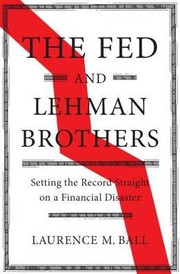
Laurence M. Ball · 2018

Evidence that the Fed could legally have saved Lehman Brothers in 2008.
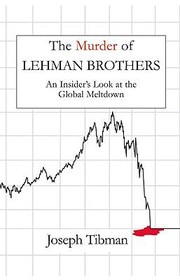
Joseph Tibman · 2009

An insider's account of the forces that led to Lehman's collapse and what followed.
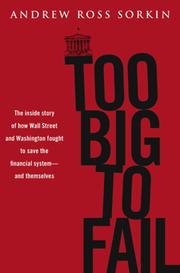
Andrew Ross Sorkin · 2009

Inside the meetings of bankers and regulators during the 2008 financial crisis.

Where it sits in the reference 2

Companies
Financial panics

Topics

Company HistoriesFinance and MarketsBiography and Memoir