Updates

  1. Person pages list letters, writing, profiles and links as sortable tables with filters, and show each person's companies as links; Fund letters show each letter's description in its own column.
  2. Experts show a checked job title and a short description of each person; 30 more people have photographs.
  3. Every company, fund, university and publication the experts work for has a page listing the people there.
  4. Fund letters show each letter's thesis and filter by it; 225 person pages list the essays, columns and newsletter issues the person wrote.
  5. Person pages list every essay and newsletter issue a person wrote, and their own books as a table in List view.
  6. Recommends shows the five largest kinds of book and the rest under More; browse pictures load sooner.
  7. Podcasts and talks link the original episode, filter by Audio and video or Press, and list each publisher once.
  8. Pages are wider, Recommends has List and Grid, and a filter clicked again turns off.
  9. Book cards sit in a ruled grid with Open Library and Goodreads links and each book's one-line note.
  10. Funds is now Investors; each investor's styles are buttons that filter the table.
  11. Podcasts and talks on a person's page filter by year and publisher and show as a list or a grid of pictures.
  12. Quotes show only people's own words: 472 summaries written by list sites are gone.
  13. Country pages open from Browse again, and every link on the shelf lands on a page.
  14. Subject and person pages show their sections as tabs, and each book appears once on a person's page.
  15. Book cards show the quote, who said it and the source; grids show five cards to a row.
  16. On a phone, a menu holds the sections, search, Updates, Feedback and dark mode.
  17. Feedback takes a screenshot of the page with no browser prompt, opens a screenshot full size when you click it, and clears itself once sent.
  18. Book cards are centred, search names the topic each book sits in, and any text cut short shows whole on hover.
  19. Search groups its results by kind: people, companies, geographies, subjects, topics, books, funds, fund letters and papers.
  20. The Books table lists who recommended each book by name, and the browser tab names the section you are in.
  21. Feedback can take a screenshot of the page, or one you paste or choose, and opens in the corner beside Updates.
  22. Each rail button reopens its section where you left it, and Browse, Table and People show on every book and subject page.
  23. Filters grey out choices that hold nothing instead of hiding them, and Books › People filters by authors or recommenders.
  24. Feedback takes a subject line and up to three screenshots.
  25. Biographies are grouped by the person they are about: 41 new pages, from Abraham Lincoln to Lee Kuan Yew.
  26. Sport splits into 23 sports, and Religion into one topic per faith.
  27. Book lists show as cards: the cover, one recommendation quote and every recommender by name.
  28. Seventeen subjects that had two or three pages under different names now have one page each.
  29. Every page lists its Experts as authors and recommenders, with a link to them on the Experts tab.
  30. Economics, Financial history, Financial panics and Accounting are subjects of their own, with one page per financial crisis.
  31. Book, person and subject pages open inside the app, so the tabs stay in view.
  32. 996 more book covers, and photographs or logos for 227 more people and companies.
  33. Books › Browse shows every subject as cards, and the rail holds Fund letters, Papers, Experts, Books and Funds.
  34. Every topic over 150 books splits into narrower topics, each with a page of its own.

Send feedback

What is it?
Screenshots, up to 3 (optional)
or paste one with Ctrl+V

We use your email only to reply to you.

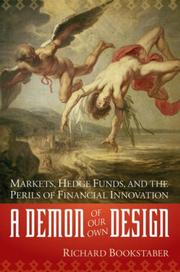
A Demon of Our Own Design

A Demon of Our Own Design

Richard M. Bookstaber
2007
T2 288 pages · about 4h 48m to read Open Librarygoodreads

Risk-manager's view; LTCM as one case among several.

Summary

Bookstaber ran risk management at Salomon Brothers and Morgan Stanley and worked at hedge funds, and this book argues that financial innovation has made markets more crisis-prone rather than safer, and that the mechanism is structural rather than behavioural.

His framework comes from Charles Perrow's normal accident theory. Systems that are both complex, meaning their components interact in unexpected ways, and tightly coupled, meaning there is no slack between processes and no time to intervene, will produce catastrophic failures as a matter of course rather than as a result of error. Bookstaber argues that derivatives, leverage, algorithmic trading and the interconnection of institutions have made markets both more complex and more tightly coupled, and that each innovation introduced to manage risk has added complexity that created new failure modes.

He supports this with first-hand accounts. He was involved in portfolio insurance, which he shows converted a hedging technique into a mechanism that generated the 1987 crash. He covers the 1998 Long-Term Capital Management collapse and the way liquidation of one fund's positions moved prices against every other fund holding similar trades, which is the mechanism by which a single failure propagates.

His prescription is counterintuitive and unpopular: reduce complexity, reduce leverage, and accept coarser instruments that do not fit needs exactly but that fail predictably. The book was published in 2007, months before the crisis it describes in general terms, which gives it standing. Its analysis of liquidity-driven contagion between apparently unrelated positions is the most useful part.

Key takeaways 7

  1. Markets have become both complex and tightly coupled, which makes catastrophic failure a structural property rather than the result of error.
  2. Each innovation introduced to manage risk adds complexity that creates new failure modes not present before it.
  3. Portfolio insurance converted a hedging technique into a mechanism that generated forced selling, which produced the 1987 crash.
  4. Liquidation of one leveraged fund's positions moves prices against every other fund holding similar trades, which is how a single failure propagates across unrelated institutions.
  5. Positions that appear diversified become perfectly correlated during a liquidity event, because the correlation comes from who holds them rather than from what they are.
  6. Reducing complexity and accepting coarser instruments that fit needs imperfectly produces a more survivable system than precise instruments that fail unpredictably.
  7. Leverage determines the speed at which a problem propagates, which is why the same shock produces different outcomes in differently levered systems.

Who should read it

Risk managers and investors who need the structural account of why financial systems fail and how liquidity contagion connects unrelated positions.

Similar books 6

Chosen by shared topics, the entries that hold them, and the people who recommended both.
Perry Mehrling · 2005

Fischer Black's life and ideas, from option pricing on, that shaped modern finance.

Recommended by: Mohnish Pabrai

Scott Patterson · 2010

The intellectual line from LTCM to the 2007 quant unwind.

Recommended by: Mohnish Pabrai
Nassim Nicholas Taleb · 1997

Technical manual on managing vanilla and exotic options

President's Working Group on Financial Markets · 1999

Primary source: the official post-mortem.

Sheldon Natenberg · 1988

Trading options as trading volatility: implied volatility, the Greeks, hedging.
Lawrence G. McMillan · 1980

A comprehensive reference on option strategies, organised strategy by strategy.

Where it sits in the reference 3

Companies
Assets
Financial panics

Topics

Finance and MarketsInvesting