Updates

  1. Person pages list letters, writing, profiles and links as sortable tables with filters, and show each person's companies as links; Fund letters show each letter's description in its own column.
  2. Experts show a checked job title and a short description of each person; 30 more people have photographs.
  3. Every company, fund, university and publication the experts work for has a page listing the people there.
  4. Fund letters show each letter's thesis and filter by it; 225 person pages list the essays, columns and newsletter issues the person wrote.
  5. Person pages list every essay and newsletter issue a person wrote, and their own books as a table in List view.
  6. Recommends shows the five largest kinds of book and the rest under More; browse pictures load sooner.
  7. Podcasts and talks link the original episode, filter by Audio and video or Press, and list each publisher once.
  8. Pages are wider, Recommends has List and Grid, and a filter clicked again turns off.
  9. Book cards sit in a ruled grid with Open Library and Goodreads links and each book's one-line note.
  10. Funds is now Investors; each investor's styles are buttons that filter the table.
  11. Podcasts and talks on a person's page filter by year and publisher and show as a list or a grid of pictures.
  12. Quotes show only people's own words: 472 summaries written by list sites are gone.
  13. Country pages open from Browse again, and every link on the shelf lands on a page.
  14. Subject and person pages show their sections as tabs, and each book appears once on a person's page.
  15. Book cards show the quote, who said it and the source; grids show five cards to a row.
  16. On a phone, a menu holds the sections, search, Updates, Feedback and dark mode.
  17. Feedback takes a screenshot of the page with no browser prompt, opens a screenshot full size when you click it, and clears itself once sent.
  18. Book cards are centred, search names the topic each book sits in, and any text cut short shows whole on hover.
  19. Search groups its results by kind: people, companies, geographies, subjects, topics, books, funds, fund letters and papers.
  20. The Books table lists who recommended each book by name, and the browser tab names the section you are in.
  21. Feedback can take a screenshot of the page, or one you paste or choose, and opens in the corner beside Updates.
  22. Each rail button reopens its section where you left it, and Browse, Table and People show on every book and subject page.
  23. Filters grey out choices that hold nothing instead of hiding them, and Books › People filters by authors or recommenders.
  24. Feedback takes a subject line and up to three screenshots.
  25. Biographies are grouped by the person they are about: 41 new pages, from Abraham Lincoln to Lee Kuan Yew.
  26. Sport splits into 23 sports, and Religion into one topic per faith.
  27. Book lists show as cards: the cover, one recommendation quote and every recommender by name.
  28. Seventeen subjects that had two or three pages under different names now have one page each.
  29. Every page lists its Experts as authors and recommenders, with a link to them on the Experts tab.
  30. Economics, Financial history, Financial panics and Accounting are subjects of their own, with one page per financial crisis.
  31. Book, person and subject pages open inside the app, so the tabs stay in view.
  32. 996 more book covers, and photographs or logos for 227 more people and companies.
  33. Books › Browse shows every subject as cards, and the rail holds Fund letters, Papers, Experts, Books and Funds.
  34. Every topic over 150 books splits into narrower topics, each with a page of its own.

Send feedback

What is it?
Screenshots, up to 3 (optional)
or paste one with Ctrl+V

We use your email only to reply to you.

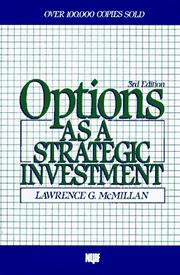
Options as a Strategic Investment

Options as a Strategic Investment

Lawrence G. McMillan
1980
T2 889 pages · about 14h 49m to read Open Librarygoodreads

Encyclopedic reference on option strategies and their payoffs.

Summary

Lawrence McMillan wrote the comprehensive reference on option strategies, running well over a thousand pages across its editions. It is organised by strategy rather than by theory, and its purpose is completeness.

The structure works through covered call writing, put buying, naked writing, spreads of every kind including vertical, calendar, diagonal, ratio and backspread, straddles and combinations, and then the same material for index options, futures options and LEAPS. For each strategy McMillan sets out the construction, the profit and loss profile, the break-even points, the effect of time decay and volatility change, the follow-up action when the position moves against the trader, and the tax treatment under American rules.

The book also covers volatility trading, arbitrage including conversions and reversals, and the mathematics needed to use the strategies, though it is not a theoretical text. Its weaknesses are its length, which makes it a reference rather than a book to read through, and the American tax and regulatory material, which dates. It is the standard desk reference for retail and professional option traders and has been kept in print through repeated editions since 1980. Readers wanting the conceptual framework should read Natenberg first and use McMillan for the specifics of a given structure.

Key takeaways 7

  1. Every option strategy has a determinate profit and loss profile that can be computed before the position is opened.
  2. Covered call writing converts an equity position into a short volatility position with capped upside, which most writers do not recognise.
  3. Follow-up action, meaning what the trader does when a position moves against them, matters more to results than the initial structure.
  4. Time decay works for the seller and against the buyer, and its rate accelerates as expiration approaches.
  5. Ratio and backspread positions carry unlimited risk in one direction and must be sized accordingly.
  6. Conversions, reversals and box spreads are arbitrage structures whose pricing enforces put-call parity.
  7. McMillan argues that strategy selection should follow from an explicit view on direction, volatility and time, and that positions without such a view are unmanageable.

Who should read it

Option traders who need a complete reference on the construction, risk profile and management of every standard strategy.

Similar books 6

Chosen by shared topics, the entries that hold them, and the people who recommended both.
Richard M. Bookstaber · 2007

How financial innovation made markets more crisis-prone, from a risk manager.
Nassim Nicholas Taleb · 1997

Technical manual on managing vanilla and exotic options

Sheldon Natenberg · 1988

Trading options as trading volatility: implied volatility, the Greeks, hedging.
Where it sits in the reference 1

Assets

Topics

InvestingFinance and Markets