Updates

  1. Person pages list letters, writing, profiles and links as sortable tables with filters, and show each person's companies as links; Fund letters show each letter's description in its own column.
  2. Experts show a checked job title and a short description of each person; 30 more people have photographs.
  3. Every company, fund, university and publication the experts work for has a page listing the people there.
  4. Fund letters show each letter's thesis and filter by it; 225 person pages list the essays, columns and newsletter issues the person wrote.
  5. Person pages list every essay and newsletter issue a person wrote, and their own books as a table in List view.
  6. Recommends shows the five largest kinds of book and the rest under More; browse pictures load sooner.
  7. Podcasts and talks link the original episode, filter by Audio and video or Press, and list each publisher once.
  8. Pages are wider, Recommends has List and Grid, and a filter clicked again turns off.
  9. Book cards sit in a ruled grid with Open Library and Goodreads links and each book's one-line note.
  10. Funds is now Investors; each investor's styles are buttons that filter the table.
  11. Podcasts and talks on a person's page filter by year and publisher and show as a list or a grid of pictures.
  12. Quotes show only people's own words: 472 summaries written by list sites are gone.
  13. Country pages open from Browse again, and every link on the shelf lands on a page.
  14. Subject and person pages show their sections as tabs, and each book appears once on a person's page.
  15. Book cards show the quote, who said it and the source; grids show five cards to a row.
  16. On a phone, a menu holds the sections, search, Updates, Feedback and dark mode.
  17. Feedback takes a screenshot of the page with no browser prompt, opens a screenshot full size when you click it, and clears itself once sent.
  18. Book cards are centred, search names the topic each book sits in, and any text cut short shows whole on hover.
  19. Search groups its results by kind: people, companies, geographies, subjects, topics, books, funds, fund letters and papers.
  20. The Books table lists who recommended each book by name, and the browser tab names the section you are in.
  21. Feedback can take a screenshot of the page, or one you paste or choose, and opens in the corner beside Updates.
  22. Each rail button reopens its section where you left it, and Browse, Table and People show on every book and subject page.
  23. Filters grey out choices that hold nothing instead of hiding them, and Books › People filters by authors or recommenders.
  24. Feedback takes a subject line and up to three screenshots.
  25. Biographies are grouped by the person they are about: 41 new pages, from Abraham Lincoln to Lee Kuan Yew.
  26. Sport splits into 23 sports, and Religion into one topic per faith.
  27. Book lists show as cards: the cover, one recommendation quote and every recommender by name.
  28. Seventeen subjects that had two or three pages under different names now have one page each.
  29. Every page lists its Experts as authors and recommenders, with a link to them on the Experts tab.
  30. Economics, Financial history, Financial panics and Accounting are subjects of their own, with one page per financial crisis.
  31. Book, person and subject pages open inside the app, so the tabs stay in view.
  32. 996 more book covers, and photographs or logos for 227 more people and companies.
  33. Books › Browse shows every subject as cards, and the rail holds Fund letters, Papers, Experts, Books and Funds.
  34. Every topic over 150 books splits into narrower topics, each with a page of its own.

Send feedback

What is it?
Screenshots, up to 3 (optional)
or paste one with Ctrl+V

We use your email only to reply to you.

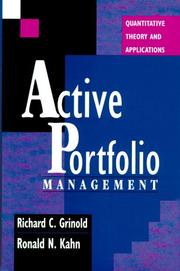
Active Portfolio Management

Active Portfolio Management

Richard C. Grinold, Ronald N. Kahn
1995
T2 369 pages · about 6h 9m to read Open Librarygoodreads

The fundamental law of active management; the quantitative manager's reference.

Summary

Grinold and Kahn, both from Barra and later BlackRock, wrote the standard quantitative text on constructing and managing active portfolios against a benchmark.

The framework is built on residual return, meaning return in excess of the benchmark after adjusting for beta, and residual risk, meaning the volatility of that excess. The information ratio is the ratio of expected residual return to residual risk, and Grinold and Kahn argue it is the correct measure of a manager's skill because it is independent of the amount of risk taken. A manager's value added is then the information ratio squared divided by four times the risk aversion, which means the information ratio determines everything and the risk level is a separate choice.

The fundamental law of active management is the book's best-known result. The information ratio approximately equals the information coefficient, meaning the correlation between forecast and realised residual returns, multiplied by the square root of breadth, meaning the number of independent bets made per year. The implication is that a manager with very modest forecasting ability can achieve a high information ratio by making many independent bets, and that a manager with excellent insight applied to few positions cannot. The law also explains why breadth must be genuinely independent, since correlated bets do not count separately.

The book then develops the machinery: forecasting returns and converting raw signals into expected returns through the refinement process, multi-factor risk models, portfolio construction through optimisation with constraints, transaction cost modelling, and performance analysis that decomposes returns into their sources.

The mathematics is demanding and the book assumes statistics and portfolio theory. The fundamental law is an approximation that requires assumptions frequently violated in practice, particularly the independence of bets and the constancy of the information coefficient, and later work has refined it with a transfer coefficient accounting for constraints. It remains the reference text for quantitative active management.

Key takeaways 7

  1. The information ratio, meaning expected residual return divided by residual risk, measures skill independently of how much risk a manager takes.
  2. The information ratio approximately equals forecasting skill multiplied by the square root of the number of independent bets.
  3. A manager with modest forecasting ability applied across many independent positions outperforms one with strong insight applied to few.
  4. Bets must be genuinely independent to count toward breadth, so correlated positions do not increase the achievable information ratio.
  5. Value added depends on the information ratio squared, so improving skill matters far more than adjusting risk.
  6. Raw forecasting signals must be scaled to expected returns, and the scaling depends on the signal's demonstrated correlation with outcomes.
  7. Constraints on a portfolio reduce the achievable information ratio by preventing the intended bets from being expressed.

Who should read it

Quantitative portfolio managers and allocators who need the analytical framework for active risk, skill measurement and portfolio construction.

Similar books 6

Chosen by shared topics, the entries that hold them, and the people who recommended both.

Lasse Heje Pedersen · 2015

Markets pay skilled active managers; a survey of the strategies they run.

Antti Ilmanen · 2011

The evidence on what drives returns across asset classes: risk factors and behaviour.

Andrew Ang · 2014

Factor investing for asset owners: factors as the nutrients inside assets.

Recommended by: Patrick O'Shaughnessy
Michael M. Pompian · 2008

Applies behavioural finance to building portfolios for real clients.
Peter L. Bernstein · 1992

How Markowitz, Sharpe, Fama, Black and Scholes built the theory of modern finance.

Turan G. Bali, Robert F. Engle, Scott Murray · 2016

The cross-sectional testing methods behind every factor claim.

Where it sits in the reference 2

Portfolio & risk
Investment styles

Topics

Investing