Updates

  1. Person pages list letters, writing, profiles and links as sortable tables with filters, and show each person's companies as links; Fund letters show each letter's description in its own column.
  2. Experts show a checked job title and a short description of each person; 30 more people have photographs.
  3. Every company, fund, university and publication the experts work for has a page listing the people there.
  4. Fund letters show each letter's thesis and filter by it; 225 person pages list the essays, columns and newsletter issues the person wrote.
  5. Person pages list every essay and newsletter issue a person wrote, and their own books as a table in List view.
  6. Recommends shows the five largest kinds of book and the rest under More; browse pictures load sooner.
  7. Podcasts and talks link the original episode, filter by Audio and video or Press, and list each publisher once.
  8. Pages are wider, Recommends has List and Grid, and a filter clicked again turns off.
  9. Book cards sit in a ruled grid with Open Library and Goodreads links and each book's one-line note.
  10. Funds is now Investors; each investor's styles are buttons that filter the table.
  11. Podcasts and talks on a person's page filter by year and publisher and show as a list or a grid of pictures.
  12. Quotes show only people's own words: 472 summaries written by list sites are gone.
  13. Country pages open from Browse again, and every link on the shelf lands on a page.
  14. Subject and person pages show their sections as tabs, and each book appears once on a person's page.
  15. Book cards show the quote, who said it and the source; grids show five cards to a row.
  16. On a phone, a menu holds the sections, search, Updates, Feedback and dark mode.
  17. Feedback takes a screenshot of the page with no browser prompt, opens a screenshot full size when you click it, and clears itself once sent.
  18. Book cards are centred, search names the topic each book sits in, and any text cut short shows whole on hover.
  19. Search groups its results by kind: people, companies, geographies, subjects, topics, books, funds, fund letters and papers.
  20. The Books table lists who recommended each book by name, and the browser tab names the section you are in.
  21. Feedback can take a screenshot of the page, or one you paste or choose, and opens in the corner beside Updates.
  22. Each rail button reopens its section where you left it, and Browse, Table and People show on every book and subject page.
  23. Filters grey out choices that hold nothing instead of hiding them, and Books › People filters by authors or recommenders.
  24. Feedback takes a subject line and up to three screenshots.
  25. Biographies are grouped by the person they are about: 41 new pages, from Abraham Lincoln to Lee Kuan Yew.
  26. Sport splits into 23 sports, and Religion into one topic per faith.
  27. Book lists show as cards: the cover, one recommendation quote and every recommender by name.
  28. Seventeen subjects that had two or three pages under different names now have one page each.
  29. Every page lists its Experts as authors and recommenders, with a link to them on the Experts tab.
  30. Economics, Financial history, Financial panics and Accounting are subjects of their own, with one page per financial crisis.
  31. Book, person and subject pages open inside the app, so the tabs stay in view.
  32. 996 more book covers, and photographs or logos for 227 more people and companies.
  33. Books › Browse shows every subject as cards, and the rail holds Fund letters, Papers, Experts, Books and Funds.
  34. Every topic over 150 books splits into narrower topics, each with a page of its own.

Send feedback

What is it?
Screenshots, up to 3 (optional)
or paste one with Ctrl+V

We use your email only to reply to you.

Efficiently Inefficient

Efficiently Inefficient

Lasse Heje Pedersen
2015
T2 368 pages · about 6h 8m to read Open Librarygoodreads

Construction under real frictions, funding and liquidity constraints.

Summary

Pedersen, a finance professor who also works at AQR, argues that markets are inefficient enough to reward active management and efficient enough that only skilled managers with real advantages capture the reward. The book is a survey of the strategies that professional investors actually run, with the academic evidence for each.

The coverage is organised by strategy. Market efficiency and the limits of arbitrage set the frame. Then: value and momentum investing, with the evidence on both and Pedersen's argument that they work in combination because their return series are negatively correlated; equity market neutral and quantitative equity, including the August 2007 quant unwind; dedicated short bias; global macro and managed futures, including trend following and carry strategies; fixed income arbitrage; convertible arbitrage; event driven investing including merger arbitrage and distressed. He also covers portfolio construction, risk management, drawdown control, transaction costs and leverage.

A distinctive feature is the interviews with practitioners including Cliff Asness, George Soros, David Harding, John Paulson, Lee Ainslie and Jim Chanos, each attached to the chapter on their strategy.

The book is aimed at advanced students and practitioners and requires finance background. It is the best available single volume mapping what hedge funds do to the academic evidence. Pedersen's affiliation with AQR shapes the treatment of factor investing, which receives more favourable coverage than some competing views would allow, and the factor performance since 2015 has been weaker than the historical evidence presented.

Key takeaways 7

  1. Markets are inefficient enough to reward skilled active management and efficient enough that unskilled managers cannot capture the reward.
  2. Value and momentum work well in combination because their returns are negatively correlated, so the combination is more reliable than either alone.
  3. Liquidity risk is priced across every asset class, and a large share of what appears as alpha is compensation for supplying liquidity.
  4. Leverage constraints faced by many investors create the low-risk anomaly, since constrained investors bid up high-beta assets and depress their returns.
  5. Trend following works across asset classes and has done so for a century, and the most credible explanation involves behavioural under-reaction followed by over-reaction.
  6. Transaction costs and capacity constraints determine whether a documented anomaly is investable, and many published effects vanish once these are included.
  7. Drawdown control and risk management determine whether a strategy survives to earn its expected return, which makes them part of the strategy rather than an overlay.

Who should read it

Professional investors and advanced students who want a map of active strategies with the academic evidence and practitioner perspective on each.

Similar books 6

Chosen by shared topics, the entries that hold them, and the people who recommended both.
Peter L. Bernstein · 1992

How Markowitz, Sharpe, Fama, Black and Scholes built the theory of modern finance.
Turan G. Bali, Robert F. Engle, Scott Murray · 2016

The cross-sectional testing methods behind every factor claim.
Richard C. Grinold, Ronald N. Kahn · 1995

The quantitative method for building active portfolios against a benchmark.
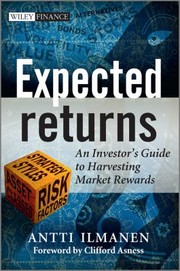
Antti Ilmanen · 2011

The evidence on what drives returns across asset classes: risk factors and behaviour.
Where it sits in the reference 4

Portfolio & risk
Investment styles
Investment styles
Mental models

Topics

InvestingFinance and Markets