Updates

  1. Person pages list letters, writing, profiles and links as sortable tables with filters, and show each person's companies as links; Fund letters show each letter's description in its own column.
  2. Experts show a checked job title and a short description of each person; 30 more people have photographs.
  3. Every company, fund, university and publication the experts work for has a page listing the people there.
  4. Fund letters show each letter's thesis and filter by it; 225 person pages list the essays, columns and newsletter issues the person wrote.
  5. Person pages list every essay and newsletter issue a person wrote, and their own books as a table in List view.
  6. Recommends shows the five largest kinds of book and the rest under More; browse pictures load sooner.
  7. Podcasts and talks link the original episode, filter by Audio and video or Press, and list each publisher once.
  8. Pages are wider, Recommends has List and Grid, and a filter clicked again turns off.
  9. Book cards sit in a ruled grid with Open Library and Goodreads links and each book's one-line note.
  10. Funds is now Investors; each investor's styles are buttons that filter the table.
  11. Podcasts and talks on a person's page filter by year and publisher and show as a list or a grid of pictures.
  12. Quotes show only people's own words: 472 summaries written by list sites are gone.
  13. Country pages open from Browse again, and every link on the shelf lands on a page.
  14. Subject and person pages show their sections as tabs, and each book appears once on a person's page.
  15. Book cards show the quote, who said it and the source; grids show five cards to a row.
  16. On a phone, a menu holds the sections, search, Updates, Feedback and dark mode.
  17. Feedback takes a screenshot of the page with no browser prompt, opens a screenshot full size when you click it, and clears itself once sent.
  18. Book cards are centred, search names the topic each book sits in, and any text cut short shows whole on hover.
  19. Search groups its results by kind: people, companies, geographies, subjects, topics, books, funds, fund letters and papers.
  20. The Books table lists who recommended each book by name, and the browser tab names the section you are in.
  21. Feedback can take a screenshot of the page, or one you paste or choose, and opens in the corner beside Updates.
  22. Each rail button reopens its section where you left it, and Browse, Table and People show on every book and subject page.
  23. Filters grey out choices that hold nothing instead of hiding them, and Books › People filters by authors or recommenders.
  24. Feedback takes a subject line and up to three screenshots.
  25. Biographies are grouped by the person they are about: 41 new pages, from Abraham Lincoln to Lee Kuan Yew.
  26. Sport splits into 23 sports, and Religion into one topic per faith.
  27. Book lists show as cards: the cover, one recommendation quote and every recommender by name.
  28. Seventeen subjects that had two or three pages under different names now have one page each.
  29. Every page lists its Experts as authors and recommenders, with a link to them on the Experts tab.
  30. Economics, Financial history, Financial panics and Accounting are subjects of their own, with one page per financial crisis.
  31. Book, person and subject pages open inside the app, so the tabs stay in view.
  32. 996 more book covers, and photographs or logos for 227 more people and companies.
  33. Books › Browse shows every subject as cards, and the rail holds Fund letters, Papers, Experts, Books and Funds.
  34. Every topic over 150 books splits into narrower topics, each with a page of its own.

Send feedback

What is it?
Screenshots, up to 3 (optional)
or paste one with Ctrl+V

We use your email only to reply to you.

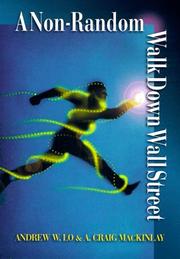
A Non-Random Walk Down Wall Street

A Non-Random Walk Down Wall Street

Andrew W. Lo, A. Craig MacKinlay
1999
T4 424 pages · about 7h 4m to read Open Librarygoodreads

Summary

Lo and MacKinlay collected their research papers challenging the random walk hypothesis, with connecting commentary. The title responds directly to Malkiel's A Random Walk Down Wall Street.

The central technical contribution is the variance ratio test. If prices follow a random walk, the variance of returns measured over a long interval should equal the sum of the variances over the shorter intervals composing it, so the ratio should be one. Lo and MacKinlay showed that for American stock indices over the postwar period the ratio exceeds one at weekly horizons, meaning returns are positively autocorrelated and the random walk is rejected. The rejection is stronger for small capitalisation stocks and for portfolios than for individual securities.

They are careful about what this does and does not mean. Rejecting the random walk does not establish that markets are inefficient, because efficiency permits predictable variation in expected returns arising from time-varying risk premia. Nor does it establish that the predictability is exploitable after transaction costs, which for the small-cap effects they document is doubtful.

Other papers in the collection address data snooping bias, meaning the distortion produced when many researchers test many hypotheses on the same data set and only the significant results are published; the statistical properties of long-horizon return regressions; the nonsynchronous trading effect that generates spurious autocorrelation in index returns; and a paper applying pattern recognition methods to technical analysis, which found that some chart patterns carry information.

The papers are technical and require econometrics. Lo's later work developed the adaptive markets hypothesis, which frames these findings within an evolutionary account of market efficiency. The specific predictabilities documented have weakened since publication, which is consistent with the argument that identified inefficiencies get traded away.

Key takeaways 7

  1. Variance ratio tests reject the random walk hypothesis for American stock index returns at weekly horizons.
  2. Rejecting the random walk does not establish inefficiency, because efficient markets permit time-varying expected returns.
  3. Predictability documented in small capitalisation stocks is unlikely to survive transaction costs.
  4. Nonsynchronous trading across securities generates autocorrelation in index returns that is a measurement artefact rather than a market property.
  5. Data snooping bias distorts published results because many researchers test the same data and only significant findings appear.
  6. Pattern recognition applied to technical chart formations found that some patterns carry statistically detectable information.
  7. Documented predictabilities weaken after publication, which is consistent with the market absorbing identified inefficiencies.

Who should read it

Quantitatively trained investors and researchers who want the primary evidence against the random walk and the careful statement of what it implies.

About Andrew W. Lo

Charles E. and Susan T. Harris Professor, MIT Sloan School of Management; Director, MIT Laboratory for Financial Engineering; founder of AlphaSimplex Group

The Econometrics of Financial Markets and the variance-ratio work with MacKinlay are primary sources the field builds on, and the Adaptive Markets Hypothesis is a named framework in its own right.

MIT Sloan School of Management, MIT Laboratory for Financial Engineering, AlphaSimplex Group

Similar books 6

Chosen by shared topics, the entries that hold them, and the people who recommended both.

Andrew W. Lo, John Y. Campbell, A. Craig MacKinlay · 1997

The statistical tools of empirical finance and the questions they test.

Turan G. Bali, Robert F. Engle, Scott Murray · 2016

The cross-sectional testing methods behind every factor claim.

James Owen Weatherall · 2013

How physicists and mathematicians came to run money; useful context for Simons.

Recommended by: Eric Weinstein

Where it sits in the reference 2

Academics
Mental models

Topics

Finance and MarketsMathematics and StatisticsInvestingGames, gambling and quantitative finance