
Updates

  1. Person pages list letters, writing, profiles and links as sortable tables with filters, and show each person's companies as links; Fund letters show each letter's description in its own column.
  2. Experts show a checked job title and a short description of each person; 30 more people have photographs.
  3. Every company, fund, university and publication the experts work for has a page listing the people there.
  4. Fund letters show each letter's thesis and filter by it; 225 person pages list the essays, columns and newsletter issues the person wrote.
  5. Person pages list every essay and newsletter issue a person wrote, and their own books as a table in List view.
  6. Recommends shows the five largest kinds of book and the rest under More; browse pictures load sooner.
  7. Podcasts and talks link the original episode, filter by Audio and video or Press, and list each publisher once.
  8. Pages are wider, Recommends has List and Grid, and a filter clicked again turns off.
  9. Book cards sit in a ruled grid with Open Library and Goodreads links and each book's one-line note.
  10. Funds is now Investors; each investor's styles are buttons that filter the table.
  11. Podcasts and talks on a person's page filter by year and publisher and show as a list or a grid of pictures.
  12. Quotes show only people's own words: 472 summaries written by list sites are gone.
  13. Country pages open from Browse again, and every link on the shelf lands on a page.
  14. Subject and person pages show their sections as tabs, and each book appears once on a person's page.
  15. Book cards show the quote, who said it and the source; grids show five cards to a row.
  16. On a phone, a menu holds the sections, search, Updates, Feedback and dark mode.
  17. Feedback takes a screenshot of the page with no browser prompt, opens a screenshot full size when you click it, and clears itself once sent.
  18. Book cards are centred, search names the topic each book sits in, and any text cut short shows whole on hover.
  19. Search groups its results by kind: people, companies, geographies, subjects, topics, books, funds, fund letters and papers.
  20. The Books table lists who recommended each book by name, and the browser tab names the section you are in.
  21. Feedback can take a screenshot of the page, or one you paste or choose, and opens in the corner beside Updates.
  22. Each rail button reopens its section where you left it, and Browse, Table and People show on every book and subject page.
  23. Filters grey out choices that hold nothing instead of hiding them, and Books › People filters by authors or recommenders.
  24. Feedback takes a subject line and up to three screenshots.
  25. Biographies are grouped by the person they are about: 41 new pages, from Abraham Lincoln to Lee Kuan Yew.
  26. Sport splits into 23 sports, and Religion into one topic per faith.
  27. Book lists show as cards: the cover, one recommendation quote and every recommender by name.
  28. Seventeen subjects that had two or three pages under different names now have one page each.
  29. Every page lists its Experts as authors and recommenders, with a link to them on the Experts tab.
  30. Economics, Financial history, Financial panics and Accounting are subjects of their own, with one page per financial crisis.
  31. Book, person and subject pages open inside the app, so the tabs stay in view.
  32. 996 more book covers, and photographs or logos for 227 more people and companies.
  33. Books › Browse shows every subject as cards, and the rail holds Fund letters, Papers, Experts, Books and Funds.
  34. Every topic over 150 books splits into narrower topics, each with a page of its own.

Send feedback

What is it?
Screenshots, up to 3 (optional)
or paste one with Ctrl+V

We use your email only to reply to you.

Behavioral Finance and Wealth Management

Behavioral Finance and Wealth Management

Michael M. Pompian
2008
T4 352 pages · about 5h 52m to read Open Librarygoodreads

Applies behavioural finance to building portfolios for real clients.

Summary

Pompian wrote this as a practical guide for financial advisers on identifying clients' behavioural biases and adjusting portfolio recommendations accordingly.

The structure has two parts. The first catalogues twenty biases, dividing them into cognitive errors, meaning faulty reasoning that can be corrected with information and education, and emotional biases, meaning feelings that resist correction and must be accommodated. Cognitive errors include overconfidence, representativeness, anchoring, availability, conservatism, confirmation, hindsight, mental accounting, framing and illusion of control. Emotional biases include loss aversion, regret aversion, status quo bias, endowment and affinity.

The practical framework follows from this distinction. Pompian argues that cognitive errors should be corrected through education and process, while emotional biases should generally be accommodated in the portfolio, because attempting to correct them produces a portfolio the client will abandon at the worst moment. The decision about whether to moderate or adapt depends on the client's wealth level relative to their needs and on the strength of the bias: a wealthy client whose lifestyle is secure can be adapted to, while a client whose plan depends on returns must be moderated.

He also presents behavioural investor types as a diagnostic framework for classifying clients, and a set of questions for identifying which biases a particular client exhibits.

The book is written for practitioners rather than researchers and does not test its own framework. The bias taxonomy is drawn from the academic literature, and some of the underlying studies have been affected by replication problems. The practical argument, that an adviser should build a portfolio a client will actually hold rather than the theoretically optimal one, is sound and is the book's main contribution.

Key takeaways 7

  1. Cognitive errors can be corrected through education and process while emotional biases resist correction and must be accommodated.
  2. A portfolio the client abandons in a drawdown is worse than a suboptimal portfolio the client will hold.
  3. Whether to moderate or accommodate a bias depends on whether the client's plan actually requires the returns being given up.
  4. Wealthy clients whose lifestyle is secure can be accommodated, while clients dependent on returns must be moderated.
  5. Diagnosing which biases a client exhibits requires structured questioning rather than inference from their stated preferences.
  6. Mental accounting can be used constructively by separating portfolios by purpose rather than being corrected.
  7. Advisers who present the theoretically optimal portfolio without regard to the client's behaviour produce worse realised outcomes.

Who should read it

Financial advisers and anyone managing money for others who needs a practical framework for adapting recommendations to how clients actually behave.

Similar books 6

Chosen by shared topics, the entries that hold them, and the people who recommended both.

Michael M. Pompian · 2012

Classifies investors into behavioural types for advice and design.
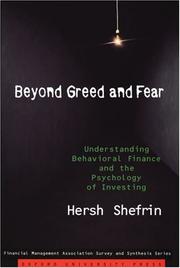
Hersh Shefrin · 2000

Behavioural finance for practitioners: mental shortcuts, framing and market errors.

David Dreman · 1999

Data showing that low-expectation stocks beat popular ones over the long run.

“all these people really were helpful in forming and getting me involved in investing” — Joel Greenblatt

Source: Masters in Business transcript: Joel Greenblatt (2018)

Recommended by: Joel Greenblatt, Mohnish Pabrai and 1 other

Where it sits in the reference 2

Investment philosophy
Portfolio & risk

Topics

InvestingPsychology and BehaviourBehavioural finance and the psychology of money