Updates

  1. Person pages list letters, writing, profiles and links as sortable tables with filters, and show each person's companies as links; Fund letters show each letter's description in its own column.
  2. Experts show a checked job title and a short description of each person; 30 more people have photographs.
  3. Every company, fund, university and publication the experts work for has a page listing the people there.
  4. Fund letters show each letter's thesis and filter by it; 225 person pages list the essays, columns and newsletter issues the person wrote.
  5. Person pages list every essay and newsletter issue a person wrote, and their own books as a table in List view.
  6. Recommends shows the five largest kinds of book and the rest under More; browse pictures load sooner.
  7. Podcasts and talks link the original episode, filter by Audio and video or Press, and list each publisher once.
  8. Pages are wider, Recommends has List and Grid, and a filter clicked again turns off.
  9. Book cards sit in a ruled grid with Open Library and Goodreads links and each book's one-line note.
  10. Funds is now Investors; each investor's styles are buttons that filter the table.
  11. Podcasts and talks on a person's page filter by year and publisher and show as a list or a grid of pictures.
  12. Quotes show only people's own words: 472 summaries written by list sites are gone.
  13. Country pages open from Browse again, and every link on the shelf lands on a page.
  14. Subject and person pages show their sections as tabs, and each book appears once on a person's page.
  15. Book cards show the quote, who said it and the source; grids show five cards to a row.
  16. On a phone, a menu holds the sections, search, Updates, Feedback and dark mode.
  17. Feedback takes a screenshot of the page with no browser prompt, opens a screenshot full size when you click it, and clears itself once sent.
  18. Book cards are centred, search names the topic each book sits in, and any text cut short shows whole on hover.
  19. Search groups its results by kind: people, companies, geographies, subjects, topics, books, funds, fund letters and papers.
  20. The Books table lists who recommended each book by name, and the browser tab names the section you are in.
  21. Feedback can take a screenshot of the page, or one you paste or choose, and opens in the corner beside Updates.
  22. Each rail button reopens its section where you left it, and Browse, Table and People show on every book and subject page.
  23. Filters grey out choices that hold nothing instead of hiding them, and Books › People filters by authors or recommenders.
  24. Feedback takes a subject line and up to three screenshots.
  25. Biographies are grouped by the person they are about: 41 new pages, from Abraham Lincoln to Lee Kuan Yew.
  26. Sport splits into 23 sports, and Religion into one topic per faith.
  27. Book lists show as cards: the cover, one recommendation quote and every recommender by name.
  28. Seventeen subjects that had two or three pages under different names now have one page each.
  29. Every page lists its Experts as authors and recommenders, with a link to them on the Experts tab.
  30. Economics, Financial history, Financial panics and Accounting are subjects of their own, with one page per financial crisis.
  31. Book, person and subject pages open inside the app, so the tabs stay in view.
  32. 996 more book covers, and photographs or logos for 227 more people and companies.
  33. Books › Browse shows every subject as cards, and the rail holds Fund letters, Papers, Experts, Books and Funds.
  34. Every topic over 150 books splits into narrower topics, each with a page of its own.

Send feedback

What is it?
Screenshots, up to 3 (optional)
or paste one with Ctrl+V

We use your email only to reply to you.

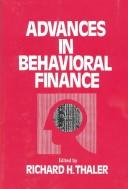
Advances in Behavioral Finance

Advances in Behavioral Finance

Richard H. Thaler
1993
T4 597 pages · about 9h 57m to read Open Librarygoodreads

Edited volume.

Summary

Thaler edited this collection of the foundational papers in behavioural finance, bringing together work published across journals during the 1980s and early 1990s that documented asset pricing behaviour inconsistent with the standard model.

The papers cover the anomalies that defined the field. Shiller's variance bounds work showed that stock prices move far more than the subsequent realised dividends justify, which contradicts the present value model. De Bondt and Thaler's overreaction papers showed that portfolios of prior losers subsequently outperform prior winners, consistent with investors extrapolating past performance too far. The closed-end fund puzzle documented persistent discounts and premiums to net asset value that no risk-based explanation accounts for, and showed the discounts co-move in ways suggesting sentiment. Papers on the equity premium puzzle showed that the historical excess return of equities over bonds is too large to be explained by plausible risk aversion. Others cover calendar effects, the small firm effect, and dividend behaviour.

The collection also includes theoretical work on the limits of arbitrage, which is the field's essential response to the objection that rational traders would eliminate any mispricing. The argument is that arbitrage is risky and costly, that arbitrageurs manage other people's money and face redemption when positions move against them, and that mispricings can therefore persist and widen.

These are technical journal papers rather than expository writing. The field has developed substantially since 1993, and several of the anomalies documented here have weakened or disappeared in subsequent data. Thaler edited a second volume in 2005, also in this reference, covering the later work.

Key takeaways 7

  1. Stock prices move far more than subsequent realised dividends justify, which contradicts the present value model.
  2. Portfolios of prior losing stocks subsequently outperform prior winners, consistent with investors extrapolating past performance.
  3. Closed-end fund discounts persist and co-move across funds in ways that no risk-based explanation accounts for.
  4. The historical equity premium is too large to be explained by any plausible degree of risk aversion.
  5. Arbitrage is risky and costly, so mispricings can persist and widen rather than being eliminated by rational traders.
  6. Arbitrageurs managing other people's money face redemptions when positions move against them, which limits how long they can hold.
  7. Documenting an anomaly does not establish that it can be traded, since transaction costs and capacity constrain what is exploitable.

Who should read it

Researchers and quantitatively trained investors who want the primary papers that established behavioural finance as a field.

About Richard H. Thaler

Charles R. Walgreen Distinguished Service Professor of Behavioral Science and Economics, University of Chicago Booth School of Business; co-founder, Fuller & Thaler Asset Management; Nobel laureate in economics 2017

The Anomalies series and Nudge are the primary sources for behavioral economics as an applied discipline in finance and public policy.

University of Chicago Booth School of Business, Fuller & Thaler Asset Management

Similar books 6

Chosen by shared topics, the entries that hold them, and the people who recommended both.
Richard H. Thaler · 2015

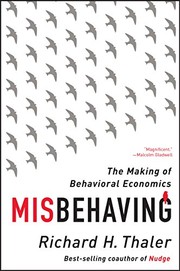
How behavioural economics was built against economists who assumed rational agents.

“He opens his new book, Misbehaving, with Vilfredo Pareto's assertion” — Howard Marks

Source: Oaktree memo 'On the Couch'

Recommended by: Howard Marks, Peter Mallouk, Tyler Cowen
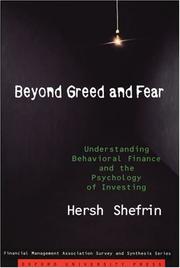
Hersh Shefrin · 2000

Behavioural finance for practitioners: mental shortcuts, framing and market errors.

Jason Zweig · 2007

Neuroscience of investing decisions, written by Graham's modern editor.

Recommended by: Mohnish Pabrai
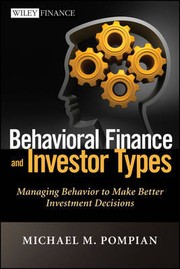
Michael M. Pompian · 2012

Classifies investors into behavioural types for advice and design.
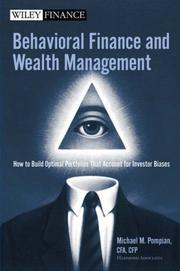
Michael M. Pompian · 2008

Applies behavioural finance to building portfolios for real clients.

Where it sits in the reference 2

Academics
Investment philosophy

Topics

Finance and MarketsPsychology and BehaviourInvestingBehavioural finance and the psychology of money