Updates

  1. Person pages list letters, writing, profiles and links as sortable tables with filters, and show each person's companies as links; Fund letters show each letter's description in its own column.
  2. Experts show a checked job title and a short description of each person; 30 more people have photographs.
  3. Every company, fund, university and publication the experts work for has a page listing the people there.
  4. Fund letters show each letter's thesis and filter by it; 225 person pages list the essays, columns and newsletter issues the person wrote.
  5. Person pages list every essay and newsletter issue a person wrote, and their own books as a table in List view.
  6. Recommends shows the five largest kinds of book and the rest under More; browse pictures load sooner.
  7. Podcasts and talks link the original episode, filter by Audio and video or Press, and list each publisher once.
  8. Pages are wider, Recommends has List and Grid, and a filter clicked again turns off.
  9. Book cards sit in a ruled grid with Open Library and Goodreads links and each book's one-line note.
  10. Funds is now Investors; each investor's styles are buttons that filter the table.
  11. Podcasts and talks on a person's page filter by year and publisher and show as a list or a grid of pictures.
  12. Quotes show only people's own words: 472 summaries written by list sites are gone.
  13. Country pages open from Browse again, and every link on the shelf lands on a page.
  14. Subject and person pages show their sections as tabs, and each book appears once on a person's page.
  15. Book cards show the quote, who said it and the source; grids show five cards to a row.
  16. On a phone, a menu holds the sections, search, Updates, Feedback and dark mode.
  17. Feedback takes a screenshot of the page with no browser prompt, opens a screenshot full size when you click it, and clears itself once sent.
  18. Book cards are centred, search names the topic each book sits in, and any text cut short shows whole on hover.
  19. Search groups its results by kind: people, companies, geographies, subjects, topics, books, funds, fund letters and papers.
  20. The Books table lists who recommended each book by name, and the browser tab names the section you are in.
  21. Feedback can take a screenshot of the page, or one you paste or choose, and opens in the corner beside Updates.
  22. Each rail button reopens its section where you left it, and Browse, Table and People show on every book and subject page.
  23. Filters grey out choices that hold nothing instead of hiding them, and Books › People filters by authors or recommenders.
  24. Feedback takes a subject line and up to three screenshots.
  25. Biographies are grouped by the person they are about: 41 new pages, from Abraham Lincoln to Lee Kuan Yew.
  26. Sport splits into 23 sports, and Religion into one topic per faith.
  27. Book lists show as cards: the cover, one recommendation quote and every recommender by name.
  28. Seventeen subjects that had two or three pages under different names now have one page each.
  29. Every page lists its Experts as authors and recommenders, with a link to them on the Experts tab.
  30. Economics, Financial history, Financial panics and Accounting are subjects of their own, with one page per financial crisis.
  31. Book, person and subject pages open inside the app, so the tabs stay in view.
  32. 996 more book covers, and photographs or logos for 227 more people and companies.
  33. Books › Browse shows every subject as cards, and the rail holds Fund letters, Papers, Experts, Books and Funds.
  34. Every topic over 150 books splits into narrower topics, each with a page of its own.

Send feedback

What is it?
Screenshots, up to 3 (optional)
or paste one with Ctrl+V

We use your email only to reply to you.

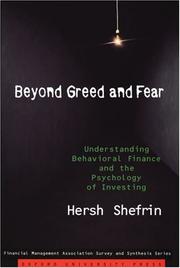
Beyond Greed and Fear

Beyond Greed and Fear

Hersh Shefrin
2000
T3 368 pages · about 6h 8m to read Open Librarygoodreads

The academic bridge between behavioural finance and portfolio practice.

Summary

Shefrin, an academic who worked with Meir Statman on behavioural portfolio theory, wrote this to translate behavioural finance research into terms practitioners could use.

The organising framework has three themes. Heuristic-driven bias covers the mental shortcuts that produce systematic errors: representativeness, which causes investors to judge a company's stock by the company's quality; overconfidence in one's own information and judgement; anchoring on prior prices; and availability, which causes recent and vivid events to dominate assessment. Frame dependence covers the finding that the way a decision is presented changes the choice, including loss aversion, mental accounting that separates money into categories treated differently, and the disposition effect, meaning the tendency to sell winners and hold losers. Inefficient markets covers the resulting asset pricing consequences.

The applications are what distinguish the book. Shefrin applies the framework to individual investors, to professional money managers whose own biases affect their decisions, to analysts whose forecasts show predictable patterns of over-optimism and slow revision, to corporate managers making capital budgeting and acquisition decisions, to options markets, to the equity premium through myopic loss aversion, and to financial advisers managing clients.

His behavioural portfolio theory, developed with Statman, argues that investors construct portfolios as layers corresponding to separate goals rather than as a single optimised whole, which explains why people simultaneously hold insurance and lottery tickets and why they resist the mean-variance framework.

The book is from 2000 and the field has developed since. Some of the studies cited come from literatures affected by replication problems. The disposition effect, the analyst forecast patterns and the mental accounting findings have held up well. Shefrin writes clearly and the practitioner orientation makes it more usable than the academic collections.

Key takeaways 7

  1. Investors judge a stock by the quality of the company, which confuses a good business with a good investment.
  2. Investors sell winning positions and hold losing ones, which is documented directly in account data and is costly after tax.
  3. Analyst forecasts show predictable over-optimism and revise too slowly in response to new information.
  4. Investors construct portfolios as separate layers for separate goals rather than as a single optimised whole.
  5. Frequent portfolio evaluation combined with loss aversion explains the size of the equity premium.
  6. Professional money managers exhibit the same biases as individuals, and their institutional setting adds new ones.
  7. Corporate managers making acquisitions display overconfidence in their own ability to improve the target.

Who should read it

Practitioners in investment management and advice who want behavioural findings organised around the decisions they actually make.

Similar books 6

Chosen by shared topics, the entries that hold them, and the people who recommended both.

Jason Zweig · 2007

Neuroscience of investing decisions, written by Graham's modern editor.

Recommended by: Mohnish Pabrai

Michael M. Pompian · 2012

Classifies investors into behavioural types for advice and design.
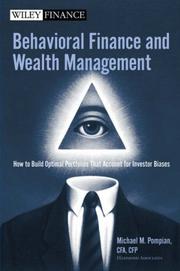
Michael M. Pompian · 2008

Applies behavioural finance to building portfolios for real clients.
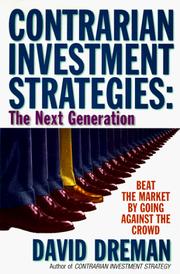
David Dreman · 1999

Data showing that low-expectation stocks beat popular ones over the long run.

“all these people really were helpful in forming and getting me involved in investing” — Joel Greenblatt

Source: Masters in Business transcript: Joel Greenblatt (2018)

Recommended by: Joel Greenblatt, Mohnish Pabrai and 1 other

Where it sits in the reference 1

Investment philosophy

Topics

InvestingPsychology and BehaviourFinance and MarketsBehavioural finance and the psychology of money