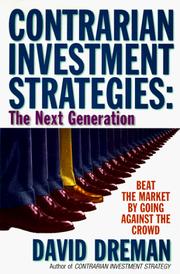
Contrarian Investment Strategies
Dreman argues low-expectation stocks beat glamour over full cycles.
Summary
Dreman argues that low expectation stocks outperform high expectation stocks systematically, and supports it with long-run data on portfolios sorted by price to earnings, price to book, price to cash flow and dividend yield. His finding is that the cheapest quintile on each measure outperformed the market and the most expensive quintile underperformed, over multiple decades.
His explanation is behavioural. Analysts' earnings forecasts are consistently wrong, and he documents the average error across tens of thousands of estimates as large enough to invalidate any strategy depending on them. Investors extrapolate recent growth and pay high multiples for companies expected to continue, which sets a standard those companies cannot meet.
His most useful contribution is the analysis of earnings surprises. He shows that a positive surprise on a low expectation stock produces a large positive price effect while a negative surprise produces little damage, and that the reverse holds for high expectation stocks, where a positive surprise produces almost nothing and a negative surprise is punished severely. This asymmetry, rather than any characteristic of the businesses, is his explanation for why the strategy works.
He also covers investor psychology, including overconfidence and the tendency to weight case detail over base rates, and gives specific portfolio construction rules covering diversification, sector limits and holding periods. The book has been revised across editions and the data has been extended. Value strategies underperformed substantially in the decade after the most recent edition, which readers should weigh. The earnings surprise asymmetry is the finding that has held up best.
Key takeaways 8
- Stocks in the cheapest quintile by price to earnings, price to book, price to cash flow and dividend yield outperformed the market over multiple decades.
- Analyst earnings forecasts are wrong by margins large enough to invalidate any strategy that depends on their accuracy.
- Investors extrapolate recent growth and pay multiples that require the growth to continue, which sets a standard the companies cannot meet.
- A positive earnings surprise on a low expectation stock produces a large price gain while a negative surprise produces little damage.
- A positive surprise on a high expectation stock produces almost no gain while a negative surprise is punished severely.
- This asymmetry in the response to surprises, rather than any property of the underlying businesses, explains why the strategy works.
- Contrarian portfolios require holding periods of several years and diversification across sectors, since individual positions fail regularly.
- The strategy requires holding through extended periods of underperformance, which is why most investors abandon it before it works.
Who should read it
Value investors who want the long-run data on low-expectation portfolios and the earnings surprise asymmetry that explains the effect.
About David Dreman
Founder and chairman of Dreman Value Management and a long-running Forbes columnist.
Contrarian Investment Strategies documents the long-run return advantage of low price-to-earnings, price-to-book and price-to-cash-flow stocks across decades of data, and attributes it to systematic forecasting errors by analysts rather than to hidden risk. The work supplies both the evidence base for contrarian portfolios and the operating rules they need, including sell discipline and position limits.
Who recommended it 3 · 3 direct
“all these people really were helpful in forming and getting me involved in investing”
Similar books 6
Chosen by shared topics, the entries that hold them, and the people who recommended both.

Value investing joined with behavioural finance, from a strategist's research notes.
Recommended by: Mohnish Pabrai
Twenty short essays on why behaviour matters more than knowledge with money.
“…books I've recommended, highlighted to death, or forced on friends.” — Andrew Wilkinson
Source: Andrew Wilkinson's Bookshelf, neverenough.com
Recommended by: Andrew Wilkinson, Nat Eliason, Ali Abdaal and 10 others

Speeches making the case for a latticework of mental models from many fields.
“…books I've recommended, highlighted to death, or forced on friends.” — Andrew Wilkinson
Source: Andrew Wilkinson's Bookshelf, neverenough.com
Recommended by: Andrew Wilkinson, Charlie Munger and 26 others
A speculator modelled on Jesse Livermore learns to read and trade the market.
“The finest trading book ever written is Reminiscences of a Stock Operator by Edwin LeFevre. It is colloquial reminiscences by a legendary speculator of the mistakes and lessons he learned over a…” — Barton Biggs
Source: Biggs calling it the finest trading book ever written
Recommended by: Barton Biggs, Bill Miller, Colm O'Shea and 5 others
Spier on the psychology and habits behind durable value investing.
“…books I've recommended, highlighted to death, or forced on friends.” — Andrew Wilkinson
Source: Andrew Wilkinson's Bookshelf, neverenough.com
Recommended by: Andrew Wilkinson, Christopher Bloomstran and 1 other
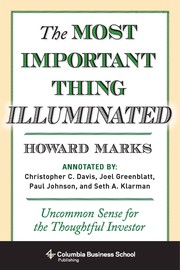
Second-level thinking on risk and cycles, with notes by Klarman and Greenblatt.
“…books I've recommended, highlighted to death, or forced on friends.” — Andrew Wilkinson
Source: Andrew Wilkinson's Bookshelf, neverenough.com
Recommended by: Andrew Wilkinson, Mohnish Pabrai and 3 others
Where it sits in the reference 4
Topics