
Value Investing: Tools and Techniques for Intelligent Investment
Montier applies behavioural evidence to a value investing process.
Summary
Montier, a strategist who worked at Societe Generale and later GMO, collected his research notes into a book combining behavioural finance with value investing practice. It is organised in sections on why everything you learned in business school is wrong, the behavioural foundations of value investing, the private equity and short-selling applications, and the evidence.
His attacks on standard finance are direct. He argues that the capital asset pricing model is empirically refuted and should not be used to set discount rates, that beta does not measure risk in any sense investors care about, that risk is the permanent impairment of capital rather than volatility, and that discounted cash flow models are so sensitive to inputs that they produce whatever answer the analyst wanted. He proposes reverse-engineered valuation and simple screens instead.
The behavioural material covers overconfidence, confirmation bias, the tendency to seek more information rather than better information, and the specific institutional pressures that prevent professional investors from acting on value criteria: career risk, benchmark tracking and the requirement to explain each position.
He also presents empirical work on quality and value screens, on short-selling candidates identified through accounting red flags and the C-score, and on the Graham net-net approach applied to modern markets.
The book is a collection of research notes and it repeats itself. Montier is combative and states positions more strongly than the evidence sometimes supports, and the material was written between 2005 and 2009, so the market context is specific. The behavioural and institutional analysis is the most durable part.
Key takeaways 7
- Risk is the permanent impairment of capital rather than volatility, and using volatility as a risk measure produces portfolios that avoid the wrong thing.
- The capital asset pricing model is empirically refuted and beta does not measure anything an investor should care about.
- Discounted cash flow models are so sensitive to their inputs that they return whatever answer the analyst intended, which makes them a rhetorical device rather than an analysis.
- Professional investors cannot act on value criteria because career risk, benchmark tracking and the requirement to justify each position all penalise being early and different.
- Investors seek more information rather than better information, which raises confidence without improving accuracy.
- Simple screens combining value and quality criteria outperform elaborate analysis, because the elaboration adds noise and confidence rather than information.
- Accounting red flags including earnings manipulation indicators identify short candidates more reliably than valuation alone does.
Who should read it
Value investors who want behavioural finance connected directly to practice and a sustained attack on the standard finance toolkit.
Who recommended it 1 · 1 direct
Similar books 6
Chosen by shared topics, the entries that hold them, and the people who recommended both.
Data showing that low-expectation stocks beat popular ones over the long run.
“all these people really were helpful in forming and getting me involved in investing” — Joel Greenblatt
Source: Masters in Business transcript: Joel Greenblatt (2018)
Recommended by: Joel Greenblatt, Mohnish Pabrai and 1 other
Spier on the psychology and habits behind durable value investing.
“…books I've recommended, highlighted to death, or forced on friends.” — Andrew Wilkinson
Source: Andrew Wilkinson's Bookshelf, neverenough.com
Recommended by: Andrew Wilkinson, Christopher Bloomstran and 1 other
Second-level thinking on risk and cycles, with notes by Klarman and Greenblatt.
“…books I've recommended, highlighted to death, or forced on friends.” — Andrew Wilkinson
Source: Andrew Wilkinson's Bookshelf, neverenough.com
Recommended by: Andrew Wilkinson, Mohnish Pabrai and 3 others
How Templeton bought maximum pessimism across global markets.

Cycles can't be timed, but knowing where you stand in one lets you adjust risk.
Recommended by: Nat Eliason, Michael Bloomberg
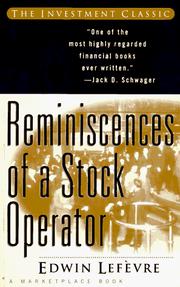
A speculator modelled on Jesse Livermore learns to read and trade the market.
“The finest trading book ever written is Reminiscences of a Stock Operator by Edwin LeFevre. It is colloquial reminiscences by a legendary speculator of the mistakes and lessons he learned over a…” — Barton Biggs
Source: Biggs calling it the finest trading book ever written
Recommended by: Barton Biggs, Bill Miller, Colm O'Shea and 5 others
Where it sits in the reference 3
Topics