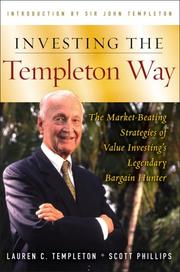
Investing the Templeton Way
How Templeton bought maximum pessimism across global markets.
Summary
Lauren Templeton, a fund manager and John Templeton's great-niece, wrote with Scott Phillips about Templeton's investment approach, drawing on family access and on the record of his funds.
The method is bargain hunting applied globally and contrarian by design. Templeton's stated rule was to buy at the point of maximum pessimism, which he defined operationally rather than emotionally: the price must be low relative to the company's own long-run normalised earnings, and the pessimism must be about circumstances rather than about the business's permanent prospects. He searched globally from the 1950s onward, when almost no American investor looked outside the United States, and he treated country markets as a source of opportunity because whole markets could become cheap for reasons unrelated to individual companies.
The book documents the specific episodes. His 1939 purchase of a hundred dollars each of every listed stock trading below one dollar on the New York and American exchanges, financed with borrowed money, at the outbreak of war. His entry into Japan in the 1960s when Japanese stocks traded at a fraction of American multiples and capital controls made it difficult. His purchase of Korean equities after the 1997 crisis. His short position in technology stocks in 2000, taken by shorting companies at the expiry of insider lock-up periods.
The practical content includes his use of a wish list of companies with limit orders set at prices that would only be reached in a panic, which removes the decision from the moment of stress.
The book is written by a family member and is admiring. It also stops in 2008 and the treatment of Templeton's later years is brief. The approach depends on a willingness to buy when the news is worst, which the book describes but cannot teach.
Key takeaways 7
- Buying at the point of maximum pessimism requires a price low against normalised earnings, not merely bad news.
- Whole national markets become cheap for reasons unrelated to individual companies, which is an opportunity unavailable to single-country investors.
- Templeton searched internationally from the 1950s, decades before institutional investors treated foreign markets as investable.
- Maintaining a wish list with standing limit orders removes the purchase decision from the moment of panic when judgement is worst.
- His 1939 purchase of every stock below one dollar demonstrated that indiscriminate buying at extreme pessimism can outperform selection.
- Bull markets end in euphoria, which Templeton treated as an observable condition rather than a description applied afterward.
- Shorting technology stocks at insider lock-up expiry in 2000 targeted a specific mechanical source of selling rather than a valuation view alone.
Who should read it
Investors interested in global contrarian value investing who want the documented episodes and the practical devices Templeton used to act during panics.
Similar books 6
Chosen by shared topics, the entries that hold them, and the people who recommended both.
Data showing that low-expectation stocks beat popular ones over the long run.
“all these people really were helpful in forming and getting me involved in investing” — Joel Greenblatt
Source: Masters in Business transcript: Joel Greenblatt (2018)
Recommended by: Joel Greenblatt, Mohnish Pabrai and 1 other
Includes a long Dalio interview predating the Principles publicity machine.

Cycles can't be timed, but knowing where you stand in one lets you adjust risk.
Recommended by: Nat Eliason, Michael Bloomberg
The explicit argument for cloning rather than originating ideas.
“It is, without a doubt, my most recommended book on investing” — Andrew Wilkinson
Source: @awilkinson on X, 22 May 2024
Recommended by: Andrew Wilkinson, Guy Spier and 1 other

Templeton's method: buying at the point of maximum pessimism worldwide
“There are a few books - really not that many which I believe are indispensable reading for every serious investor: The Templeton Touch by William Proctor.” — Peter Cundill
Source: Cundill's list of books indispensable for every serious investor
Recommended by: Mohnish Pabrai, Peter Cundill

Value investing joined with behavioural finance, from a strategist's research notes.
Recommended by: Mohnish Pabrai
Where it sits in the reference 3
Topics