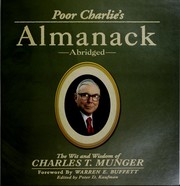
Poor Charlie's Almanack
Edited by Peter Kaufman; expanded Stripe Press edition published 2023.
Summary
The book collects Munger's speeches, talks and writings, edited by Peter Kaufman, with Munger's own commentary added. The centrepiece is the argument for a latticework of mental models drawn from many disciplines. Munger says that a person who knows only finance will force every problem into finance, and that competence requires the big ideas from psychology, mathematics, physics, biology, engineering and accounting held together well enough to be used.
The most cited section is The Psychology of Human Misjudgment, a talk that lists twenty-five standard causes of human error, including incentive-caused bias, liking and disliking distortion, doubt avoidance, inconsistency avoidance, deprival superreaction, social proof and what Munger calls lollapalooza effects, where several biases act at once in the same direction. He built the list from observation rather than from academic psychology, and he criticises academic psychology for not teaching the interactions.
The investing material argues for extreme concentration in a few understandable businesses bought at sensible prices, for inverting problems, for using checklists, and for staying inside a circle of competence with a clearly marked edge. Munger's talks on worldly wisdom in business include his account of how Coca-Cola could have been built from first principles, which is the clearest published example of his reasoning method.
The book has real limits. It repeats itself, because the speeches were given to different audiences over decades. Its editions are expensive and physically large, though a free authorised version now exists. Munger's psychology list is not a research literature and some items overlap or lack evidence. His investment advice presupposes a temperament and a capital base most readers do not have. It works best as a source of reasoning habits rather than as a method to copy.
Key takeaways 8
- A person needs eighty to ninety models from multiple disciplines to think competently, because a single discipline forces every problem into the wrong shape.
- Incentives explain more behaviour than intelligence or intention does, and anyone analysing a situation should identify who is paid for what before anything else.
- Inverting a problem, by asking what would guarantee failure and then avoiding it, solves questions that direct reasoning cannot.
- Several psychological biases acting together in the same direction produce effects far larger than the sum of the individual biases.
- Extreme concentration in a few well-understood businesses beats diversification for an investor who does the work.
- A great business bought at a fair price beats a fair business bought at a great price, which is the change Munger pushed Buffett to make.
- Knowing the boundary of your competence matters more than the size of that competence.
- Avoiding standard stupidities produces better lifetime results than pursuing brilliance.
Who should read it
Investors who want the reasoning method behind Berkshire's decisions, and anyone building a checklist for their own recurring errors.
About Charlie Munger
Vice-chairman, Berkshire Hathaway 1978-2023; chairman, Wesco Financial and Daily Journal Corporation
His latticework-of-mental-models talks reframed investing as applied multidisciplinary psychology and are quoted as a primary source across fields.
Berkshire Hathaway, Wesco Financial, Daily Journal Corporation
Who recommended it 28 · 9 direct
“…books I've recommended, highlighted to death, or forced on friends.”
“I think if you assimilate everything in that simple book [Poor Charlie's Almanack] you will know a lot more than about 95 percent of your compatriots. And it's not that hard to do.”
“if you want to get to know Charlie, you can't do it properly without reading Poor Charlie's Almanack... Get the book.”
“Another book that should be in the hall of fame is Poor Charlie's Almanack by Peter D. Kaufman. This great book goes well beyond the field of finance and into philosophy and life values.”
“is by far the most comprehensive publication that captures the essence of Charlie's philosophy... I treated the book as a treasure and read it cover to cover multiple times.”
“Poor Charlie's Almanack, which is a great read and something that every serious investor should go back to read periodically.”
“if you haven't read Poor Charlie's Almanack I think that should be the number one book.”
“You will never find a book with more useful ideas.”
Similar books 6
Chosen by shared topics, the entries that hold them, and the people who recommended both.
Builds out Munger's latticework idea from primary sources.
“…books I've recommended, highlighted to death, or forced on friends.” — Andrew Wilkinson
Source: Andrew Wilkinson's Bookshelf, neverenough.com
Recommended by: Andrew Wilkinson, Nat Eliason and 8 others
Synthesis of his mental-models framework, not a life.
“…books I've recommended, highlighted to death, or forced on friends.” — Andrew Wilkinson
Source: Andrew Wilkinson's Bookshelf, neverenough.com
Recommended by: Andrew Wilkinson, Christopher Bloomstran and 7 others
Kahneman's synthesis of behavioral economics is the cognitive science underpinning every negotiation tactic. Anchoring, loss aversion, framing effects, and the planning fallacy — understanding why these biases operate, not just that they exist, makes you harder to exploit and more honest about your own irrationality.
“…books I've recommended, highlighted to death, or forced on friends.” — Andrew Wilkinson
Source: Andrew Wilkinson's Bookshelf, neverenough.com
Recommended by: Andrew Wilkinson, Charles de Vaulx and 32 others
Dialogue form; Munger's inversion habit worked through systematically.
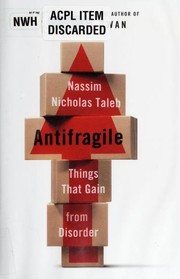
Incerto volume 4
“Nassim Taleb, author of the new book Antifragile, praises volatility and criticises those who would artificially damp it at great unseen cost. Taleb advises us to be 'anti-fragile'. This is exactly…” — Seth Klarman
Source: Klarman on Taleb's praise of volatility and what Baupost strives for
Recommended by: Mohnish Pabrai, Nat Eliason and 25 others
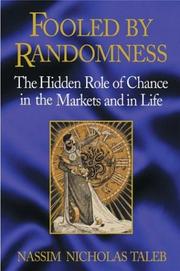
Why people mistake luck for skill, above all in markets.
“Fooled by Randomness is a serious, intellectually sophisticated book, well worth reading carefully. At times, the book is condescending. Nevertheless, there are some great insights.” — Barton Biggs
Source: Biggs on a sophisticated book worth reading carefully
Recommended by: Barton Biggs, Michael Mauboussin and 11 others
Where it sits in the reference 10
Topics