
Charlie Munger: The Complete Investor
Synthesis of his mental-models framework, not a life.
Summary
Griffin organises Munger's publicly stated views into a structured treatment of the Graham value investing system as Munger practises it. Munger did not write or authorise it, and the material comes from speeches, Berkshire and Wesco meeting transcripts and published interviews.
The book's organising claim is that Munger's approach reduces to four principles from Graham, which are treating a share as a claim on a business, requiring a margin of safety, treating the market as a servant rather than a guide, and being rational. Griffin then adds the elements Munger contributed, which are the multidisciplinary latticework of mental models, the psychology of misjudgment, and the shift toward paying fair prices for high-quality businesses.
The most useful chapters cover the worldly wisdom framework and the treatment of moats. Griffin sets out the categories of competitive advantage Munger looks for, including supply-side and demand-side economies of scale, brand, regulatory position and network effects, and connects them to the requirement that a business earn high returns on capital over long periods.
Griffin is a technology executive and investor rather than a professional investor, and the book is a synthesis rather than original research. Readers who have read Poor Charlie's Almanack will find most of the content familiar and better stated in Munger's own words. The advantage of Griffin's version is organisation, since the Almanack is a collection of speeches with heavy repetition. The book adds a useful appendix of Munger quotations by topic. It does not engage with any criticism of the approach or with cases where Munger was wrong.
Key takeaways 8
- Munger's method combines Graham's four core principles with a multidisciplinary set of models and a systematic list of psychological errors.
- A share should be treated as a fractional claim on a business, which makes business analysis rather than price analysis the work.
- Buying a wonderful business at a fair price beats buying a fair business at a wonderful price, which was Munger's departure from Graham.
- Investors should concentrate heavily in a few positions they understand rather than diversify across positions they do not.
- The circle of competence is defined by its boundary, and knowing where the boundary sits matters more than how much it encloses.
- Waiting without acting is the correct behaviour most of the time, and the pressure to do something destroys more capital than bad analysis does.
- Checklists compensate for the fact that knowing about psychological errors does not prevent committing them.
- Return on capital over long periods identifies a durable business, while growth alone identifies nothing.
Who should read it
Investors who want Munger's approach in organised form, though his own collected talks state it better if the reader can tolerate the repetition.
Who recommended it 9 · 4 direct
“…books I've recommended, highlighted to death, or forced on friends.”
“The two I'd recommend that I thoroughly enjoyed are Damn Right... and Charlie Munger: The Complete Investor by Tren Griffin.”
Similar books 6
Chosen by shared topics, the entries that hold them, and the people who recommended both.
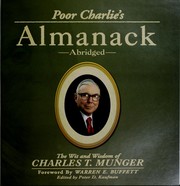
Speeches making the case for a latticework of mental models from many fields.
“…books I've recommended, highlighted to death, or forced on friends.” — Andrew Wilkinson
Source: Andrew Wilkinson's Bookshelf, neverenough.com
Recommended by: Andrew Wilkinson, Charlie Munger and 26 others

Builds out Munger's latticework idea from primary sources.
“…books I've recommended, highlighted to death, or forced on friends.” — Andrew Wilkinson
Source: Andrew Wilkinson's Bookshelf, neverenough.com
Recommended by: Andrew Wilkinson, Nat Eliason and 8 others
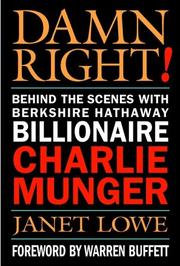
The only full biography; written with Munger's cooperation.
“The two I'd recommend that I thoroughly enjoyed are Damn Right: Behind the Scenes with Berkshire Hathaway Billionaire Charlie Munger by Janet Lowe” — Christopher Bloomstran
Source: Semper Augustus 2023 Letter to Clients, 'Worldly Wisdom', p. 81
Recommended by: Christopher Bloomstran, Mohnish Pabrai
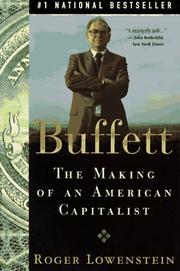
Buffett's life from Omaha and Graham's class to building Berkshire Hathaway.
“…books I've recommended, highlighted to death, or forced on friends.” — Andrew Wilkinson
Source: Andrew Wilkinson's Bookshelf, neverenough.com
Recommended by: Andrew Wilkinson, Christopher Bloomstran and 12 others
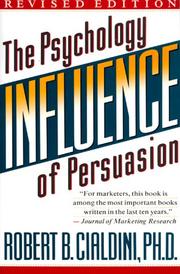
Six principles of compliance, from reciprocity to scarcity, and how sellers use them.
“…books I've recommended, highlighted to death, or forced on friends.” — Andrew Wilkinson
Source: Andrew Wilkinson's Bookshelf, neverenough.com
Recommended by: Andrew Wilkinson, Charlie Munger and 29 others
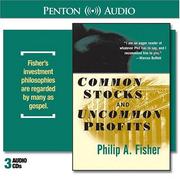
Buy a few outstanding growth companies, research them by scuttlebutt, and hold.
“The late Philip Fisher wrote several books that are very good [including] Common Stocks and Uncommon Profits.” — Arnold Van Den Berg
Source: Van Den Berg on Fisher's books
Recommended by: Arnold Van Den Berg, Bill Stewart and 10 others
Where it sits in the reference 4
Topics