Updates

  1. Person pages list letters, writing, profiles and links as sortable tables with filters, and show each person's companies as links; Fund letters show each letter's description in its own column.
  2. Experts show a checked job title and a short description of each person; 30 more people have photographs.
  3. Every company, fund, university and publication the experts work for has a page listing the people there.
  4. Fund letters show each letter's thesis and filter by it; 225 person pages list the essays, columns and newsletter issues the person wrote.
  5. Person pages list every essay and newsletter issue a person wrote, and their own books as a table in List view.
  6. Recommends shows the five largest kinds of book and the rest under More; browse pictures load sooner.
  7. Podcasts and talks link the original episode, filter by Audio and video or Press, and list each publisher once.
  8. Pages are wider, Recommends has List and Grid, and a filter clicked again turns off.
  9. Book cards sit in a ruled grid with Open Library and Goodreads links and each book's one-line note.
  10. Funds is now Investors; each investor's styles are buttons that filter the table.
  11. Podcasts and talks on a person's page filter by year and publisher and show as a list or a grid of pictures.
  12. Quotes show only people's own words: 472 summaries written by list sites are gone.
  13. Country pages open from Browse again, and every link on the shelf lands on a page.
  14. Subject and person pages show their sections as tabs, and each book appears once on a person's page.
  15. Book cards show the quote, who said it and the source; grids show five cards to a row.
  16. On a phone, a menu holds the sections, search, Updates, Feedback and dark mode.
  17. Feedback takes a screenshot of the page with no browser prompt, opens a screenshot full size when you click it, and clears itself once sent.
  18. Book cards are centred, search names the topic each book sits in, and any text cut short shows whole on hover.
  19. Search groups its results by kind: people, companies, geographies, subjects, topics, books, funds, fund letters and papers.
  20. The Books table lists who recommended each book by name, and the browser tab names the section you are in.
  21. Feedback can take a screenshot of the page, or one you paste or choose, and opens in the corner beside Updates.
  22. Each rail button reopens its section where you left it, and Browse, Table and People show on every book and subject page.
  23. Filters grey out choices that hold nothing instead of hiding them, and Books › People filters by authors or recommenders.
  24. Feedback takes a subject line and up to three screenshots.
  25. Biographies are grouped by the person they are about: 41 new pages, from Abraham Lincoln to Lee Kuan Yew.
  26. Sport splits into 23 sports, and Religion into one topic per faith.
  27. Book lists show as cards: the cover, one recommendation quote and every recommender by name.
  28. Seventeen subjects that had two or three pages under different names now have one page each.
  29. Every page lists its Experts as authors and recommenders, with a link to them on the Experts tab.
  30. Economics, Financial history, Financial panics and Accounting are subjects of their own, with one page per financial crisis.
  31. Book, person and subject pages open inside the app, so the tabs stay in view.
  32. 996 more book covers, and photographs or logos for 227 more people and companies.
  33. Books › Browse shows every subject as cards, and the rail holds Fund letters, Papers, Experts, Books and Funds.
  34. Every topic over 150 books splits into narrower topics, each with a page of its own.

Send feedback

What is it?
Screenshots, up to 3 (optional)
or paste one with Ctrl+V

We use your email only to reply to you.

Argentina's Economic Reforms of the 1990s in

Argentina's Economic Reforms of the 1990s in Contemporary and Historical Perspective

Domingo Cavallo, Sonia Cavallo Runde
2017
T3 307 pages · about 5h 7m to read Open Librarygoodreads

Insider: the economy minister who built convertibility defending the record.

Summary

The reference has not verified this book in detail; the summary states only what the title, author and subject establish.

Cavallo served as Argentina's economy minister from 1991 to 1996, when he designed and implemented the convertibility regime, and again briefly in 2001 during the collapse. This volume presents his account and defence of the reforms, written with Sonia Cavallo Runde.

The reference has not verified the book's detailed contents. What the authorship establishes is the perspective: the architect of convertibility explaining what the programme was intended to do, what it achieved, and why he considers the collapse attributable to subsequent decisions rather than to the design.

The reforms covered include the Convertibility Law of 1991 fixing the peso to the dollar with reserve backing, which ended hyperinflation within months; the privatisation of state enterprises including telecommunications, energy, water and the airline; trade liberalisation and Mercosur; the deregulation of domestic markets; tax reform; and the partial privatisation of the pension system.

Cavallo's general position, stated in his subsequent writing, is that convertibility worked as designed, that the fiscal deficits of the later 1990s and particularly provincial spending undermined it, that the Brazilian devaluation of 1999 and dollar strength imposed an external shock the country could have absorbed with better fiscal policy, and that the 2001 and 2002 handling of the exit, including the deposit freeze and the asymmetric conversion of dollar contracts, caused damage beyond what was necessary.

Readers should treat this as the responsible official's defence and read it against Mussa's assessment and Blustein's account, both in this reference, and against the critics who hold that the regime was unsustainable by design.

Key takeaways 7

  1. The Convertibility Law fixed the peso to the dollar with reserve backing and ended hyperinflation within months.
  2. Privatisation of state enterprises transferred loss-making operations off the budget and attracted foreign investment.
  3. Cavallo attributes the collapse to fiscal deficits and provincial spending rather than to the exchange rate regime itself.
  4. The 1999 Brazilian devaluation and dollar strength imposed an external shock that better fiscal policy could have absorbed.
  5. The handling of the exit in 2001 and 2002 caused damage beyond what leaving the regime required.
  6. A currency board's credibility rests on the government's willingness to accept the fiscal discipline it implies.
  7. This is the architect's own defence and should be read against the assessments of those who judge the design unsustainable.

Who should read it

Readers studying the Argentine crisis who want the responsible minister's own account, read against the critical assessments.

Similar books 6

Chosen by shared topics, the entries that hold them, and the people who recommended both.
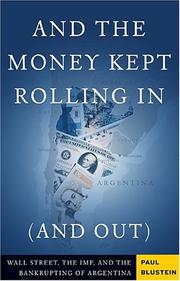
Paul Blustein · 2005

How Argentina and the IMF headed toward the 2001 default and devaluation.
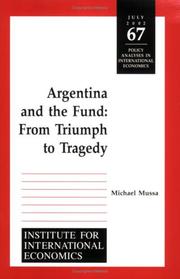
Michael Mussa · 2002

The IMF's own former chief economist on the Fund's failures in Argentina.

Joseph Collins, John Lear · 1995

The critical case; distributional costs behind the headline growth numbers.

Javier Martínez, Alvaro Díaz · 1996

How the productive structure and business class were remade after 1973.

Sebastian Edwards · 1995

Latin America's reforms from the 1980s debt crisis to the mid-1990s, assessed.

Raúl Gallegos · 2016

The mechanics of subsidised fuel, multiple exchange rates and arbitrage as a national industry.

Where it sits in the reference 3

Geographies
Economics
Geographies

Topics

EconomicsPolitics and Government