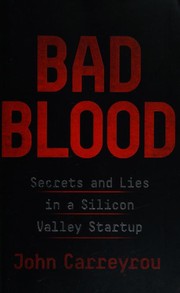
Bad Blood: Secrets and Lies in a Silicon Valley Startup
How Theranos reached a $9 billion value with blood tests that never worked.
By the WSJ reporter who exposed the fraud; no serious rival account exists.
Summary
Carreyrou reconstructs the rise and collapse of Theranos, the blood-testing company founded by Elizabeth Holmes that reached a valuation of nine billion dollars while its technology never worked. He broke the story at the Wall Street Journal in 2015 and the book expands that reporting with about one hundred and fifty interviews, sixty of them former employees.
The technical claim was that a proprietary device could run hundreds of tests from a finger-prick sample. It could not. Theranos ran most patient samples on modified commercial analysers from Siemens, diluting the small samples in ways that pushed results outside validated ranges, while presenting the results as produced by its own device. Patients received incorrect results in a live clinical setting through the Walgreens partnership.
Carreyrou documents the mechanisms that kept it running: extreme compartmentalisation so no employee saw the whole picture, aggressive litigation and non-disclosure enforcement by David Boies, a board of former statesmen with no scientific or diagnostic expertise including Kissinger, Shultz and Mattis, and investors who did not obtain audited financials or independent technical validation. The treatment of whistleblowers, particularly Tyler Shultz, is the book's moral centre.
The reporting is careful and the sourcing is documented. Carreyrou is a participant in the story, which he acknowledges in the final chapters. The book is less interested in explaining why sophisticated investors failed to conduct diligence than in narrating what happened, so readers looking for a systematic analysis of diligence failure will have to extract it. Holmes was convicted on four counts of fraud in 2022 and is serving a prison sentence.
Key takeaways 8
- Theranos never had working technology, and ran patient samples on modified commercial analysers while claiming its own device produced the results.
- Investors committed hundreds of millions without audited financial statements or independent technical validation of the core claim.
- A board composed of prominent people without domain expertise provided credibility to outsiders while performing no oversight function.
- Extreme internal compartmentalisation prevented employees from assembling evidence of the fraud and made each one doubt their own observation.
- Aggressive legal threats against departing employees suppressed disclosure for years and worked because individuals could not fund a defence.
- Regulatory gaps around laboratory-developed tests allowed the company to operate clinically without the validation a device approval would have required.
- Journalists and regulators acted only after former employees accepted substantial personal risk to speak.
- Applying software development practice, including shipping before the product works, to a medical diagnostic caused direct harm to patients.
Who should read it
Investors and board members who want a documented case of diligence failure, and founders considering how far ahead of the product a narrative can run.
Who recommended it 10 · 2 direct
Similar books 6
Chosen by shared topics, the entries that hold them, and the people who recommended both.
How Enron used mark-to-market accounting and hidden deals until its 2001 bankruptcy.
“Two other books I’d recommend are The Smartest Guys in the Room by Bethany McLean and Peter Elkind, and In an Uncertain World by Bob Rubin.” — Warren Buffett
Source: Berkshire Hathaway Chairman’s Letter 2003, page 20
Recommended by: Andrew Wilkinson, Bill Gurley and 2 others
How Jho Low diverted billions from Malaysia's 1MDB fund into parties and politics.
Recommended by: Alexis Ohanian, Alfred Lin and 5 others
Enron's collapse told scene by scene from depositions, emails and interviews.
“We have to grow EBITDA. That’s all that matters.” See Kurt Eichenwald, Conspiracy of Fools: A True Story (New York: Broadway Books, 2005), 278” — Michael Mauboussin
Source: What Does an EV/EBITDA Multiple Mean?, page 18
Recommended by: Michael Mauboussin, Mohnish Pabrai
How a running-shoe importer became Nike, surviving one cash crisis after another.
“…books I've recommended, highlighted to death, or forced on friends.” — Andrew Wilkinson
Source: Andrew Wilkinson's Bookshelf, neverenough.com
Recommended by: Andrew Wilkinson, Bill Gates, Bill Gurley and 27 others
How Uber grew on subsidies and aggression until its founder was pushed out in 2017.
“But, the best book of last weekend was Super Pumped: The Battle for Uber by Mike Isaac.” — Brad Feld
Source: Book: Super Pumped: The Battle for Uber — Feld Thoughts
Recommended by: Brad Feld, Alexis Ohanian, Andrew Wilkinson and 4 others
How one trader's losses destroyed Barings, Britain's oldest merchant bank, in 1995.
Where it sits in the reference 3
Topics 3
As an Amazon Associate I earn from qualifying purchases.