Updates

  1. Person pages list letters, writing, profiles and links as sortable tables with filters, and show each person's companies as links; Fund letters show each letter's description in its own column.
  2. Experts show a checked job title and a short description of each person; 30 more people have photographs.
  3. Every company, fund, university and publication the experts work for has a page listing the people there.
  4. Fund letters show each letter's thesis and filter by it; 225 person pages list the essays, columns and newsletter issues the person wrote.
  5. Person pages list every essay and newsletter issue a person wrote, and their own books as a table in List view.
  6. Recommends shows the five largest kinds of book and the rest under More; browse pictures load sooner.
  7. Podcasts and talks link the original episode, filter by Audio and video or Press, and list each publisher once.
  8. Pages are wider, Recommends has List and Grid, and a filter clicked again turns off.
  9. Book cards sit in a ruled grid with Open Library and Goodreads links and each book's one-line note.
  10. Funds is now Investors; each investor's styles are buttons that filter the table.
  11. Podcasts and talks on a person's page filter by year and publisher and show as a list or a grid of pictures.
  12. Quotes show only people's own words: 472 summaries written by list sites are gone.
  13. Country pages open from Browse again, and every link on the shelf lands on a page.
  14. Subject and person pages show their sections as tabs, and each book appears once on a person's page.
  15. Book cards show the quote, who said it and the source; grids show five cards to a row.
  16. On a phone, a menu holds the sections, search, Updates, Feedback and dark mode.
  17. Feedback takes a screenshot of the page with no browser prompt, opens a screenshot full size when you click it, and clears itself once sent.
  18. Book cards are centred, search names the topic each book sits in, and any text cut short shows whole on hover.
  19. Search groups its results by kind: people, companies, geographies, subjects, topics, books, funds, fund letters and papers.
  20. The Books table lists who recommended each book by name, and the browser tab names the section you are in.
  21. Feedback can take a screenshot of the page, or one you paste or choose, and opens in the corner beside Updates.
  22. Each rail button reopens its section where you left it, and Browse, Table and People show on every book and subject page.
  23. Filters grey out choices that hold nothing instead of hiding them, and Books › People filters by authors or recommenders.
  24. Feedback takes a subject line and up to three screenshots.
  25. Biographies are grouped by the person they are about: 41 new pages, from Abraham Lincoln to Lee Kuan Yew.
  26. Sport splits into 23 sports, and Religion into one topic per faith.
  27. Book lists show as cards: the cover, one recommendation quote and every recommender by name.
  28. Seventeen subjects that had two or three pages under different names now have one page each.
  29. Every page lists its Experts as authors and recommenders, with a link to them on the Experts tab.
  30. Economics, Financial history, Financial panics and Accounting are subjects of their own, with one page per financial crisis.
  31. Book, person and subject pages open inside the app, so the tabs stay in view.
  32. 996 more book covers, and photographs or logos for 227 more people and companies.
  33. Books › Browse shows every subject as cards, and the rail holds Fund letters, Papers, Experts, Books and Funds.
  34. Every topic over 150 books splits into narrower topics, each with a page of its own.

Send feedback

What is it?
Screenshots, up to 3 (optional)
or paste one with Ctrl+V

We use your email only to reply to you.

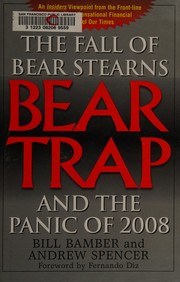
Bear Trap: The Fall of Bear Stearns and the

Bear Trap: The Fall of Bear Stearns and the Panic of 2008

Bill Bamber, Andrew Spencer
2008
T4 235 pages · about 3h 55m to read Open Librarygoodreads

Insider account by a former Bear senior managing director.

Summary

The reference has not verified this book in detail; the summary states only what the title, author and subject establish.

Bamber, a former senior managing director at Bear Stearns, wrote this with Andrew Spencer as an insider account of the firm's collapse in March 2008.

The reference has not verified the book's detailed claims. The established facts are that Bear Stearns was the smallest of the major American investment banks, had the highest leverage, was heavily concentrated in mortgage securities and in the repurchase agreement funding market, and had two internal hedge funds holding subprime-related assets that collapsed in mid-2007 and were partially supported by the firm. Over four days in March 2008, counterparties and prime brokerage clients withdrew, repurchase agreement lenders refused to roll funding, and the firm's liquidity fell from around eighteen billion dollars to nothing. The Federal Reserve arranged a sale to JPMorgan Chase, initially at two dollars a share and revised to ten, with the Federal Reserve taking on a portfolio of the firm's assets.

Bamber's argument, as insiders at the firm generally argued, is that Bear Stearns was solvent and was destroyed by a loss of confidence that became self-fulfilling, that rumours circulated by market participants with short positions contributed, and that the firm was allowed to fail in a way that other institutions were not.

That framing is contested. The firm's leverage, its asset concentration and its dependence on overnight secured funding meant it could not survive any loss of confidence, which is a solvency question rather than only a liquidity one. Cohan's House of Cards is the more thorough account. Read this as a participant's defence.

Key takeaways 7

  1. Bear Stearns had the highest leverage of the major American investment banks and the greatest concentration in mortgage securities.
  2. Dependence on overnight repurchase agreement funding meant the firm needed to refinance a large balance sheet every day.
  3. The firm's liquidity fell from around eighteen billion dollars to nothing within four days once counterparties withdrew.
  4. Supporting its own failed internal hedge funds in 2007 signalled to the market that the firm stood behind exposures it had not disclosed.
  5. Prime brokerage clients withdrawing removed both funding and revenue simultaneously, which accelerated the collapse.
  6. The Federal Reserve took on a portfolio of the firm's assets to enable the sale, which was the first such intervention of the crisis.
  7. The insider claim that the firm was solvent and destroyed by rumour does not address whether its funding structure could have survived any loss of confidence.

Who should read it

Readers wanting the insider's defence of Bear Stearns, with Cohan's account for the fuller record.

Similar books 6

Chosen by shared topics, the entries that hold them, and the people who recommended both.
William D. Cohan · 2009

Bear Stearns's ten-day collapse in March 2008, and the firm's history before it.

Recommended by: Mohnish Pabrai
Kate Kelly · 2009

The last three days of Bear Stearns in March 2008, hour by hour.
Andrew Ross Sorkin · 2009

Inside the meetings of bankers and regulators during the 2008 financial crisis.

David Wessel · 2009

The Federal Reserve under Bernanke in the 2008 crisis, August 2007 to spring 2009.

Recommended by: Bill Gates
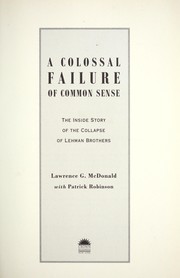
Lawrence G. McDonald, Patrick Robinson · 2009

Lehman Brothers' fall seen from its trading floor, and the warnings it ignored.

David Enrich · 2020

How Deutsche Bank became an aggressive global investment bank, and what followed.

Where it sits in the reference 2

Companies
Financial panics

Topics

Company HistoriesFinance and Markets