Updates

  1. Person pages list letters, writing, profiles and links as sortable tables with filters, and show each person's companies as links; Fund letters show each letter's description in its own column.
  2. Experts show a checked job title and a short description of each person; 30 more people have photographs.
  3. Every company, fund, university and publication the experts work for has a page listing the people there.
  4. Fund letters show each letter's thesis and filter by it; 225 person pages list the essays, columns and newsletter issues the person wrote.
  5. Person pages list every essay and newsletter issue a person wrote, and their own books as a table in List view.
  6. Recommends shows the five largest kinds of book and the rest under More; browse pictures load sooner.
  7. Podcasts and talks link the original episode, filter by Audio and video or Press, and list each publisher once.
  8. Pages are wider, Recommends has List and Grid, and a filter clicked again turns off.
  9. Book cards sit in a ruled grid with Open Library and Goodreads links and each book's one-line note.
  10. Funds is now Investors; each investor's styles are buttons that filter the table.
  11. Podcasts and talks on a person's page filter by year and publisher and show as a list or a grid of pictures.
  12. Quotes show only people's own words: 472 summaries written by list sites are gone.
  13. Country pages open from Browse again, and every link on the shelf lands on a page.
  14. Subject and person pages show their sections as tabs, and each book appears once on a person's page.
  15. Book cards show the quote, who said it and the source; grids show five cards to a row.
  16. On a phone, a menu holds the sections, search, Updates, Feedback and dark mode.
  17. Feedback takes a screenshot of the page with no browser prompt, opens a screenshot full size when you click it, and clears itself once sent.
  18. Book cards are centred, search names the topic each book sits in, and any text cut short shows whole on hover.
  19. Search groups its results by kind: people, companies, geographies, subjects, topics, books, funds, fund letters and papers.
  20. The Books table lists who recommended each book by name, and the browser tab names the section you are in.
  21. Feedback can take a screenshot of the page, or one you paste or choose, and opens in the corner beside Updates.
  22. Each rail button reopens its section where you left it, and Browse, Table and People show on every book and subject page.
  23. Filters grey out choices that hold nothing instead of hiding them, and Books › People filters by authors or recommenders.
  24. Feedback takes a subject line and up to three screenshots.
  25. Biographies are grouped by the person they are about: 41 new pages, from Abraham Lincoln to Lee Kuan Yew.
  26. Sport splits into 23 sports, and Religion into one topic per faith.
  27. Book lists show as cards: the cover, one recommendation quote and every recommender by name.
  28. Seventeen subjects that had two or three pages under different names now have one page each.
  29. Every page lists its Experts as authors and recommenders, with a link to them on the Experts tab.
  30. Economics, Financial history, Financial panics and Accounting are subjects of their own, with one page per financial crisis.
  31. Book, person and subject pages open inside the app, so the tabs stay in view.
  32. 996 more book covers, and photographs or logos for 227 more people and companies.
  33. Books › Browse shows every subject as cards, and the rail holds Fund letters, Papers, Experts, Books and Funds.
  34. Every topic over 150 books splits into narrower topics, each with a page of its own.

Send feedback

What is it?
Screenshots, up to 3 (optional)
or paste one with Ctrl+V

We use your email only to reply to you.

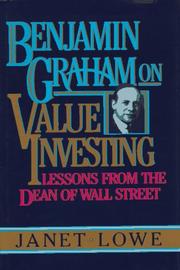
Benjamin Graham on Value Investing

Benjamin Graham on Value Investing

Janet Lowe
1994
T3 246 pages · about 4h 6m to read Open Librarygoodreads

Part life, part method; based on interviews with his circle.

Summary

Lowe wrote a biography of Benjamin Graham covering his childhood poverty after his father's death and his mother's losses in the 1907 panic, his education at Columbia, his career on Wall Street, the losses of 1929 to 1932, the writing of Security Analysis with David Dodd, his teaching at Columbia, the Graham-Newman partnership, and his later years.

The investment content covers the development of his method: the insistence on quantitative criteria that could be applied without forecasting, the margin of safety, the net current asset approach that bought companies below liquidation value, and the Mr Market device. She covers his major investment, GEICO, which he bought in 1948 in a position that violated his own diversification rules and which eventually accounted for more of the partnership's profits than everything else combined, a fact Graham noted with some discomfort about what it implied for his method.

The biographical material covers his personal life, which was complicated, his literary and classical interests, his work on commodity reserve currency proposals, and his late-career statement that detailed security analysis had become unrewarding as the market became better analysed, which is the position most likely to unsettle his followers.

Lowe is a journalist and the book is accessible rather than scholarly. The reference has not verified its specific claims. It is a biography rather than a method book, and readers wanting Graham's approach should read The Intelligent Investor or Security Analysis directly.

Key takeaways 7

  1. Graham's method was designed to be applied without forecasting, using quantitative criteria that could be checked from published statements.
  2. The margin of safety, meaning buying substantially below a conservatively estimated value, is the concept Graham considered central to his entire approach.
  3. His largest single profit came from GEICO, a concentrated position that violated his own diversification rules and produced more than everything else combined.
  4. Graham's formation included his family's loss of savings in the 1907 panic and his own losses from 1929 to 1932, which shaped the emphasis on capital preservation.
  5. He concluded late in life that detailed individual security analysis had become unrewarding as the market became better analysed by more participants.
  6. Treating market quotations as offers from a business partner rather than as information about value is the psychological discipline the method requires.
  7. The reference has not verified the specific biographical claims in this account.

Who should read it

Investors interested in Graham's life and the origins of his method, with his own books as the source for the method itself.

About Janet Lowe

American financial journalist and biographer of Charlie Munger, Benjamin Graham, Warren Buffett and Bill Miller.

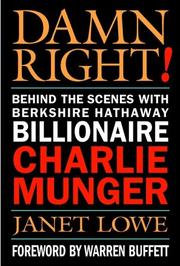
Damn Right! is the standard full-length life of Charlie Munger, built from interviews with Munger, his family and his partners, and the Graham volumes put writings and lectures that had gone out of print back in circulation. The books supply the biographical record behind quotations that circulate everywhere else without sources.

Who recommended it 1 · 1 direct

Similar books 6

Chosen by shared topics, the entries that hold them, and the people who recommended both.
Benjamin Graham · 1996

Published posthumously; edited by Seymour Chatman.

Recommended by: Mohnish Pabrai

Janet Lowe · 2000

The only full biography; written with Munger's cooperation.

“The two I'd recommend that I thoroughly enjoyed are Damn Right: Behind the Scenes with Berkshire Hathaway Billionaire Charlie Munger by Janet Lowe” — Christopher Bloomstran

Source: Semper Augustus 2023 Letter to Clients, 'Worldly Wisdom', p. 81

Recommended by: Christopher Bloomstran, Mohnish Pabrai

Joe Carlen · 2012

The only full biography; workmanlike rather than definitive.

Recommended by: Mohnish Pabrai

Where it sits in the reference 2

Journalists
Biographies

Topics

InvestingBiography and MemoirInvestors, Traders and Gamblers