Updates

  1. Person pages list letters, writing, profiles and links as sortable tables with filters, and show each person's companies as links; Fund letters show each letter's description in its own column.
  2. Experts show a checked job title and a short description of each person; 30 more people have photographs.
  3. Every company, fund, university and publication the experts work for has a page listing the people there.
  4. Fund letters show each letter's thesis and filter by it; 225 person pages list the essays, columns and newsletter issues the person wrote.
  5. Person pages list every essay and newsletter issue a person wrote, and their own books as a table in List view.
  6. Recommends shows the five largest kinds of book and the rest under More; browse pictures load sooner.
  7. Podcasts and talks link the original episode, filter by Audio and video or Press, and list each publisher once.
  8. Pages are wider, Recommends has List and Grid, and a filter clicked again turns off.
  9. Book cards sit in a ruled grid with Open Library and Goodreads links and each book's one-line note.
  10. Funds is now Investors; each investor's styles are buttons that filter the table.
  11. Podcasts and talks on a person's page filter by year and publisher and show as a list or a grid of pictures.
  12. Quotes show only people's own words: 472 summaries written by list sites are gone.
  13. Country pages open from Browse again, and every link on the shelf lands on a page.
  14. Subject and person pages show their sections as tabs, and each book appears once on a person's page.
  15. Book cards show the quote, who said it and the source; grids show five cards to a row.
  16. On a phone, a menu holds the sections, search, Updates, Feedback and dark mode.
  17. Feedback takes a screenshot of the page with no browser prompt, opens a screenshot full size when you click it, and clears itself once sent.
  18. Book cards are centred, search names the topic each book sits in, and any text cut short shows whole on hover.
  19. Search groups its results by kind: people, companies, geographies, subjects, topics, books, funds, fund letters and papers.
  20. The Books table lists who recommended each book by name, and the browser tab names the section you are in.
  21. Feedback can take a screenshot of the page, or one you paste or choose, and opens in the corner beside Updates.
  22. Each rail button reopens its section where you left it, and Browse, Table and People show on every book and subject page.
  23. Filters grey out choices that hold nothing instead of hiding them, and Books › People filters by authors or recommenders.
  24. Feedback takes a subject line and up to three screenshots.
  25. Biographies are grouped by the person they are about: 41 new pages, from Abraham Lincoln to Lee Kuan Yew.
  26. Sport splits into 23 sports, and Religion into one topic per faith.
  27. Book lists show as cards: the cover, one recommendation quote and every recommender by name.
  28. Seventeen subjects that had two or three pages under different names now have one page each.
  29. Every page lists its Experts as authors and recommenders, with a link to them on the Experts tab.
  30. Economics, Financial history, Financial panics and Accounting are subjects of their own, with one page per financial crisis.
  31. Book, person and subject pages open inside the app, so the tabs stay in view.
  32. 996 more book covers, and photographs or logos for 227 more people and companies.
  33. Books › Browse shows every subject as cards, and the rail holds Fund letters, Papers, Experts, Books and Funds.
  34. Every topic over 150 books splits into narrower topics, each with a page of its own.

Send feedback

What is it?
Screenshots, up to 3 (optional)
or paste one with Ctrl+V

We use your email only to reply to you.

Warren Buffett Speaks - Wit and Wisdom of th

Warren Buffett Speaks - Wit and Wisdom of the World's Greatest Investor

Janet Lowe
1997
T3 248 pages · about 4h 8m to read Open Librarygoodreads

Summary

Lowe collected quotations from Buffett drawn from shareholder letters, annual meeting transcripts, interviews and speeches, and organised them by subject with brief connecting commentary. The categories cover his early life and Omaha, his views on business, his investment principles, his opinions on Wall Street, management, taxation, inheritance and philanthropy.

The book supplies the quotable Buffett rather than the analytical one. Familiar formulations appear here in their original context, including his remarks on the margin of safety, on the difference between price and value, on the institutional imperative, on why he prefers businesses that a fool could run, on the effect of costs and activity on investor returns, and on his intention not to leave large fortunes to his children.

Lowe's commentary is light and biographical rather than interpretive.

The limitation is straightforward. Buffett's shareholder letters are freely published and Lawrence Cunningham's arranged edition of them organises the same material with the reasoning attached. A quotation collection strips the argument from the conclusion, which suits browsing but not study. The book is also from 1997 and predates most of Berkshire's later acquisitions, its scale problems, and Buffett's later positions on technology holdings and on succession.

Key takeaways 7

  1. Buffett judges an investment by the business's economics over a decade rather than by the security's price behaviour.
  2. He prefers businesses with economics so favourable that competent management is not required for adequate results.
  3. Activity and cost, not market direction, account for most of the gap between market returns and investor returns.
  4. The institutional imperative pushes managers to imitate peers and to resist changing direction, and Buffett treats it as the main destroyer of corporate value.
  5. He argues that large inherited fortunes damage the recipients and that he intends to give his own away.
  6. Buffett attributes much of his own advantage to temperament rather than to intelligence or information.
  7. He has consistently argued that most investors should hold index funds because they will not beat the market after costs.

Who should read it

Readers who want Buffett's formulations to hand for reference, though the shareholder letters themselves are freely available and contain the reasoning.

About Janet Lowe

American financial journalist and biographer of Charlie Munger, Benjamin Graham, Warren Buffett and Bill Miller.

Damn Right! is the standard full-length life of Charlie Munger, built from interviews with Munger, his family and his partners, and the Graham volumes put writings and lectures that had gone out of print back in circulation. The books supply the biographical record behind quotations that circulate everywhere else without sources.

Who recommended it 1 · 1 direct

Similar books 6

Chosen by shared topics, the entries that hold them, and the people who recommended both.
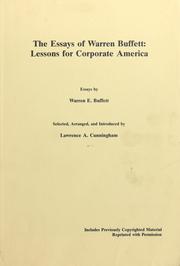
Warren Buffett, Lawrence A. Cunningham · 1997

Berkshire's shareholder letters arranged by topic: governance, valuation, mergers.

“The resource is as valuable as Larry Cunningham's The Essays of Warren Buffett, which similarly organizes by subject matter” — Christopher Bloomstran

Source: Semper Augustus 2024 Letter to Clients, 'Books and Tunes for Walking', p. 96

Recommended by: Christopher Bloomstran, Francois Rochon and 11 others

Andrew Kilpatrick · 1994

Sprawling, repeatedly expanded compendium of Buffett material.

Recommended by: Mohnish Pabrai

Carol J. Loomis · 2012

Fortune's articles by and about Buffett from 1966 to 2012, with commentary.

“I hope many people, even those who think they know Warren well, will read it cover to cover.” — Bill Gates

Source: Gates Notes review of Tap Dancing to Work

Recommended by: Bill Gates, Guy Spier, Mohnish Pabrai and 2 others

Where it sits in the reference 3

Journalists
Investment styles
Biographies

Topics

InvestingBiography and MemoirInvestors, Traders and Gamblers