Updates

  1. Person pages list letters, writing, profiles and links as sortable tables with filters, and show each person's companies as links; Fund letters show each letter's description in its own column.
  2. Experts show a checked job title and a short description of each person; 30 more people have photographs.
  3. Every company, fund, university and publication the experts work for has a page listing the people there.
  4. Fund letters show each letter's thesis and filter by it; 225 person pages list the essays, columns and newsletter issues the person wrote.
  5. Person pages list every essay and newsletter issue a person wrote, and their own books as a table in List view.
  6. Recommends shows the five largest kinds of book and the rest under More; browse pictures load sooner.
  7. Podcasts and talks link the original episode, filter by Audio and video or Press, and list each publisher once.
  8. Pages are wider, Recommends has List and Grid, and a filter clicked again turns off.
  9. Book cards sit in a ruled grid with Open Library and Goodreads links and each book's one-line note.
  10. Funds is now Investors; each investor's styles are buttons that filter the table.
  11. Podcasts and talks on a person's page filter by year and publisher and show as a list or a grid of pictures.
  12. Quotes show only people's own words: 472 summaries written by list sites are gone.
  13. Country pages open from Browse again, and every link on the shelf lands on a page.
  14. Subject and person pages show their sections as tabs, and each book appears once on a person's page.
  15. Book cards show the quote, who said it and the source; grids show five cards to a row.
  16. On a phone, a menu holds the sections, search, Updates, Feedback and dark mode.
  17. Feedback takes a screenshot of the page with no browser prompt, opens a screenshot full size when you click it, and clears itself once sent.
  18. Book cards are centred, search names the topic each book sits in, and any text cut short shows whole on hover.
  19. Search groups its results by kind: people, companies, geographies, subjects, topics, books, funds, fund letters and papers.
  20. The Books table lists who recommended each book by name, and the browser tab names the section you are in.
  21. Feedback can take a screenshot of the page, or one you paste or choose, and opens in the corner beside Updates.
  22. Each rail button reopens its section where you left it, and Browse, Table and People show on every book and subject page.
  23. Filters grey out choices that hold nothing instead of hiding them, and Books › People filters by authors or recommenders.
  24. Feedback takes a subject line and up to three screenshots.
  25. Biographies are grouped by the person they are about: 41 new pages, from Abraham Lincoln to Lee Kuan Yew.
  26. Sport splits into 23 sports, and Religion into one topic per faith.
  27. Book lists show as cards: the cover, one recommendation quote and every recommender by name.
  28. Seventeen subjects that had two or three pages under different names now have one page each.
  29. Every page lists its Experts as authors and recommenders, with a link to them on the Experts tab.
  30. Economics, Financial history, Financial panics and Accounting are subjects of their own, with one page per financial crisis.
  31. Book, person and subject pages open inside the app, so the tabs stay in view.
  32. 996 more book covers, and photographs or logos for 227 more people and companies.
  33. Books › Browse shows every subject as cards, and the rail holds Fund letters, Papers, Experts, Books and Funds.
  34. Every topic over 150 books splits into narrower topics, each with a page of its own.

Send feedback

What is it?
Screenshots, up to 3 (optional)
or paste one with Ctrl+V

We use your email only to reply to you.

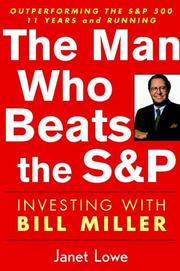
The Man Who Beats the S&P: Investing with Bi

The Man Who Beats the S&P: Investing with Bill Miller

Janet Lowe
2002
T3 262 pages · about 4h 22m to read Open Librarygoodreads

Summary

Lowe wrote a profile of Bill Miller during the run in which his Legg Mason Value Trust beat the S&P 500 in each calendar year from 1991 through 2005. The book was published in 2002, in the middle of that streak.

The substantive content concerns Miller's definition of value. He rejected the identification of value investing with low price-to-earnings or low price-to-book ratios, arguing instead that value means paying less than the present value of future free cash flow, which can be true of a company trading at a high multiple if the growth is durable. On that basis he bought technology and internet companies including America Online, Dell and later Amazon, which put him outside the value community of the time. Lowe also covers his interest in complexity theory and the Santa Fe Institute, his concentration in relatively few positions, his willingness to average down, and his low portfolio turnover.

The book is admiring and written before the outcome. Miller's fund lost roughly two thirds of its value in 2008 after large positions in financial stocks and homebuilders, and he underperformed heavily in the years around the crisis, which reframes the earlier record. Statisticians also pointed out that the calendar-year streak was partly an artefact of measuring in January-to-December windows.

Read it for the argument about what value means, which was ahead of its time and has since become the mainstream position, and discount the treatment of the streak as evidence of skill.

Key takeaways 7

  1. Value means paying less than the present value of future cash flows, so a high accounting multiple does not make a stock expensive.
  2. Low price-to-book and low price-to-earnings screens select for businesses in decline as often as for bargains.
  3. Miller bought technology and internet companies on value grounds while the value community treated them as untouchable.
  4. A concentrated portfolio with low turnover is the practical consequence of holding a genuine differentiated view.
  5. Averaging down is correct when the analysis is unchanged and wrong when the price fall is information.
  6. Miller drew on complexity and adaptive systems research to argue that competitive advantage can persist longer than models assume.
  7. A fifteen-year run of calendar-year outperformance is weaker evidence of skill than it appears once measurement windows are varied.

Who should read it

Investors interested in the argument that growth and value are the same calculation, who should read it against an account of Miller's 2008 losses.

About Janet Lowe

American financial journalist and biographer of Charlie Munger, Benjamin Graham, Warren Buffett and Bill Miller.

Damn Right! is the standard full-length life of Charlie Munger, built from interviews with Munger, his family and his partners, and the Graham volumes put writings and lectures that had gone out of print back in circulation. The books supply the biographical record behind quotations that circulate everywhere else without sources.

Who recommended it 1 · 1 direct

Similar books 6

Chosen by shared topics, the entries that hold them, and the people who recommended both.
Philip L. Carret, Philip Carret · 1995

A fund manager of sixty years on investing, business and a long life.

Recommended by: Mohnish Pabrai
Guy Spier · 2014

Spier on the psychology and habits behind durable value investing.

“…books I've recommended, highlighted to death, or forced on friends.” — Andrew Wilkinson

Source: Andrew Wilkinson's Bookshelf, neverenough.com

Recommended by: Andrew Wilkinson, Christopher Bloomstran and 1 other
Where it sits in the reference 2

Journalists
Investment styles

Topics

InvestingBiography and MemoirInvestors, Traders and GamblersValue investors