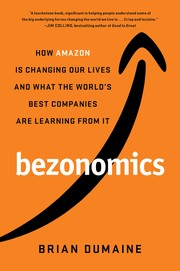
Bezonomics
Amazon's business model and its flywheel, from interviews with staff and rivals.
Business-model analysis rather than a life.
Summary
Dumaine, a former Fortune editor, wrote an account of Amazon's business model and its effects, based on interviews with executives, competitors, suppliers, workers and analysts.
The model he describes centres on what Amazon calls the flywheel: lower prices attract customers, more customers attract third-party sellers, more sellers widen selection, wider selection attracts more customers, and the resulting scale lowers cost, permitting lower prices. Dumaine adds that machine learning now runs inside every loop, setting prices, forecasting demand, routing inventory, recommending products and allocating advertising, which he argues compounds the advantage in a way that earlier retail scale did not. He treats Prime as the mechanism that converts customers into subscribers whose purchasing shifts almost entirely to the platform, and Amazon Web Services as the profit source that funded a decade of retail investment at low margin.
He also covers the costs: warehouse working conditions and injury rates, the effect on suppliers and on brands that become dependent on the platform, the use of third-party seller data, the effect on physical retail, and the regulatory questions.
The reporting is competent and the book is a reasonable single-volume description of Amazon around 2019. It does not attempt original analysis of the economics and it takes the flywheel framing largely from Amazon's own account of itself. Brad Stone's two books cover the corporate history more thoroughly. It predates the pandemic surge, the union campaigns, the antitrust cases brought in the United States and Europe, and the slowdown and cost reductions that followed, so the treatment of Amazon's trajectory is now dated.
Key takeaways 7
- Amazon's flywheel connects price, selection and scale so that improvement in any one reinforces the others.
- Amazon Web Services generated the profit that funded a decade of retail expansion at margins competitors could not sustain.
- Prime converts customers into subscribers whose purchasing consolidates onto the platform rather than being split across retailers.
- Machine learning applied to pricing, forecasting and routing compounds a scale advantage that older retailers could not extract.
- Third-party sellers supply selection without Amazon holding the inventory risk, while paying fees that have grown into a major revenue line.
- Brands that grow on the platform become dependent on it and lose the customer relationship and the data that come with it.
- Advertising revenue from sellers competing for placement has become a large profit source that changes what customers see.
Who should read it
Operators and investors who want a readable single-volume description of how Amazon's model works and what it does to suppliers and competitors.
Similar books 6
Chosen by shared topics, the entries that hold them, and the people who recommended both.
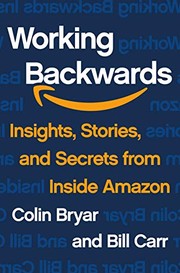
Amazon's operating mechanisms, from leadership principles to the six-page memo.
Recommended by: Jeff Bezos
How corporate governance brought down Nortel Networks, the Canadian technology firm.
“You may understand why I say this if you read the recent book on Nortel’s bankruptcy ‘‘100 Days: The rush to judgment that killed Nortel’’, by James Bagnall.” — Prem Watsa
Source: Chairman's Letter to Shareholders 2013, page 6
Recommended by: Mohnish Pabrai, Prem Watsa

An eyewitness account of how Ford and the American car industry undid themselves.
Recommended by: Mohnish Pabrai

The story of the Walgreens drugstore chain and the American history around it.
Recommended by: Mohnish Pabrai
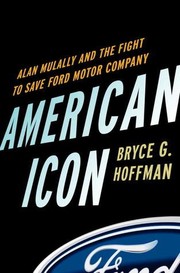
How Alan Mulally turned Ford around and saved it without bankruptcy.
Recommended by: Mohnish Pabrai

How General Motors succeeded in China: its people, decisions and breaks.
Recommended by: Mohnish Pabrai