Updates

  1. Person pages list letters, writing, profiles and links as sortable tables with filters, and show each person's companies as links; Fund letters show each letter's description in its own column.
  2. Experts show a checked job title and a short description of each person; 30 more people have photographs.
  3. Every company, fund, university and publication the experts work for has a page listing the people there.
  4. Fund letters show each letter's thesis and filter by it; 225 person pages list the essays, columns and newsletter issues the person wrote.
  5. Person pages list every essay and newsletter issue a person wrote, and their own books as a table in List view.
  6. Recommends shows the five largest kinds of book and the rest under More; browse pictures load sooner.
  7. Podcasts and talks link the original episode, filter by Audio and video or Press, and list each publisher once.
  8. Pages are wider, Recommends has List and Grid, and a filter clicked again turns off.
  9. Book cards sit in a ruled grid with Open Library and Goodreads links and each book's one-line note.
  10. Funds is now Investors; each investor's styles are buttons that filter the table.
  11. Podcasts and talks on a person's page filter by year and publisher and show as a list or a grid of pictures.
  12. Quotes show only people's own words: 472 summaries written by list sites are gone.
  13. Country pages open from Browse again, and every link on the shelf lands on a page.
  14. Subject and person pages show their sections as tabs, and each book appears once on a person's page.
  15. Book cards show the quote, who said it and the source; grids show five cards to a row.
  16. On a phone, a menu holds the sections, search, Updates, Feedback and dark mode.
  17. Feedback takes a screenshot of the page with no browser prompt, opens a screenshot full size when you click it, and clears itself once sent.
  18. Book cards are centred, search names the topic each book sits in, and any text cut short shows whole on hover.
  19. Search groups its results by kind: people, companies, geographies, subjects, topics, books, funds, fund letters and papers.
  20. The Books table lists who recommended each book by name, and the browser tab names the section you are in.
  21. Feedback can take a screenshot of the page, or one you paste or choose, and opens in the corner beside Updates.
  22. Each rail button reopens its section where you left it, and Browse, Table and People show on every book and subject page.
  23. Filters grey out choices that hold nothing instead of hiding them, and Books › People filters by authors or recommenders.
  24. Feedback takes a subject line and up to three screenshots.
  25. Biographies are grouped by the person they are about: 41 new pages, from Abraham Lincoln to Lee Kuan Yew.
  26. Sport splits into 23 sports, and Religion into one topic per faith.
  27. Book lists show as cards: the cover, one recommendation quote and every recommender by name.
  28. Seventeen subjects that had two or three pages under different names now have one page each.
  29. Every page lists its Experts as authors and recommenders, with a link to them on the Experts tab.
  30. Economics, Financial history, Financial panics and Accounting are subjects of their own, with one page per financial crisis.
  31. Book, person and subject pages open inside the app, so the tabs stay in view.
  32. 996 more book covers, and photographs or logos for 227 more people and companies.
  33. Books › Browse shows every subject as cards, and the rail holds Fund letters, Papers, Experts, Books and Funds.
  34. Every topic over 150 books splits into narrower topics, each with a page of its own.

Send feedback

What is it?
Screenshots, up to 3 (optional)
or paste one with Ctrl+V

We use your email only to reply to you.

By Force of Thought

By Force of Thought

János Kornai
2006
T2 472 pages · about 7h 52m to read Open Librarygoodreads

Memoir by the economist who advised the reforms from inside the system.

Summary

Kornai wrote this memoir late in life, covering his intellectual development from a young communist journalist in postwar Hungary to the economist who produced the definitive analysis of the socialist system.

The personal narrative is a record of the period. Kornai came from an assimilated Jewish family; his father was killed at Auschwitz. He joined the party and worked as an economic journalist, believing in the system. His disillusionment came through investigative work: assigned to report on the textile and light industry sectors, he found the shortages, hoarding and irrational behaviour that his later theoretical work would explain. He was dismissed after 1956, interrogated, and spent years outside the academic establishment.

The intellectual narrative traces the development of his ideas. Overcentralization, his 1957 dissertation, was among the first empirical critiques of central planning published inside the bloc. His work on two-level planning with Tamas Liptak applied mathematical methods and won international attention. Anti-Equilibrium challenged general equilibrium theory. Economics of Shortage established the theory that shortage in socialist economies is systemic rather than a planning failure, and introduced the soft budget constraint. The Socialist System, published as the system collapsed, brought it together.

He is candid about the compromises: what he could and could not publish, the self-censorship, and the position of a critic permitted to operate within limits.

The memoir is long and the intellectual sections assume interest in the ideas. Its value is as a record of how economic thinking developed inside a system its practitioners could not openly criticise, and of what it costs to do serious work under those conditions.

Key takeaways 7

  1. Kornai's critique of central planning developed from empirical investigation of specific industries rather than from theory.
  2. Overcentralization, published in 1957, was among the first empirical critiques of planning to appear inside the socialist bloc.
  3. Shortage in socialist economies is systemic rather than a failure of planning, which is the central finding of his career.
  4. The soft budget constraint, meaning that a firm expects rescue if it loses money, explains the behaviour that produces shortage.
  5. Working as a critic inside the system required self-censorship and acceptance of limits on what could be published.
  6. Kornai's early belief in the system and his disillusionment through investigation shaped what he chose to study.
  7. Serious analytical work was possible inside the bloc but carried personal costs including dismissal and interrogation.

Who should read it

Readers interested in how economic ideas developed under socialism and in the personal position of an analyst working inside a system he came to reject.

Similar books 6

Chosen by shared topics, the entries that hold them, and the people who recommended both.

János Kornai · 1979

A theory of socialist economies, where chronic shortage is the normal state.
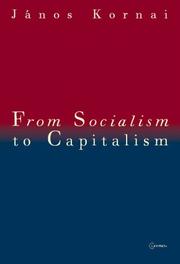
János Kornai · 2008

Eight essays on the post-1989 move from socialism to capitalism.
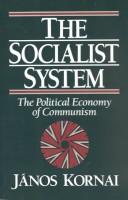
János Kornai · 1992

How socialist economies really worked: soft budgets, shortage and party power.

Ivan T. Berend · 1996

Economic history that explains the industrial base the Czechs privatised.

Marcin Piatkowski · 2018

How Poland achieved Europe's fastest sustained growth after 1989.
Tadeusz Kowalik · 2011

The critique of the transition's distributional cost.

Where it sits in the reference 2

Geographies
Economics

Topics

Biography and MemoirEconomicsPolitics and GovernmentScientists, Doctors and ThinkersEurope, Britain and Russia