Updates

  1. Person pages list letters, writing, profiles and links as sortable tables with filters, and show each person's companies as links; Fund letters show each letter's description in its own column.
  2. Experts show a checked job title and a short description of each person; 30 more people have photographs.
  3. Every company, fund, university and publication the experts work for has a page listing the people there.
  4. Fund letters show each letter's thesis and filter by it; 225 person pages list the essays, columns and newsletter issues the person wrote.
  5. Person pages list every essay and newsletter issue a person wrote, and their own books as a table in List view.
  6. Recommends shows the five largest kinds of book and the rest under More; browse pictures load sooner.
  7. Podcasts and talks link the original episode, filter by Audio and video or Press, and list each publisher once.
  8. Pages are wider, Recommends has List and Grid, and a filter clicked again turns off.
  9. Book cards sit in a ruled grid with Open Library and Goodreads links and each book's one-line note.
  10. Funds is now Investors; each investor's styles are buttons that filter the table.
  11. Podcasts and talks on a person's page filter by year and publisher and show as a list or a grid of pictures.
  12. Quotes show only people's own words: 472 summaries written by list sites are gone.
  13. Country pages open from Browse again, and every link on the shelf lands on a page.
  14. Subject and person pages show their sections as tabs, and each book appears once on a person's page.
  15. Book cards show the quote, who said it and the source; grids show five cards to a row.
  16. On a phone, a menu holds the sections, search, Updates, Feedback and dark mode.
  17. Feedback takes a screenshot of the page with no browser prompt, opens a screenshot full size when you click it, and clears itself once sent.
  18. Book cards are centred, search names the topic each book sits in, and any text cut short shows whole on hover.
  19. Search groups its results by kind: people, companies, geographies, subjects, topics, books, funds, fund letters and papers.
  20. The Books table lists who recommended each book by name, and the browser tab names the section you are in.
  21. Feedback can take a screenshot of the page, or one you paste or choose, and opens in the corner beside Updates.
  22. Each rail button reopens its section where you left it, and Browse, Table and People show on every book and subject page.
  23. Filters grey out choices that hold nothing instead of hiding them, and Books › People filters by authors or recommenders.
  24. Feedback takes a subject line and up to three screenshots.
  25. Biographies are grouped by the person they are about: 41 new pages, from Abraham Lincoln to Lee Kuan Yew.
  26. Sport splits into 23 sports, and Religion into one topic per faith.
  27. Book lists show as cards: the cover, one recommendation quote and every recommender by name.
  28. Seventeen subjects that had two or three pages under different names now have one page each.
  29. Every page lists its Experts as authors and recommenders, with a link to them on the Experts tab.
  30. Economics, Financial history, Financial panics and Accounting are subjects of their own, with one page per financial crisis.
  31. Book, person and subject pages open inside the app, so the tabs stay in view.
  32. 996 more book covers, and photographs or logos for 227 more people and companies.
  33. Books › Browse shows every subject as cards, and the rail holds Fund letters, Papers, Experts, Books and Funds.
  34. Every topic over 150 books splits into narrower topics, each with a page of its own.

Send feedback

What is it?
Screenshots, up to 3 (optional)
or paste one with Ctrl+V

We use your email only to reply to you.

From Solidarity to Sellout

From Solidarity to Sellout

Tadeusz Kowalik
2011
T3 366 pages · about 6h 6m to read Open Librarygoodreads

The critique of the transition's distributional cost.

Summary

Kowalik, a Polish economist who had advised Solidarity during its formation and who had been part of the reform economics tradition, wrote a critical account of the Polish transition.

His argument is that the transition betrayed the movement that made it possible. Solidarity in 1980 and 1981 was a workers' movement demanding self-management, workplace democracy and a socialised economy under worker control, and its programme documents said so. What was implemented after 1989 was a rapid liberalisation and privatisation programme designed by a small group of economists and advisers, which produced mass unemployment, sharply increased inequality, and the transfer of enterprises to managers, foreign investors and connected parties rather than to the workers whose movement had brought down the previous system.

He attacks the Balcerowicz programme specifically: the price liberalisation combined with a wage control mechanism that suppressed wages while prices rose, the monetary tightening that produced a deeper contraction than necessary, the exchange rate policy, and the sequencing that opened the economy before domestic firms could compete. He argues that a slower transition with worker ownership and stronger social protection was available and was rejected for ideological reasons.

He also examines the outcome: unemployment that persisted for years, regions where the closure of a single enterprise removed the local economy, and an inequality increase from a very low starting point.

Kowalik writes from an explicitly social democratic position and against the consensus among Polish economists. Piatkowski's Europe's Growth Champion, also in this reference, presents the favourable account of the same period. Poland's aggregate record over three decades is the strongest response to Kowalik, though the distributional and regional points he raises are supported by the evidence and connect to the subsequent political reaction.

Key takeaways 7

  1. Solidarity's own programme demanded worker self-management and a socialised economy, not the liberalisation that followed.
  2. The transition programme was designed by a small group of economists and advisers rather than by the movement that made it possible.
  3. Price liberalisation combined with wage suppression transferred income from workers during the adjustment.
  4. Monetary tightening produced a deeper contraction than the stabilisation required.
  5. Enterprises were transferred to managers, foreign investors and connected parties rather than to workers.
  6. Unemployment persisted for years and was concentrated in regions where a single enterprise had been the local economy.
  7. A slower transition with worker ownership and stronger protection was available and was rejected on ideological grounds.

Who should read it

Readers who want the critical account of the Polish transition from a participant in the movement that preceded it, read against the favourable assessments.

Similar books 6

Chosen by shared topics, the entries that hold them, and the people who recommended both.

Marcin Piatkowski · 2018

How Poland achieved Europe's fastest sustained growth after 1989.

Anders Aslund, Anders Åslund · 2007

Comparative transition account; Czech vouchers judged against other sequencing choices.

Jeffrey Sachs · 1993

The case for Poland's 1990 shock therapy, from an adviser to the programme.

Jane Hardy · 2009

Foreign investment, labour and the costs of the transition, told critically.
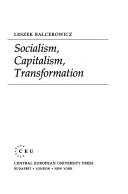
Leszek Balcerowicz · 1995

Essays on moving from socialism to markets by Poland's reforming finance minister.

Ivan T. Berend · 1996

Economic history that explains the industrial base the Czechs privatised.

Where it sits in the reference 2

Geographies
Economics

Topics

EconomicsPolitics and GovernmentGeneral HistoryModern Europe and RussiaEurope, Britain and Russia