Updates

  1. Fund letters lists 118 more letters, each with its own page: 44 weekly commentaries by Jeremy Siegel from 2026, 31 issues of Van Tharp's newsletter from 2018, 23 Pabrai Investment Funds letters from 2021 to Q3 2026, 13 Efficient Frontier essays by William Bernstein, Oakmark's three 3Q 2026 commentaries, two Lindsell Train reports, a John Hussman comment and Third Point's Q3 2026 letter.
  2. 2,027 more books carry a one-line description in the Books table and on their pages; 7,067 of 7,715 have one, every tier 1, 2 and 3 book among them.
  3. Fund letters lists 187 more letters from 19 firms, among them Permanent Equity, Social Capital, Lux Capital, Square Peg, Bestinver, Cobas, Sequoia Fund, Marketfield and EquityCompass; each shows on its investor's page and has a page of its own.
  4. 2,928 more books carry a one-line description in the Books table and on their pages, so every tier 1, 2 and 3 book has one; 5,040 in all.
  5. Every publication on Newsletters has its own page: its writing, its writers, its staff and who recommends it. Investor pages have a Management tab; a company's Experts tab now leaves out its own people, who list under Management. Tabs on a phone move sideways only.
  6. Every fund letter and research paper has its own page: the thesis, the PDF, the companies and books it names, and for 176 letters and 24 papers so far a summary, key insights and quotes with their page.
  7. 99 books that no page listed now sit under their topics in Books, among them Caste, American Prometheus and Pale Blue Dot.
  8. Newsletters lists every newspaper, magazine, investment newsletter, journal and blog the reference holds, 442 in all, with the people who write there. The search box keeps your last 20 searches. You can create an account.
  9. 283 books that fund managers recommend in their letters are on the shelf, each with the letter's own words and page; investor pages have a Recommends tab.
  10. Person, company, investor and show pages link their own accounts on X, Threads, Instagram, LinkedIn, YouTube and Substack: 275 people, 552 companies and organisations, 88 investors and 478 shows.
  11. 716 more book recommendations name their source: the person's own reading list, letter, blog post, speech or interview, or an article that reports it. 232 of them quote the person's own words about the book, on the book card and on the book's page.
  12. Every US-listed company has a page with its SEC filings. Company pages list their experts and their management, past and present. Fund managers sit under Investors. Each show has a page of its episodes, and an episode page names its guests and hosts. Biographies lists groups, then people. Breadcrumbs show where a page sits.
  13. Media lists every podcast episode, video, interview and talk, over 10,000, by person, company, publisher and event; each filter searches its own choices. Books opens on its table, then Browse, then Authors and Recommenders. A filter's count no longer covers its arrow.
  14. A book that no company, country or subject page lists shows its topics under Where it sits in the reference. On a phone, a page's tabs scroll sideways only. Descriptions read the same on every page. See them in the Experts tab lists every expert the page names.
  15. Every podcast episode, video and interview has its own page with a video or audio player and a link to the source. Investor pages show each company's sector and market cap; firms such as Berkshire Hathaway have one page that holds their letters and their company tabs. Letters tabs filter by company and search the theses. Companies filter by Public, Private and Defunct and link each company's website.
  16. Every tab, view and search has its own address, such as /books/table/asset or /letters/companies, so Back works and a link opens the same place. Page addresses no longer end in .html. Fund letters, Investors, Companies and Papers load about a fifth of the data they did.
  17. Fund letters has a Companies tab: every company the letters name, with its market cap, sector, country, and how many letters and investors name it. Investor pages link each investor's website. Lists in table cells end with “… and N more” at every width.
  18. 1,120 more book summaries; descriptions for 373 papers; pages for 137 more companies, each with the fund letters that discuss it; 215 official photographs; search has its own page.
  19. 411 more books have a summary; person pages list 930 more of the books they wrote; 147 people show their official photograph.
  20. Every investor has a page with its letters and the companies they discuss; company pages list the investors whose letters name them.
  21. A Companies section at the top of the rail lists every company the books, experts and fund letters name.
  22. Person pages list letters, writing, profiles and links as sortable tables with filters, and show each person's companies as links; Fund letters show each letter's description in its own column.
  23. Experts show a checked job title and a short description of each person; 30 more people have photographs.
  24. Every company, fund, university and publication the experts work for has a page listing the people there.
  25. Fund letters show each letter's thesis and filter by it; 225 person pages list the essays, columns and newsletter issues the person wrote.
  26. Person pages list every essay and newsletter issue a person wrote, and their own books as a table in List view.
  27. Recommends shows the five largest kinds of book and the rest under More; browse pictures load sooner.
  28. Podcasts and talks link the original episode, filter by Audio and video or Press, and list each publisher once.
  29. Pages are wider, Recommends has List and Grid, and a filter clicked again turns off.
  30. Book cards sit in a ruled grid with Open Library and Goodreads links and each book's one-line note.
  31. Funds is now Investors; each investor's styles are buttons that filter the table.
  32. Podcasts and talks on a person's page filter by year and publisher and show as a list or a grid of pictures.
  33. Quotes show only people's own words: 472 summaries written by list sites are gone.
  34. Country pages open from Browse again, and every link on the shelf lands on a page.
  35. Subject and person pages show their sections as tabs, and each book appears once on a person's page.
  36. Book cards show the quote, who said it and the source; grids show five cards to a row.
  37. On a phone, a menu holds the sections, search, Updates, Feedback and dark mode.
  38. Feedback takes a screenshot of the page with no browser prompt, opens a screenshot full size when you click it, and clears itself once sent.
  39. Book cards are centred, search names the topic each book sits in, and any text cut short shows whole on hover.
  40. Search groups its results by kind: people, companies, geographies, subjects, topics, books, funds, fund letters and papers.
  41. The Books table lists who recommended each book by name, and the browser tab names the section you are in.
  42. Feedback can take a screenshot of the page, or one you paste or choose, and opens in the corner beside Updates.
  43. Each rail button reopens its section where you left it, and Browse, Table and People show on every book and subject page.
  44. Filters grey out choices that hold nothing instead of hiding them, and Books › People filters by authors or recommenders.
  45. Feedback takes a subject line and up to three screenshots.
  46. Biographies are grouped by the person they are about: 41 new pages, from Abraham Lincoln to Lee Kuan Yew.
  47. Sport splits into 23 sports, and Religion into one topic per faith.
  48. Book lists show as cards: the cover, one recommendation quote and every recommender by name.
  49. Seventeen subjects that had two or three pages under different names now have one page each.
  50. Every page lists its Experts as authors and recommenders, with a link to them on the Experts tab.
  51. Economics, Financial history, Financial panics and Accounting are subjects of their own, with one page per financial crisis.
  52. Book, person and subject pages open inside the app, so the tabs stay in view.
  53. 996 more book covers, and photographs or logos for 227 more people and companies.
  54. Books › Browse shows every subject as cards, and the rail holds Fund letters, Papers, Experts, Books and Funds.
  55. Every topic over 150 books splits into narrower topics, each with a page of its own.

Send feedback

What is it?
Screenshots, up to 3 (optional)
or paste one with Ctrl+V

We use your email only to reply to you.

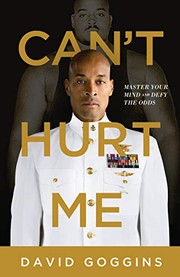
Can't Hurt Me

Can't Hurt Me

From abused child and 300-pound exterminator to Navy SEAL, and how to get tough.

David Goggins
2018
364 pages · about 6h 4m to read Open Librarygoodreads

Summary

Goggins tells his own story: an abusive childhood, a period weighing three hundred pounds working as an exterminator, three rounds of Navy SEAL training including two repeats of Hell Week, subsequent Army Ranger and Air Force tactical air control training, and an ultra-endurance running career that included a hundred-mile race with no preparation.

The method he extracts is deliberate accumulation of voluntary hardship. His concepts include the accountability mirror, meaning writing your actual failures on notes attached to a mirror and reading them daily; callusing the mind through repeated exposure to what you avoid; the forty percent rule, his claim that when a person believes they are finished they have used about forty percent of their capacity; taking souls, meaning outperforming someone who expects you to fail; and the cookie jar, meaning a mental store of past difficulties overcome, retrieved during present difficulty as evidence.

The book is structured with challenges at the end of each chapter that instruct the reader to do specific uncomfortable things.

The factual accuracy of some accounts has been questioned, and the forty percent figure has no basis in physiology as stated. Goggins describes extreme methods including running on fractured legs and severe overtraining, and the book does not distinguish between voluntary discomfort as a training method and injury that produces permanent damage. He has had multiple surgeries. The psychological argument, that avoiding discomfort compounds and that deliberately seeking it builds tolerance, is defensible. The specific practices should not be copied literally. Read it for the argument about self-imposed limits and the accountability mechanism, not as a training programme.

Key takeaways 8

  1. Most people stop far short of their physical and mental capacity, and the sensation of being finished arrives long before the actual limit.
  2. Writing your actual failures where you must see them daily produces change that private acknowledgment does not.
  3. Deliberately doing what you avoid, repeatedly, builds tolerance for discomfort that transfers to unrelated situations.
  4. A record of past difficulties overcome can be retrieved deliberately as evidence during present difficulty.
  5. Suffering that a person chooses is a different category from suffering imposed on them, and the first can be used as training.
  6. Blaming circumstances, however genuine, removes the only mechanism a person has for changing their situation.
  7. Being underestimated is an advantage that can be used deliberately by outperforming the expectation in front of the person holding it.
  8. Goggins describes training through fractures and severe injury, which produced lasting damage and should be read as a description rather than as instruction.

Who should read it

Readers who need a direct argument against their own self-imposed limits, with the extreme physical practices treated as biography rather than as a programme.

Who recommended it 10 · 2 direct

Ali Abdaalreported
Justin Kanreported
Nick Huberreported
Tim Ferrissreported

Similar books 6

Chosen by shared topics, the entries that hold them, and the people who recommended both.
Dan Harris · 2014

A news anchor's panic attack on air leads him to meditation, and what it did for him.

Viktor E. Frankl · 1968

Life in Nazi concentration camps, and logotherapy: finding meaning to survive.

“What's more certain to me is that we all need a why, as Viktor Frankl told us in Man's Search for Meaning.” — David Heinemeier Hansson

Source: Universal Basic Dead End

Recommended by: David Heinemeier Hansson, Frank Martin and 25 others

Jesse Itzler · 2015

An entrepreneur hires a Navy SEAL to live with and train him for a month.

Recommended by: Marc Andreessen
James Clear · 2016

Build habits by making them obvious, attractive, easy and satisfying.

“Last October, my friend James Clear published the breakout hit book, Atomic Habits. As we both discovered in the months that followed, we have many readers in common.” — Cal Newport

Source: The Atomic Minimalist: My Conversation with James Clear

Recommended by: Ali Abdaal, Balaji S. Srinivasan and 21 others
Ron Chernow · 1998

How Rockefeller built Standard Oil, faced its breakup and gave his fortune away.

“…books I've recommended, highlighted to death, or forced on friends.” — Andrew Wilkinson

Source: Andrew Wilkinson's Bookshelf, neverenough.com

Recommended by: Andrew Wilkinson, Austen Allred and 12 others

Where it sits in the reference 3

Health and FitnessBiography and MemoirPersonal and Spiritual Memoirs

As an Amazon Associate I earn from qualifying purchases.