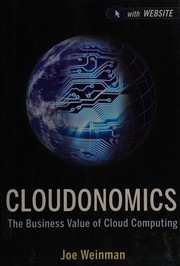
Cloudonomics
Mathematical models of when renting cloud computing beats owning capacity.
The maths of pay-per-use versus owned capacity.
Summary
Weinman, an engineer and executive who worked at AT&T and HP, wrote a quantitative treatment of when cloud computing is economically preferable to owned infrastructure, using explicit models rather than assertion.
His central results concern demand variability. Owned capacity must be sized for peak demand, so it is idle in proportion to the gap between peak and average. Utility capacity is paid for only when used but carries a price premium per unit. Weinman derives the condition under which the utility is cheaper: it depends on the ratio of peak to average demand and on the utility premium, and he shows that pay-per-use wins whenever the premium is less than the peak-to-average ratio. He extends this to hybrid arrangements, showing that the cost-minimising configuration typically owns capacity for the base load and rents for the peak, and he derives the optimal split.
He then treats the value of on-demand capacity separately from its cost. If demand cannot be forecast accurately, both over-provisioning and under-provisioning impose costs, and he models the penalty function to show that the value of elasticity rises with forecast error. Other chapters cover the economics of distributed nodes and latency, the statistics of aggregating uncorrelated demands, parallelism and the value of completing work faster, and the reliability mathematics of redundant components.
The book is unusual in the cloud literature for actually doing the arithmetic, and the models are simple enough to apply. The limitation is that they capture cost and capacity while omitting most of what drives cloud adoption in practice: managed services, developer productivity, security and compliance, and the cost of operating infrastructure staff. The pricing environment has also changed substantially since 2012, and the repatriation debate about large workloads moving back to owned hardware has produced evidence Weinman's framework accommodates but does not anticipate.
Key takeaways 7
- Owned capacity must be sized for peak demand, so its unused fraction equals the gap between peak and average utilisation.
- Pay-per-use is cheaper than ownership whenever the utility price premium is smaller than the ratio of peak to average demand.
- The cost-minimising configuration for most workloads owns the base load and rents the peak rather than choosing one model entirely.
- The value of on-demand capacity rises with forecast error, because both over-provisioning and under-provisioning carry costs.
- Aggregating many uncorrelated demand streams reduces the relative variability of the total, which is the source of a provider's cost advantage.
- Distributed nodes reduce latency and network cost, and the benefit follows a diminishing curve in the number of locations.
- Completing a task faster through parallelism has value independent of cost when the result has time-sensitive worth.
Who should read it
Technology operators and investors who want explicit models for infrastructure sourcing decisions rather than vendor arguments.
Similar books 6
Chosen by shared topics, the entries that hold them, and the people who recommended both.
Forecasts of how information technology and biotechnology will change business.
Recommended by: Mohnish Pabrai
How the new economics of information ends the trade-off between richness and reach.
“Evans, Philip, and Thomas S. Wurster, Blown to Bits: How the New Economics of Information Transforms Strategy (Boston: Harvard Business School Press, 1999)” — Michael Mauboussin
Source: Measuring the Moat: Assessing the Magnitude and Sustainability of Value Creation, page 48
Recommended by: Michael Mauboussin, Mohnish Pabrai
How technology can run businesses better and change the nature of business.
Recommended by: Mohnish Pabrai
Harvard Business Review articles on doing business in networked markets.
Recommended by: Mohnish Pabrai
How the internet lets organisations draw on the talent of the crowd.
“Great look at a different way of getting a project done: not outsourcing it to a person, but developing a system where thousands of people can contribute a little bit.” — Derek Sivers
Source: Derek Sivers book notes (primary, rated list) · Rating: 7/10
Recommended by: Derek Sivers, Marc Benioff

How technology has changed the way brands and businesses innovate and connect.
Recommended by: Gary Vaynerchuk