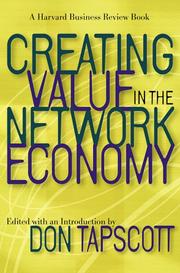
Creating Value in the Network Economy
Harvard Business Review articles on doing business in networked markets.
Summary
Tapscott edited this collection of Harvard Business Review articles and related pieces on doing business in networked markets, published in 1999 as a companion to his other work of the period.
The contributions cover the economics of information goods, disintermediation and re-intermediation, virtual organisations and outsourcing, the effect of networks on customer relationships, electronic commerce strategy, and the management of knowledge as an asset. Contributors include established management writers of the period.
The durable arguments in this literature concern the economics of goods with near-zero marginal cost, the effect of falling coordination costs on firm boundaries, and the shift of bargaining power toward customers who can compare offerings cheaply. Those have held up. The specific predictions about which companies and technologies would prevail, and the general expectation that established firms would be displaced rapidly, largely did not.
The reference has not verified the specific contents and contributors of this volume. It is a period collection assembled at the height of the first internet boom and should be read as a record of what informed opinion held at that moment rather than as current analysis. Shapiro and Varian's Information Rules, published in 1998, covers the same economics with analytical rigour and remains the standard reference. Readers should use that instead unless they specifically want the period document.
Key takeaways 7
- Information goods have near-zero marginal cost, which makes pricing a matter of value to the customer rather than of cost recovery.
- Falling coordination costs change the economic boundary of the firm, allowing networks of specialists to substitute for integrated organisations.
- Customers who can compare offerings cheaply gain bargaining power, which compresses margins in markets where the comparison is easy.
- Intermediaries whose function is moving information are removed, while intermediaries who add trust, curation or aggregation reappear in new forms.
- Knowledge assets constitute the principal value of information-era firms and appear nowhere in their accounts.
- The expectation that established firms would be rapidly displaced by networked entrants was largely not borne out.
- The reference has not verified this volume's specific contents, and Shapiro and Varian's Information Rules is the rigorous treatment of the same economics.
Who should read it
Readers interested in a 1999 period document, with Information Rules as the substantive source on network and information economics.
About Don Tapscott
Canadian business author and consultant, co-founder of the Blockchain Research Institute, who wrote The Digital Economy and Wikinomics.
The Digital Economy set out early how networks would redraw firm boundaries, and Wikinomics documented mass collaboration - open source, peer production, crowdsourced research - as a working production model rather than a curiosity. Blockchain Revolution extends the argument to distributed ledgers and their business applications.
Who recommended it 1 · 1 direct
Similar books 6
Chosen by shared topics, the entries that hold them, and the people who recommended both.
How cheap coordination lets crowds outside a firm do work firms once did.
“Lessons learned from Wikipedia can be applied to most other businesses. How can you harness the spare-time or self-interest of thousands to build something better for everyone?” — Derek Sivers
Source: Derek Sivers book notes (primary, rated list) · Rating: 7/10
Recommended by: Derek Sivers, Michael Mauboussin and 1 other

Forecasts of how information technology and biotechnology will change business.
Recommended by: Mohnish Pabrai
How the new economics of information ends the trade-off between richness and reach.
“Evans, Philip, and Thomas S. Wurster, Blown to Bits: How the New Economics of Information Transforms Strategy (Boston: Harvard Business School Press, 1999)” — Michael Mauboussin
Source: Measuring the Moat: Assessing the Magnitude and Sustainability of Value Creation, page 48
Recommended by: Michael Mauboussin, Mohnish Pabrai
How technology can run businesses better and change the nature of business.
Recommended by: Mohnish Pabrai
A manager's guide to electronic commerce and the technology behind it.
Recommended by: Mohnish Pabrai