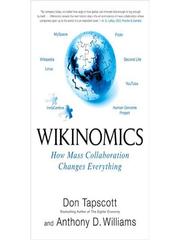
Wikinomics
How cheap coordination lets crowds outside a firm do work firms once did.
Summary
Tapscott and Williams argue that falling coordination costs allow large numbers of people outside a firm to collaborate on work that firms previously did internally, and that companies which organise for this outperform those that do not. They name four principles: being open, peering, sharing and acting globally.
The cases are the substance. Goldcorp published its geological data on the internet and offered prize money for identifying drilling targets, which produced discoveries its own geologists had missed. InnoCentive posted research problems from corporate laboratories and paid outside solvers, many of whom came from adjacent disciplines. Linux and Wikipedia illustrate peer production without price signals or managerial direction. Boeing's 787 programme is presented as distributed design across partner firms. Procter and Gamble's Connect and Develop programme sourced a growing share of innovation externally. The authors also cover what they call prosumers, meaning customers who modify and extend products, and ideagoras, meaning markets for problems and solutions.
The theoretical claim rests on Coase's account of the firm: firms exist because internal coordination is cheaper than market transactions, so falling transaction costs should shrink firm boundaries and increase outsourced collaboration.
The book is heavily promotional in tone and selects successful cases without examining failures. Several examples aged badly, most notably Boeing's 787, where distributed design produced years of delay and billions in overruns. The broader prediction that peer production would displace firm-based production has not happened at the scale claimed. What did happen instead, the concentration of platform power in a small number of companies that capture the value of user contributions, is largely absent from the analysis.
Key takeaways 7
- Falling coordination costs move the boundary of the firm outward, so work previously done internally can be sourced from outside contributors.
- Publishing proprietary data can produce more value than protecting it when outside solvers hold knowledge the firm lacks.
- Problems posted to open markets are often solved by people from adjacent disciplines rather than by specialists in the field.
- Peer production communities coordinate large complex projects without prices or managerial authority.
- Companies should measure the share of innovation sourced externally and treat internal research as one option among several.
- Customers who modify products are a source of product development, and firms that suppress them lose that contribution.
- Distributing design work across partner firms creates integration risk that the coordination savings may not cover.
Who should read it
Executives considering open innovation or external collaboration who should read the cases critically, since the failures are omitted.
About Don Tapscott
Canadian business author and consultant, co-founder of the Blockchain Research Institute, who wrote The Digital Economy and Wikinomics.
The Digital Economy set out early how networks would redraw firm boundaries, and Wikinomics documented mass collaboration - open source, peer production, crowdsourced research - as a working production model rather than a curiosity. Blockchain Revolution extends the argument to distributed ledgers and their business applications.
Who recommended it 3 · 3 direct
“Lessons learned from Wikipedia can be applied to most other businesses. How can you harness the spare-time or self-interest of thousands to build something better for everyone?”
“Don Tapscott and Anthony Williams, Wikinomics: How Mass Collaboration Changes Everything (New York: Portfolio, 2006)”
Similar books 6
Chosen by shared topics, the entries that hold them, and the people who recommended both.
Harvard Business Review articles on doing business in networked markets.
Recommended by: Mohnish Pabrai

How the new economics of information ends the trade-off between richness and reach.
“Evans, Philip, and Thomas S. Wurster, Blown to Bits: How the New Economics of Information Transforms Strategy (Boston: Harvard Business School Press, 1999)” — Michael Mauboussin
Source: Measuring the Moat: Assessing the Magnitude and Sustainability of Value Creation, page 48
Recommended by: Michael Mauboussin, Mohnish Pabrai
How the internet lets organisations draw on the talent of the crowd.
“Great look at a different way of getting a project done: not outsourcing it to a person, but developing a system where thousands of people can contribute a little bit.” — Derek Sivers
Source: Derek Sivers book notes (primary, rated list) · Rating: 7/10
Recommended by: Derek Sivers, Marc Benioff

A theory of modularity in design, applied to the history of the computer industry.
“Carliss Y. Baldwin and Kim B. Clark, Design Rules: The Power of Modularity (Cambridge, MA: MIT Press, 2000)” — Michael Mauboussin
Source: Cultivating Your Judgment Skills: A Framework for Improving the Quality of Decisions, page 12
Recommended by: Michael Mauboussin

Economics for information goods: pricing, versioning, lock-in and network effects.
“Carl Shapiro and Hal R. Varian, Information Rules (Boston, MA: Harvard Business School Press, 1999), 174” — Michael Mauboussin
Source: The Ecosystem Edge, page 10
Recommended by: Michael Mauboussin, Mohnish Pabrai and 1 other

Run a tech company for shareholder value by funding its core advantage.
“Moore’s forthcoming book, Living on the Fault Line: Managing for Shareholder Value in the Age of the Internet, is terrific and highly recommended.” — Michael Mauboussin
Source: Network to Net Worth: Exploring Network Dynamics, page 29
Recommended by: Michael Mauboussin