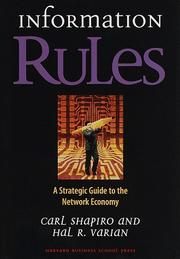
Information Rules
Economics for information goods: pricing, versioning, lock-in and network effects.
Lock-in, switching costs and versioning; still the sharpest account of information economics.
Summary
Shapiro and Varian, both economists who later worked at Google and in antitrust enforcement, apply industrial organisation economics to information goods. Their argument is that the technology changes and the economic principles do not, which is why they build the book from durable economics rather than from case descriptions.
The core economics is that information goods have high fixed cost and near-zero marginal cost, which means competitive pricing drives price to zero and no producer survives. Their prescriptions follow: price according to customer value rather than cost, differentiate products and prices across customer segments, and use versioning to let customers self-select into segments by offering deliberately degraded versions.
The second half concerns lock-in and networks. They analyse switching costs systematically, arguing that the total switching cost across a customer base is the relevant asset, and give the categories including contractual commitments, durable purchases, brand-specific training, information and databases, specialised suppliers, search costs and loyalty programmes. On networks they cover positive feedback, the choice between openness and control, standards wars and the strategic assets that determine who wins them, and the use of alliances to build a coalition around a standard.
The examples are from the 1990s and many are now unrecognisable, which readers should expect from a book published in 1998. The economics has held completely, and the analysis of versioning, switching costs and standards wars predicted the structure of the platform economy before it existed. It remains the best available treatment of why information markets concentrate.
Key takeaways 8
- Information goods have high fixed cost and near-zero marginal cost, so competitive pricing drives price toward zero and eliminates the producer.
- Information should be priced according to what it is worth to each customer rather than according to what it cost to produce.
- Versioning, meaning offering deliberately degraded versions at lower prices, lets customers sort themselves into segments without the seller identifying them.
- Switching costs across the whole customer base constitute the firm's principal asset, and they should be measured and managed directly.
- Lock-in follows a predictable cycle of brand selection, sampling, entrenchment and then the point where switching becomes uneconomic.
- Positive feedback means that the strong get stronger and the weak get weaker, which is why information markets concentrate rather than converge.
- Winning a standards war depends on assets including installed base, intellectual property, complementary products and brand, and these should be assessed before entering one.
- Openness and control are a trade-off between a larger total market and a larger captured share, and the correct choice depends on the strength of your existing position.
Who should read it
Founders and investors in software, platforms and information businesses who want the underlying economics of pricing, lock-in and standards.
Who recommended it 3 · 2 direct
“Carl Shapiro and Hal R. Varian, Information Rules (Boston, MA: Harvard Business School Press, 1999), 174”
Similar books 6
Chosen by shared topics, the entries that hold them, and the people who recommended both.

How platforms create value by matching groups, unlike linear pipeline businesses.
Recommended by: Reid Hoffman

How multi-sided platforms such as card networks get both sides on board at once.
“David S. Evans and Richard Schmalensee, Matchmakers: The New Economics of Multisided Platforms (Boston, MA: Harvard Business Review Press, 2016)” — Michael Mauboussin
Source: Measuring the Moat: Assessing the Magnitude and Sustainability of Value Creation
Recommended by: Michael Mauboussin
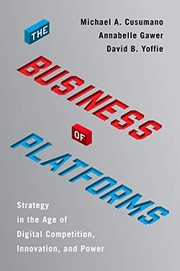
Innovation platforms and transaction platforms, and what each needs to succeed.
“See Michael A. Cusumano, Annabelle Gawer, and David B. Yoffie, The Business of Platforms: Strategy in the Age of Digital Competition, Innovation, and Power (New York: Harper Business, 2019), 107-138” — Michael Mauboussin
Source: Market Share: Understanding Competitive Advantage Through Market Power, page 42
Recommended by: Michael Mauboussin

How platform businesses connecting users differ from firms that make products.
“Alex Moazed and Nicholas L. Johnson, Modern Monopolies: What It Takes to Dominate in the 21st Century (New York: St. Martin’s Press, 2016)” — Michael Mauboussin
Source: Measuring the Moat: Assessing the Magnitude and Sustainability of Value Creation
Recommended by: Michael Mauboussin
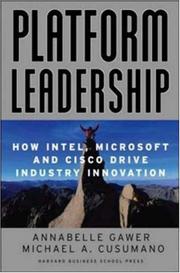
How Intel and others became and stayed leaders of technology platforms.
“Annabelle Gawer and Michael A. Cusumano, Platform Leadership (Boston, MA: Harvard Business School Press, 2002)” — Michael Mauboussin
Source: The Ecosystem Edge, page 10
Recommended by: Michael Mauboussin

Without shelf limits, sales of many niche products add up to rival the hits.
“also Chris Anderson, The Long Tail: Why the Future of Business Is Selling Less of More (New York: Hyperion, 2006), 121” — Michael Mauboussin
Source: Was Harry Potter Inevitable? Cumulative Advantage, Counterfactuals, and the Halo Effect, page 10
Recommended by: Jim Collins, Michael Mauboussin, Ev Williams and 2 others