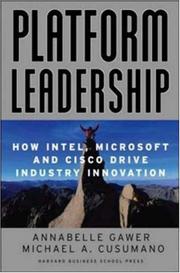
Platform Leadership
How Intel and others became and stayed leaders of technology platforms.
Intel, Microsoft, Cisco and the levers a platform owner pulls on its ecosystem.
Summary
Annabelle Gawer and Michael Cusumano studied how a firm becomes and remains the leader of a technology platform, based on field research at Intel, Microsoft, Cisco, Palm and NTT DoCoMo. Their central case is Intel's creation of the Intel Architecture Lab in the 1990s.
The problem they identify is specific. A platform owner's product gains value from complements built by other firms, but those firms may not build them, may build for a rival, or may build things that undermine the platform. The owner must therefore influence an industry it does not control. Gawer and Cusumano identify four levers: the scope of the firm, meaning what the platform owner makes itself versus what it leaves to others; product technology, meaning architecture, interfaces and intellectual property decisions; relationships with external complementors, including how conflicts of interest are managed; and internal organisation, meaning how the firm structures itself to be a credible neutral party while also competing.
The Intel case shows this working. Intel needed the PC industry to adopt buses and interfaces that would create demand for faster processors, and it needed to do this without appearing to compete with the firms it was asking to invest. It created a laboratory that developed and gave away interface specifications including USB and PCI, separated organisationally from its product business, and worked to persuade rather than to mandate. The book predates app stores and the mobile platform duopoly, so the specific cases are dated. The four levers remain the standard framework for platform strategy.
Key takeaways 7
- A platform owner must influence firms it does not control, which is a different problem from managing a supply chain.
- The scope decision, meaning what the owner builds and what it leaves to complementors, determines whether complementors will invest.
- Giving away interface specifications creates the complement supply that makes the platform valuable, at the cost of surrendering that layer's revenue.
- Complementors will not invest in a platform whose owner might enter their business, so the owner must make credible commitments not to.
- Intel separated its interface development organisation from its product business specifically to make those commitments credible.
- Platform leadership requires solving a coordination problem across an industry rather than winning a competition within it.
- Intellectual property decisions are strategic instruments for shaping who builds what, not merely protections for the owner's own inventions.
Who should read it
Founders and executives running platform businesses who need a framework for influencing complementors and for deciding what to build versus what to leave open.
Who recommended it 1 · 1 direct
“Annabelle Gawer and Michael A. Cusumano, Platform Leadership (Boston, MA: Harvard Business School Press, 2002)”
Similar books 6
Chosen by shared topics, the entries that hold them, and the people who recommended both.
Economics for information goods: pricing, versioning, lock-in and network effects.
“Carl Shapiro and Hal R. Varian, Information Rules (Boston, MA: Harvard Business School Press, 1999), 174” — Michael Mauboussin
Source: The Ecosystem Edge, page 10
Recommended by: Michael Mauboussin, Mohnish Pabrai and 1 other
Innovation platforms and transaction platforms, and what each needs to succeed.
“See Michael A. Cusumano, Annabelle Gawer, and David B. Yoffie, The Business of Platforms: Strategy in the Age of Digital Competition, Innovation, and Power (New York: Harper Business, 2019), 107-138” — Michael Mauboussin
Source: Market Share: Understanding Competitive Advantage Through Market Power, page 42
Recommended by: Michael Mauboussin
How platforms create value by matching groups, unlike linear pipeline businesses.
Recommended by: Reid Hoffman

How the new economics of information ends the trade-off between richness and reach.
“Evans, Philip, and Thomas S. Wurster, Blown to Bits: How the New Economics of Information Transforms Strategy (Boston: Harvard Business School Press, 1999)” — Michael Mauboussin
Source: Measuring the Moat: Assessing the Magnitude and Sustainability of Value Creation, page 48
Recommended by: Michael Mauboussin, Mohnish Pabrai

A theory of modularity in design, applied to the history of the computer industry.
“Carliss Y. Baldwin and Kim B. Clark, Design Rules: The Power of Modularity (Cambridge, MA: MIT Press, 2000)” — Michael Mauboussin
Source: Cultivating Your Judgment Skills: A Framework for Improving the Quality of Decisions, page 12
Recommended by: Michael Mauboussin

Run a tech company for shareholder value by funding its core advantage.
“Moore’s forthcoming book, Living on the Fault Line: Managing for Shareholder Value in the Age of the Internet, is terrific and highly recommended.” — Michael Mauboussin
Source: Network to Net Worth: Exploring Network Dynamics, page 29
Recommended by: Michael Mauboussin