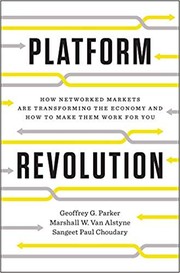
Platform Revolution
How platforms create value by matching groups, unlike linear pipeline businesses.
The standard text on network effects, governance and platform pricing.
Summary
Parker, Van Alstyne and Choudary set out the economics and design of platform businesses, meaning businesses that create value by facilitating exchange between two or more groups rather than by producing goods themselves. Their central analytical distinction is between pipeline businesses, which control a linear value chain from input to customer, and platforms, which orchestrate interactions and where the assets sit with the participants. This changes what a business optimises: pipelines optimise internal processes and platforms optimise the interactions between users.
The economic content covers network effects in detail, distinguishing same-side from cross-side effects and positive from negative ones, and treating the management of negative network effects, including low-quality participants and spam, as a core design problem rather than a nuisance. They cover the chicken and egg problem of building both sides simultaneously, with eight specific strategies including seeding one side, single-side first, and marquee participant acquisition.
The design material addresses the core interaction that must be identified before anything else, the pull, facilitate and match functions a platform must perform, and openness decisions covering who may participate, who may develop on the platform and who controls the resulting value.
They also cover monetisation, arguing that a platform must decide which side subsidises the other and which interaction to charge for, and governance including rules, standards and dispute resolution. The book is academic in origin and reads as a textbook. The examples are from before 2016 and the platform regulatory environment has changed substantially. It remains the most systematic treatment of the mechanics rather than the narrative of platform businesses.
Key takeaways 8
- Platforms create value by facilitating interactions between groups rather than by producing goods, which changes what the business optimises.
- The core interaction between participants must be identified before any feature is designed, since everything else exists to enable it.
- Cross-side network effects mean each side's value depends on the other's participation, which is what creates the chicken and egg problem.
- Negative network effects from low-quality participants can destroy a platform, which makes curation a core design function rather than a policing cost.
- A platform must decide which side subsidises the other, and the choice depends on which side is harder to attract and which creates more value.
- Openness decisions determine who may participate, who may build on the platform and who captures the resulting value, and all three are separate choices.
- Platforms invert the firm, since the productive assets sit with participants rather than being owned by the business.
- Governance including rules, standards and dispute resolution is what allows strangers to transact, and platforms that neglect it fail on trust rather than on demand.
Who should read it
Founders and investors building or evaluating multi-sided businesses who want the mechanics of network effects, monetisation and governance.
Who recommended it 1
Similar books 6
Chosen by shared topics, the entries that hold them, and the people who recommended both.
Economics for information goods: pricing, versioning, lock-in and network effects.
“Carl Shapiro and Hal R. Varian, Information Rules (Boston, MA: Harvard Business School Press, 1999), 174” — Michael Mauboussin
Source: The Ecosystem Edge, page 10
Recommended by: Michael Mauboussin, Mohnish Pabrai and 1 other

How multi-sided platforms such as card networks get both sides on board at once.
“David S. Evans and Richard Schmalensee, Matchmakers: The New Economics of Multisided Platforms (Boston, MA: Harvard Business Review Press, 2016)” — Michael Mauboussin
Source: Measuring the Moat: Assessing the Magnitude and Sustainability of Value Creation
Recommended by: Michael Mauboussin
Innovation platforms and transaction platforms, and what each needs to succeed.
“See Michael A. Cusumano, Annabelle Gawer, and David B. Yoffie, The Business of Platforms: Strategy in the Age of Digital Competition, Innovation, and Power (New York: Harper Business, 2019), 107-138” — Michael Mauboussin
Source: Market Share: Understanding Competitive Advantage Through Market Power, page 42
Recommended by: Michael Mauboussin

How platform businesses connecting users differ from firms that make products.
“Alex Moazed and Nicholas L. Johnson, Modern Monopolies: What It Takes to Dominate in the 21st Century (New York: St. Martin’s Press, 2016)” — Michael Mauboussin
Source: Measuring the Moat: Assessing the Magnitude and Sustainability of Value Creation
Recommended by: Michael Mauboussin

How Intel and others became and stayed leaders of technology platforms.
“Annabelle Gawer and Michael A. Cusumano, Platform Leadership (Boston, MA: Harvard Business School Press, 2002)” — Michael Mauboussin
Source: The Ecosystem Edge, page 10
Recommended by: Michael Mauboussin

A design guide for founders building marketplaces and networks.