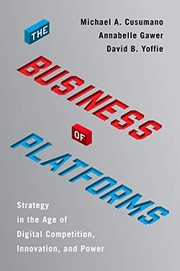
The Business of Platforms
Innovation platforms and transaction platforms, and what each needs to succeed.
Innovation platforms versus transaction platforms, and why most fail.
Summary
Cusumano, Gawer and Yoffie, academics who have studied platform businesses for two decades, distinguish two types and analyse what each requires. Innovation platforms, such as operating systems, provide a technological foundation on which others build complementary products. Transaction platforms, such as marketplaces, intermediate exchanges between parties. Hybrid platforms do both, which is what the largest technology companies have become.
The strategic analysis covers the four steps of building a platform: choose which sides of the market to bring together, solve the chicken and egg problem, design a business model that captures value without destroying the network, and establish rules and governance. They are specific that the choice between innovation and transaction platform determines almost everything that follows.
The most distinctive material is on failure. The authors studied a large sample of platform businesses over two decades and found the failure rate very high, and they identify four recurring causes: mispricing on one side, failure to develop trust between users, prematurely dismissing competition, and entering too late without a differentiated approach. They also examine platforms that were killed by their own subsidies.
The final section covers regulation and the political position of dominant platforms, and it is more sympathetic to intervention than earlier work in this literature.
The book is academic in origin but written for practitioners. It is more empirically grounded than most platform books because of the failure sample, and less rigorous on the underlying economics than Evans and Schmalensee.
Key takeaways 7
- Innovation platforms provide a foundation for others to build on while transaction platforms intermediate exchanges, and the choice determines strategy entirely.
- Platform failure rates are very high, and the four recurring causes are mispricing a side, failing to build trust, dismissing competition and entering late without differentiation.
- Subsidising one side of a market can kill the platform if the subsidy attracts users who leave when it stops.
- Trust between users must be engineered deliberately through ratings, guarantees and dispute processes, because a transaction platform is otherwise unusable between strangers.
- The largest technology companies are hybrid platforms that combine both types, which is what allows them to defend positions across multiple markets.
- Governance rules determine which complementors invest in a platform, since a platform that competes with its own complementors will lose them.
- Winning a platform market requires deciding early which side to subsidise and which to charge, and reversing that decision later is extremely difficult.
Who should read it
Founders and investors building platform businesses who want the empirical failure evidence alongside the strategic framework.
Who recommended it 1 · 1 direct
“See Michael A. Cusumano, Annabelle Gawer, and David B. Yoffie, The Business of Platforms: Strategy in the Age of Digital Competition, Innovation, and Power (New York: Harper Business, 2019), 107-138”
Similar books 6
Chosen by shared topics, the entries that hold them, and the people who recommended both.
Economics for information goods: pricing, versioning, lock-in and network effects.
“Carl Shapiro and Hal R. Varian, Information Rules (Boston, MA: Harvard Business School Press, 1999), 174” — Michael Mauboussin
Source: The Ecosystem Edge, page 10
Recommended by: Michael Mauboussin, Mohnish Pabrai and 1 other
How platforms create value by matching groups, unlike linear pipeline businesses.
Recommended by: Reid Hoffman

How multi-sided platforms such as card networks get both sides on board at once.
“David S. Evans and Richard Schmalensee, Matchmakers: The New Economics of Multisided Platforms (Boston, MA: Harvard Business Review Press, 2016)” — Michael Mauboussin
Source: Measuring the Moat: Assessing the Magnitude and Sustainability of Value Creation
Recommended by: Michael Mauboussin

How platform businesses connecting users differ from firms that make products.
“Alex Moazed and Nicholas L. Johnson, Modern Monopolies: What It Takes to Dominate in the 21st Century (New York: St. Martin’s Press, 2016)” — Michael Mauboussin
Source: Measuring the Moat: Assessing the Magnitude and Sustainability of Value Creation
Recommended by: Michael Mauboussin
How Intel and others became and stayed leaders of technology platforms.
“Annabelle Gawer and Michael A. Cusumano, Platform Leadership (Boston, MA: Harvard Business School Press, 2002)” — Michael Mauboussin
Source: The Ecosystem Edge, page 10
Recommended by: Michael Mauboussin

Without shelf limits, sales of many niche products add up to rival the hits.
“also Chris Anderson, The Long Tail: Why the Future of Business Is Selling Less of More (New York: Hyperion, 2006), 121” — Michael Mauboussin
Source: Was Harry Potter Inevitable? Cumulative Advantage, Counterfactuals, and the Halo Effect, page 10
Recommended by: Jim Collins, Michael Mauboussin, Ev Williams and 2 others