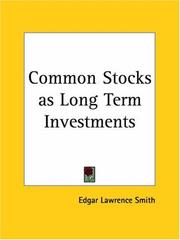
Common Stocks as Long Term Investments
The study that first showed stocks beat bonds over long periods.
Summary
Smith published this study in 1924, and it is the origin of the argument that equities outperform bonds over long periods. Before it, the prevailing view among conservative investors was that bonds were investments and common stocks were speculations.
His method was empirical. Smith constructed portfolios of common stocks and of high-grade bonds and compared their performance over a series of overlapping periods from 1866 to 1922, testing periods of inflation and deflation separately because he expected bonds to win during deflation. He found that the stock portfolios outperformed in nearly every period tested, including the deflationary ones, which contradicted his own hypothesis.
His explanation is the part that matters and it is correct. A bond returns its coupon and its principal, so its return is capped by contract. A corporation retains a portion of its earnings and reinvests them, which increases the earning power of the equity over time. Compounding of reinvested earnings is what produces the equity advantage, and it operates regardless of the price level.
The book was enormously influential and Keynes reviewed it favourably. It was also used to justify the late 1920s enthusiasm for equities at any price, and Smith's finding that stocks outperform was converted into a claim that stocks are always attractive, which the 1929 crash refuted. That misuse is a lesson about how empirical findings are deployed rather than a fault in the study.
Key takeaways 7
- Diversified portfolios of common stocks outperformed high-grade bonds over nearly every long period tested between 1866 and 1922.
- The equity advantage comes from corporations retaining and reinvesting a portion of earnings, which compounds the earning power behind the shares.
- A bond's return is capped by contract while an equity's is not, which is the structural reason for the performance difference.
- Stocks outperformed during deflationary periods as well as inflationary ones, which contradicted the author's own hypothesis and the prevailing view.
- The prevailing view before this study held that bonds were investments and common stocks were speculations, and this evidence reversed it.
- An empirical finding that stocks outperform over long periods does not establish that stocks are attractive at any price, which is how the study was misused in the 1920s.
- Diversification across a portfolio is necessary for the finding to hold, since the result concerns the class rather than individual securities.
Who should read it
Investors who want the original evidence for equity outperformance and a case study in how a correct finding is misapplied.
Who recommended it 2 · 2 direct
“Edgar Lawrence Smith, Common Stocks as Long Term Investments (New York: The Macmillan Company, 1924)”
“The Power of Retained Earnings In 1924, Edgar Lawrence Smith, an obscure economist and financial advisor, wrote Common Stocks as Long Term Investments, a slim book that changed the investment world.”
Similar books 6
Chosen by shared topics, the entries that hold them, and the people who recommended both.
US returns since 1802 show stocks beat bonds and cash over every long period.
“his book "Stocks for the Long Run" contributed greatly to the bull market's middle years” — Howard Marks
Source: Oaktree memo 'Irrational Exuberance'
Recommended by: Howard Marks, John C. Bogle and 4 others
How Markowitz, Sharpe, Fama, Black and Scholes built the theory of modern finance.
“But it was in his Capital Ideas, published in 1992, that I first learned of Louis Bachelier’s 1900 dissertation, The Theory of Speculation.” — John C. Bogle
Source: Success In Investment Management: What Can We Learn From Indexing?, page 1
Recommended by: John C. Bogle, Michael Mauboussin
A long-run, chart-driven history of the American stock market.
“Faber, Meb, Investing In America: The Rise of a 250-Year Bull Market (El Segundo, CA: The Idea Farm, 2026)” — Michael Mauboussin
Source: The Wisdom of Crowds in Markets: Crowd Behavior in Prediction, Betting, and Stock Markets
Recommended by: Michael Mauboussin
How index funds went from academic idea to owning much of the world's shares.
“Wigglesworth, Robin, Trillions: How a Band of Wall Street Renegades Invested the Index Fund and Changed Finance Forever (New York: Portfolio/Penguin, 2021)” — Michael Mauboussin
Source: Who Is On the Other Side? A Framework for Understanding Market (In)Efficiency
Recommended by: Michael Mauboussin

Why Wall Street grows rich on fees while its clients' results stay ordinary.
“First published in 1940, this is the funniest book ever written about investing - and one of the wisest. Schwed, a veteran of Wall Street who survived the Crash of 1929, knew exactly how the markets worked back then. Nothing has changed.” — Jason Zweig
Source: Best Books for Investors: A Short Shelf — jasonzweig.com
Recommended by: Jason Zweig, John C. Bogle, Mohnish Pabrai and 6 others
Short sketches of one hundred people who shaped American financial markets.
Recommended by: The Barefoot Investor
Where it sits in the reference 2
Topics 2
As an Amazon Associate I earn from qualifying purchases.