Updates

  1. Person pages list letters, writing, profiles and links as sortable tables with filters, and show each person's companies as links; Fund letters show each letter's description in its own column.
  2. Experts show a checked job title and a short description of each person; 30 more people have photographs.
  3. Every company, fund, university and publication the experts work for has a page listing the people there.
  4. Fund letters show each letter's thesis and filter by it; 225 person pages list the essays, columns and newsletter issues the person wrote.
  5. Person pages list every essay and newsletter issue a person wrote, and their own books as a table in List view.
  6. Recommends shows the five largest kinds of book and the rest under More; browse pictures load sooner.
  7. Podcasts and talks link the original episode, filter by Audio and video or Press, and list each publisher once.
  8. Pages are wider, Recommends has List and Grid, and a filter clicked again turns off.
  9. Book cards sit in a ruled grid with Open Library and Goodreads links and each book's one-line note.
  10. Funds is now Investors; each investor's styles are buttons that filter the table.
  11. Podcasts and talks on a person's page filter by year and publisher and show as a list or a grid of pictures.
  12. Quotes show only people's own words: 472 summaries written by list sites are gone.
  13. Country pages open from Browse again, and every link on the shelf lands on a page.
  14. Subject and person pages show their sections as tabs, and each book appears once on a person's page.
  15. Book cards show the quote, who said it and the source; grids show five cards to a row.
  16. On a phone, a menu holds the sections, search, Updates, Feedback and dark mode.
  17. Feedback takes a screenshot of the page with no browser prompt, opens a screenshot full size when you click it, and clears itself once sent.
  18. Book cards are centred, search names the topic each book sits in, and any text cut short shows whole on hover.
  19. Search groups its results by kind: people, companies, geographies, subjects, topics, books, funds, fund letters and papers.
  20. The Books table lists who recommended each book by name, and the browser tab names the section you are in.
  21. Feedback can take a screenshot of the page, or one you paste or choose, and opens in the corner beside Updates.
  22. Each rail button reopens its section where you left it, and Browse, Table and People show on every book and subject page.
  23. Filters grey out choices that hold nothing instead of hiding them, and Books › People filters by authors or recommenders.
  24. Feedback takes a subject line and up to three screenshots.
  25. Biographies are grouped by the person they are about: 41 new pages, from Abraham Lincoln to Lee Kuan Yew.
  26. Sport splits into 23 sports, and Religion into one topic per faith.
  27. Book lists show as cards: the cover, one recommendation quote and every recommender by name.
  28. Seventeen subjects that had two or three pages under different names now have one page each.
  29. Every page lists its Experts as authors and recommenders, with a link to them on the Experts tab.
  30. Economics, Financial history, Financial panics and Accounting are subjects of their own, with one page per financial crisis.
  31. Book, person and subject pages open inside the app, so the tabs stay in view.
  32. 996 more book covers, and photographs or logos for 227 more people and companies.
  33. Books › Browse shows every subject as cards, and the rail holds Fund letters, Papers, Experts, Books and Funds.
  34. Every topic over 150 books splits into narrower topics, each with a page of its own.

Send feedback

What is it?
Screenshots, up to 3 (optional)
or paste one with Ctrl+V

We use your email only to reply to you.

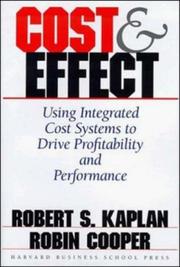
Cost & Effect

Cost & Effect

Robert S. Kaplan, Robin Cooper
1998
T2 357 pages · about 5h 57m to read Open Librarygoodreads

Activity-based costing worked through in practice.

Summary

Kaplan and Cooper, who developed activity-based costing, wrote this to set out how cost and performance measurement systems should be designed and what each is for.

Their central diagnostic is the four-stage model. Stage one systems are broken and produce numbers no one trusts. Stage two systems are built for external financial reporting, allocate overhead using volume-based measures such as direct labour hours, and produce product costs that are systematically wrong: they overcost high-volume simple products and undercost low-volume complex ones, because overhead is driven by transactions and complexity rather than by volume. Stage three systems add separate managerial systems, including activity-based costing for product and customer profitability and operational feedback systems for process improvement, alongside the financial reporting system. Stage four integrates these.

Activity-based costing is their principal contribution. Rather than allocating overhead by volume, it identifies the activities the organisation performs, measures the cost of each, and assigns costs to products and customers according to their actual consumption of those activities. The results frequently overturn management's understanding of which products and customers are profitable, and Kaplan and Cooper document cases where a minority of products and customers generated all the profit while others destroyed it.

The customer profitability analysis is the most practically valuable part. Customers consuming small orders, frequent deliveries, engineering changes, returns and support consume activities that pricing does not reflect.

They also cover activity-based budgeting, capacity measurement and the distinction between the cost of resources supplied and resources used, which is where the savings from an activity-based analysis actually come from.

The method is expensive to implement and maintain, which is the standard criticism and which Kaplan later addressed with time-driven activity-based costing. Adoption has been mixed. The diagnostic that volume-based overhead allocation systematically misprices products has not been disputed.

Key takeaways 7

  1. Volume-based overhead allocation overcosts high-volume simple products and undercosts low-volume complex ones.
  2. Overhead is driven by transactions and complexity rather than by production volume, so allocating it by volume is systematically wrong.
  3. Assigning costs according to actual consumption of activities frequently overturns management's understanding of which products are profitable.
  4. Customer profitability analysis reveals that some customers consume more in service activities than they generate in margin.
  5. Systems built for external financial reporting cannot also serve operational decision-making, so separate systems are required.
  6. Savings from an activity-based analysis are realised only when the resources freed are actually removed or redeployed.
  7. The distinction between resources supplied and resources used identifies unused capacity that cost accounting conceals.

Who should read it

Operators and finance leaders who need to know which products and customers actually make money, and why conventional costing does not tell them.

Similar books 6

Chosen by shared topics, the entries that hold them, and the people who recommended both.

Jeremy Hope, Robin Fraser · 2003

Why the annual budget harms firms, and how some run without one.

Karen Berman, Joe Knight · 2006

How non-financial managers can read income statements, balance sheets and cash flow.

Recommended by: Nat Eliason

Brian H. Maskell, Bruce Baggaley · 2003

Why standard costing hinders lean factories, and value-stream costing instead.

H. Thomas Johnson, Robert S. Kaplan · 1987

How cost accounting served managers until financial reporting took it over.

H. Thomas Johnson · 1992

Johnson's follow-up, arguing against the ABC fix he helped start.

Greg Crabtree, Beverly Herzog · 2011

Owner-operator economics: labour efficiency and the four keys.

Recommended by: Nat Eliason

Where it sits in the reference 1

Accounting

Topics

AccountingBusiness and Management