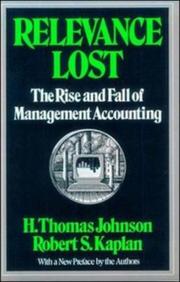
Relevance Lost: The Rise and Fall of Management Accounting
The book that started the field's self-criticism.
Summary
Thomas Johnson and Robert Kaplan argue that management accounting stopped supplying managers with useful information around 1925 and had not recovered by the time they wrote in 1987. The book combines a history of cost accounting with a critique of contemporary practice.
The historical section is original research. Johnson traces the development of cost systems at the Springfield Armory, the New England textile mills, the railroads, Andrew Carnegie's steel operations, and then the Du Pont and General Motors systems that introduced return on investment as the measure connecting operating decisions to capital. The authors argue that these systems were designed to inform managers, and that they worked.
The break came when external financial reporting requirements grew, and companies stopped maintaining separate systems for management purposes. Cost systems were then designed to value inventory for the balance sheet, which requires allocating overhead to units by some simple measure, usually direct labour. As overhead grew as a share of cost and direct labour shrank, these allocations became severely distorting: high-volume standard products were assigned too much overhead and low-volume complex products too little, which led managers to drop the products that were actually profitable. The authors also attack short-term financial measures for driving decisions that damage long-term position. The proposed remedy, activity-based costing, was developed further by Kaplan afterward. Johnson later repudiated it, arguing in Relevance Regained that better cost measurement was the wrong answer.
Key takeaways 7
- Cost accounting systems designed for external inventory valuation supply management with distorted product cost information.
- Allocating overhead by direct labour hours misprices products systematically as overhead grows and direct labour shrinks.
- High-volume simple products are assigned too much overhead and low-volume complex products too little, which reverses apparent profitability.
- Nineteenth-century cost systems were designed to inform managers and worked better for that purpose than modern ones do.
- Return on investment as developed at Du Pont and General Motors connected operating decisions to capital employed.
- Managing to short-term financial measures produces decisions that improve reported results and damage competitive position.
- Johnson and Kaplan argue that companies need separate systems for external reporting and for management decisions.
Who should read it
Executives and controllers who want the historical and analytical case for why their product cost numbers mislead, and where the numbers came from.
Similar books 6
Chosen by shared topics, the entries that hold them, and the people who recommended both.
Why the annual budget harms firms, and how some run without one.
How to design cost systems, from activity-based costing to performance measures.

How non-financial managers can read income statements, balance sheets and cash flow.
Recommended by: Nat Eliason
Why standard costing hinders lean factories, and value-stream costing instead.
Johnson's follow-up, arguing against the ABC fix he helped start.

Owner-operator economics: labour efficiency and the four keys.
Recommended by: Nat Eliason
Where it sits in the reference 1
Topics