Updates

  1. Person pages list letters, writing, profiles and links as sortable tables with filters, and show each person's companies as links; Fund letters show each letter's description in its own column.
  2. Experts show a checked job title and a short description of each person; 30 more people have photographs.
  3. Every company, fund, university and publication the experts work for has a page listing the people there.
  4. Fund letters show each letter's thesis and filter by it; 225 person pages list the essays, columns and newsletter issues the person wrote.
  5. Person pages list every essay and newsletter issue a person wrote, and their own books as a table in List view.
  6. Recommends shows the five largest kinds of book and the rest under More; browse pictures load sooner.
  7. Podcasts and talks link the original episode, filter by Audio and video or Press, and list each publisher once.
  8. Pages are wider, Recommends has List and Grid, and a filter clicked again turns off.
  9. Book cards sit in a ruled grid with Open Library and Goodreads links and each book's one-line note.
  10. Funds is now Investors; each investor's styles are buttons that filter the table.
  11. Podcasts and talks on a person's page filter by year and publisher and show as a list or a grid of pictures.
  12. Quotes show only people's own words: 472 summaries written by list sites are gone.
  13. Country pages open from Browse again, and every link on the shelf lands on a page.
  14. Subject and person pages show their sections as tabs, and each book appears once on a person's page.
  15. Book cards show the quote, who said it and the source; grids show five cards to a row.
  16. On a phone, a menu holds the sections, search, Updates, Feedback and dark mode.
  17. Feedback takes a screenshot of the page with no browser prompt, opens a screenshot full size when you click it, and clears itself once sent.
  18. Book cards are centred, search names the topic each book sits in, and any text cut short shows whole on hover.
  19. Search groups its results by kind: people, companies, geographies, subjects, topics, books, funds, fund letters and papers.
  20. The Books table lists who recommended each book by name, and the browser tab names the section you are in.
  21. Feedback can take a screenshot of the page, or one you paste or choose, and opens in the corner beside Updates.
  22. Each rail button reopens its section where you left it, and Browse, Table and People show on every book and subject page.
  23. Filters grey out choices that hold nothing instead of hiding them, and Books › People filters by authors or recommenders.
  24. Feedback takes a subject line and up to three screenshots.
  25. Biographies are grouped by the person they are about: 41 new pages, from Abraham Lincoln to Lee Kuan Yew.
  26. Sport splits into 23 sports, and Religion into one topic per faith.
  27. Book lists show as cards: the cover, one recommendation quote and every recommender by name.
  28. Seventeen subjects that had two or three pages under different names now have one page each.
  29. Every page lists its Experts as authors and recommenders, with a link to them on the Experts tab.
  30. Economics, Financial history, Financial panics and Accounting are subjects of their own, with one page per financial crisis.
  31. Book, person and subject pages open inside the app, so the tabs stay in view.
  32. 996 more book covers, and photographs or logos for 227 more people and companies.
  33. Books › Browse shows every subject as cards, and the rail holds Fund letters, Papers, Experts, Books and Funds.
  34. Every topic over 150 books splits into narrower topics, each with a page of its own.

Send feedback

What is it?
Screenshots, up to 3 (optional)
or paste one with Ctrl+V

We use your email only to reply to you.

Crisis Economics

Crisis Economics

Nouriel Roubini, Stephen Mihm
2010
T2 359 pages · about 5h 59m to read Open Librarygoodreads

Crises as the norm rather than the exception.

Summary

Roubini, who had publicly forecast a severe crisis before 2008, wrote this with the historian Stephen Mihm as both an explanation of the crisis and an argument that such events are normal rather than exceptional.

The organising claim is in the framing. Roubini argues that crises are not black swans, meaning unpredictable and unprecedented events, but what he calls white swans: recurring events with identifiable causes that the economics profession chose to treat as impossible because its models excluded them. He supports this with the history of financial crises and with the intellectual history, covering Mill, Bagehot, Fisher, Keynes, Minsky and Kindleberger, whose accounts of credit-driven boom and bust were displaced by models assuming rational expectations and efficient markets.

The explanatory chapters cover the mechanisms: the securitisation chain and the separation of originator from holder, the compensation structures rewarding volume, the rating agencies' conflicts, shadow banking's growth outside the regulatory perimeter, leverage across the system, and the global imbalances that supplied the capital.

The prescriptive chapters are more specific than most crisis books. Roubini argues for breaking up institutions too large to fail rather than regulating them more heavily, for compensation deferred and clawed back on outcomes, for central clearing of derivatives, for capital requirements that rise in booms, for regulating shadow banks by function rather than by legal form, and for resolution mechanisms that permit failure.

Roubini's forecasting record was correct on this occasion and has been substantially wrong on others, including repeated predictions of subsequent crises that did not occur, which readers should hold in mind. The book was written in 2010 and its assessment of the reforms then being negotiated is provisional.

Key takeaways 7

  1. Financial crises are recurring events with identifiable causes rather than unpredictable and unprecedented ones.
  2. Economic models assuming rational expectations and efficient markets excluded crises by construction rather than by evidence.
  3. The tradition running from Mill and Bagehot through Fisher, Keynes and Minsky described credit-driven boom and bust accurately and was displaced.
  4. Shadow banking grew outside the regulatory perimeter because regulation applies to legal form rather than to economic function.
  5. Regulating by function rather than by charter type is required, or activity migrates to whatever entity is unregulated.
  6. Capital requirements should rise during booms and fall during contractions, which reverses how they actually behave.
  7. Breaking up institutions too large to fail is more reliable than regulating them more heavily while leaving them intact.

Who should read it

Readers who want the crisis explained within the historical tradition of credit cycles, along with specific reform proposals.

Similar books 6

Chosen by shared topics, the entries that hold them, and the people who recommended both.

Barry Eichengreen · 2015

How 1930s lessons guided policy in 2008, averting a depression but adding errors.

Barry Eichengreen, Asmaa El-Ganainy, Rui Esteves, Kris James Mitchener · 2021

Sovereign borrowing from Italian city-states to the pandemic, and what it paid for.
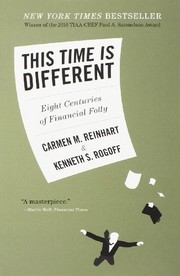
Carmen M. Reinhart, Kenneth S. Rogoff · 2009

Eight centuries of defaults and banking crises show the same patterns recurring.

Murray N. Rothbard · 1963

The Austrian account of 1929 and the policy response that followed

Ray Dalio · 2018

A template for how big debt crises unfold, with detailed case studies.

Where it sits in the reference 2

Secular themes
Economics

Topics

EconomicsFinancial History