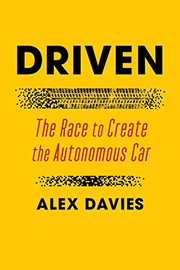
Driven: The Race to Create the Autonomous Car
The people behind self-driving cars, from the DARPA Grand Challenge onward.
The self-driving contest Tesla bet its valuation on.
Summary
Davies, a technology journalist who covered the field for Wired, wrote the history of autonomous vehicle development centred on the people who did it.
The narrative begins with the DARPA Grand Challenge of 2004, in which no vehicle completed the course, the 2005 rerun in which five did, and the 2007 Urban Challenge which required vehicles to obey traffic rules and interact with each other. Davies argues these events created the field by assembling the researchers, demonstrating feasibility and establishing the personal networks that determined who worked with whom afterward.
The subsequent narrative follows those people: Sebastian Thrun founding Google's programme, Chris Urmson leading it and later founding Aurora, Anthony Levandowski's role and his departure to found Otto which Uber acquired, the trade secrets litigation between Waymo and Uber that followed, the founding of Cruise and its acquisition by General Motors, Zoox, Argo, and the movement of a relatively small number of researchers between all of them.
Davies covers the technical approaches, including the reliance on lidar and on detailed prior mapping against the camera-based approach Tesla pursued, and the disagreement about whether incremental driver assistance leads to autonomy or is a different problem.
He also covers the failures: the Uber fatality in Tempe in 2018, the Tesla Autopilot fatalities, and the retrenchment as the timelines slipped.
The book is reported journalism about people and does not analyse the technology deeply or the economics at all. It was published in 2021 and the field has continued to consolidate since, with several well-funded programmes closing and deployment limited to defined mapped areas. Burns's Autonomy, also in this reference, covers overlapping ground from a participant's perspective.
Key takeaways 7
- The DARPA challenges created the field by assembling the researchers and establishing the personal networks that determined subsequent teams.
- A very small number of researchers moved between nearly every major autonomous vehicle programme.
- Approaches diverged between lidar with detailed prior mapping and camera-based perception without maps, and the disagreement was never resolved technically.
- Incremental driver assistance and full autonomy are different problems, and progress on one does not produce the other.
- The 2018 Uber fatality in Tempe followed from disabled safety systems and inadequate operator monitoring rather than from a perception failure alone.
- Trade secrets litigation between Waymo and Uber followed from a single engineer's movement between the two organisations.
- Timelines announced by every programme slipped by years, and deployment remains limited to defined mapped areas.
Who should read it
Investors and technologists in autonomy who want the personnel and organisational history of how the field was built and why it consolidated.
Similar books 6
Chosen by shared topics, the entries that hold them, and the people who recommended both.
How driverless cars were built, and how they will change commuting, jobs and safety.
The race between DeepMind and OpenAI, told through Demis Hassabis and Sam Altman.
Recommended by: Andrew Wilkinson
Why computers must recognise and express emotion to be intelligent.
“And so I was looking for a thesis topic and my fiance at the time went on Amazon and he said, "Oh, there's this really interesting book by this MIT professor called Rosalind Picard called Affective Computing.” — Rana el Kaliouby
Recommended by: Rana el Kaliouby
Why China may match the US in AI now that applying it matters more than research.
“Kai-Fu Lee, AI Superpowers: China, Silicon Valley, and the New World Order (Boston: Houghton Mifflin Harcourt Publishing, 2018), 22-26” — Michael Mauboussin
Source: One Job: Expectations and the Role of Intangible Investments, page 21
Recommended by: Balaji S. Srinivasan, Michael Mauboussin and 3 others
AI research from Dartmouth in 1956 to the funding cuts, told by the field's leaders.